Hawkbill Knife: What the Hooked Blade Is Actually For (and Who Should Carry One)
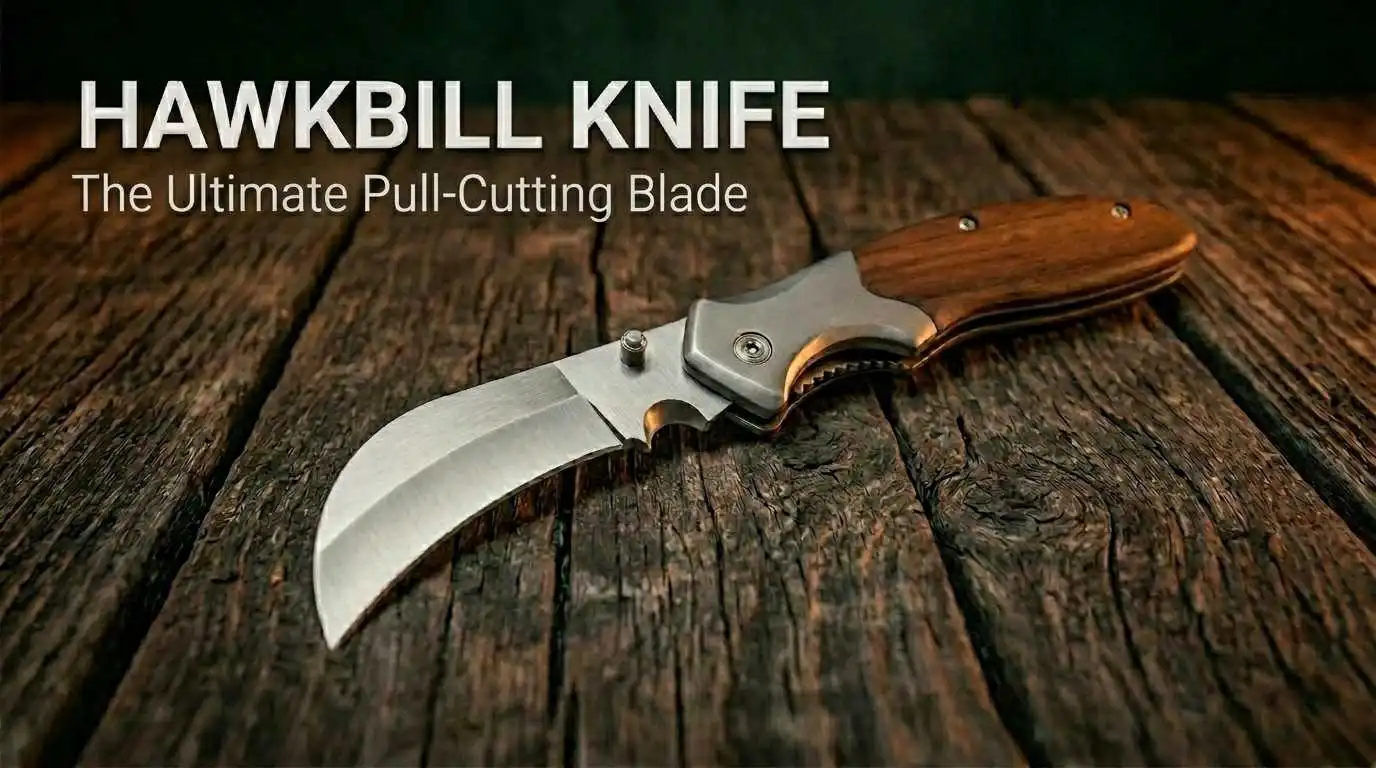
Table of Contents
Most people meet a hawkbill knife and file it away as a one-trick relic. They see a blade that curves downward like a claw, decide it must be a gardening leftover, and reach for something straighter. Then they watch an electrician strip a cable in one clean pull, or a roofer score a shingle without nicking the felt beneath it, and the hooked blade suddenly looks less like a relic and more like the right tool used by people who cut for a living.
That misread happens because the hawkbill works backward from what we expect. A normal knife pushes a cut away from you. A hawkbill pulls the material into the deepest part of the curve and slices as you draw it back, so the blade bites and holds instead of skating off. Once you understand that single idea, every strength and weakness of the shape falls into place.
This guide covers the geometry, the history (including the naming mix-up almost everyone gets wrong), who actually carries one, the steel that matters, and how to sharpen the part that trips people up. For the full map of every common profile, our knife blade types pillar guide shows where the hawkbill sits in the larger family.
What Is a Hawkbill Knife?
A hawkbill knife is a blade with a concave cutting edge and a downward-hooked point, shaped like the beak of a bird of prey. The edge curves inward rather than outward, so the knife cuts on the pull stroke, drawing material into the hook and slicing through it under control rather than pushing the edge forward.
That one description explains the whole tool: inward curve for biting pull-cuts, hooked tip for trapping and starting a cut, almost no flat belly for slicing on a board. Every advantage and limitation of the hawkbill blade flows from that geometry.
You will see the term written several ways across catalogs and listings: hawkbill blade, hawkbill knives, hawkbill blades, and the spaced spelling hawk bill knife. They all describe the same profile. One spelling worth flagging is hawksbill knife with an “s,” which is a common slip because the hawksbill is also a species of sea turtle. The blade has nothing to do with the turtle; it is named for a hawk’s beak. People who do not know the proper name often search for a “hook knife” or “hooked blade knife” instead, and they are all describing this same curved tool.
Hawkbill Blade Anatomy: Understanding the Hooked Geometry
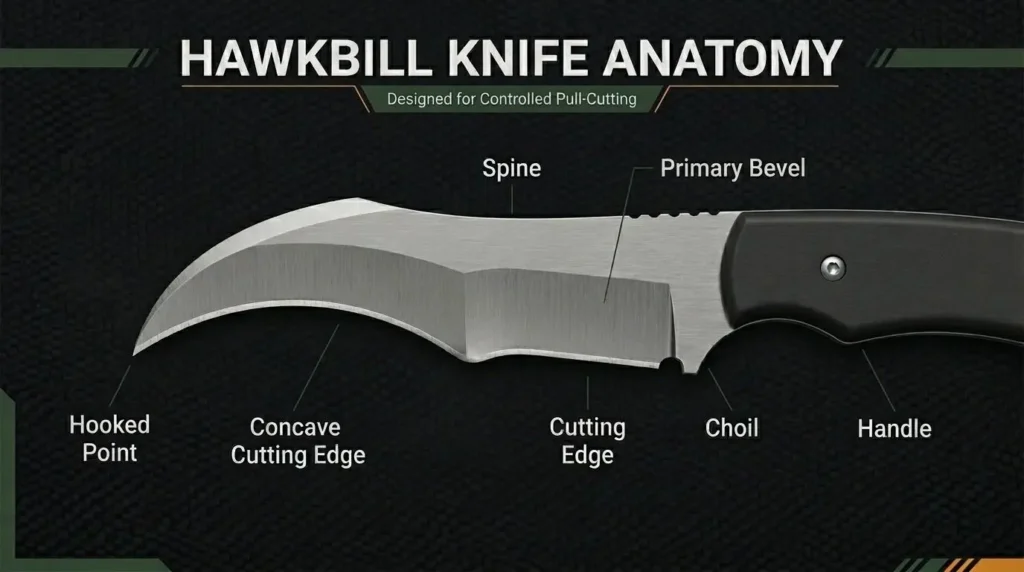
The hawkbill blade shape comes down to a few features that set it apart from every other profile.
The concave cutting edge. The edge curves inward, like the inside of a shallow bowl. This is the heart of the design: anything you pull into it gets funneled toward the lowest point of the curve and held there while you slice, instead of sliding away the way it would off a straight or convex edge. This is what makes a hawkbill so good at cutting rope, cordage, and anything that wants to roll off a normal blade.
The hooked, downward point. The tip drops below the spine and curves back toward the edge, forming the “beak.” That hook traps material so a cut cannot escape forward, and lets you start a cut by hooking into a surface and drawing back. It also keeps the point angled away from whatever sits beyond your cut, which matters more than it sounds for trade and rescue work.
The recurve. The technical name for the inward-curving edge is a recurve. You will see the word in knife forums constantly, and it is the single most important term for understanding why a hawkbill sharpens differently from everything else. A recurve edge does not sit flat against a bench stone, and that one fact drives the entire sharpening section below.
Minimal belly. A hawkbill has almost no convex “belly,” the gentle outward curve a drop point knife uses for slicing and skinning. That is a deliberate trade: it gives up flat-surface slicing to gain biting, controlled pull-cuts.
Why It’s Called a Hawkbill (History and the Naming Mix-Up)
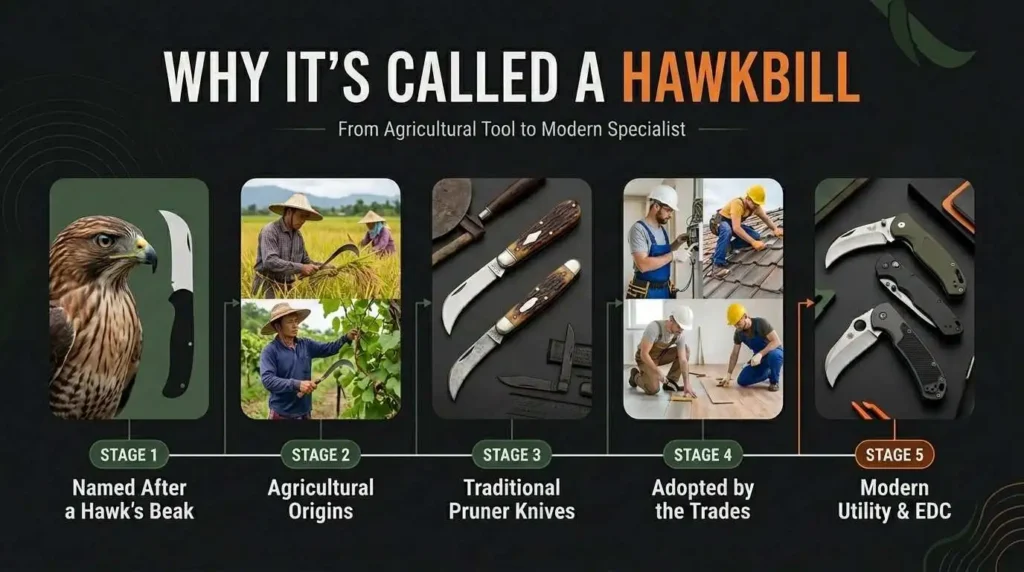
The hawkbill is named for the obvious: its profile mirrors the short, hooked beak of a hawk or other raptor. That is the whole story behind the name, and it is worth stating plainly because the spelling “hawksbill” sends people down the wrong path toward the sea turtle of the same name. They are unrelated. The blade is a hawk’s bill; the turtle is a separate animal that happens to share a hooked shape.
The shape itself is far older than the name, and its origins are agricultural. The earliest hawkbill-style blades likely emerged in Southeast Asia, where a hooked, pull-cutting edge was ideal for harvesting rice, managing vines, and pruning crops without bruising the plant. That heritage is why the hawkbill is still widely called a pruner knife or pruning knife today. The pulling cut slices cleanly through green stems while doing minimal damage to the surrounding plant, which is exactly what a gardener wants.
As the design spread to Europe and then America, traditional cutlery houses standardized it. Brands like Case, Schrade, and Remington produced hawkbill pruners on a large scale, cementing the slip-joint pruner as a recognizable American pocketknife pattern. From there the shape migrated into the trades, where electricians, roofers, and floor layers found that a blade built to pull-cut vines was just as good at pulling through insulation, shingles, and carpet. Its newest chapter is the tactical and EDC world, where designers borrowed the hook for karambit-style folders and rescue tools.
What Is a Hawkbill Knife Used For?
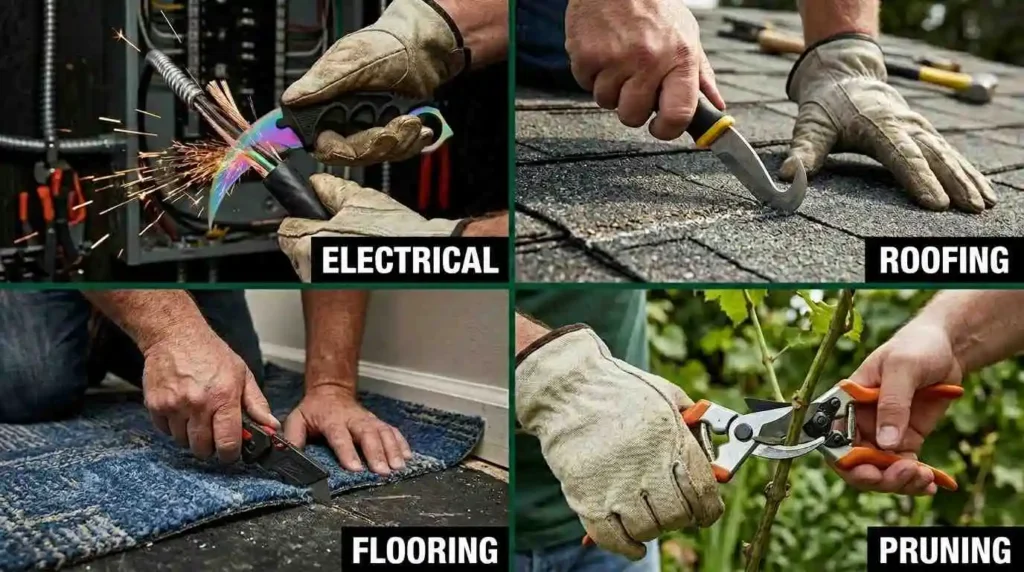
The hawkbill is a pull-cut specialist, and that makes it a favorite of people who cut the same tough materials all day. Here is where the hook genuinely outperforms.
Pruning, Gardening, and Landscaping
This is the original job, and the hawkbill still does it best. Drawing the concave edge through a stem or vine slices cleanly in one motion while the hook keeps the cut from slipping. Gardeners, landscapers, and growers reach for a hawkbill pruning knife for the same reason their ancestors did: it removes growth quickly without crushing what stays behind.
Hawkbill for Electricians
The hawkbill is one of the classic electrician’s blades. A hawkbill electrician knife strips and scores cable insulation with a controlled pull: you hook the blade under the jacket and draw it back, letting the curve cut while the downward point steers away from the conductors you are trying not to nick. That hooked tip is far safer than a straight point when you are working blind in a panel or crawlspace, because it is not pointing at your other hand. It is no accident that trade brands like Klein Tools and Milwaukee build hawkbill and slitting-blade knives specifically for linemen and electricians.
Hawkbill for Flooring and Carpet
Floor layers love the hawkbill because the hook scores carpet, vinyl, and linoleum from above without gouging the underlay or subfloor beneath. A straight blade has to be angled and tends to dive; the hawkbill’s curve lets you pull a shallow, accurate cut along a line while the point stays clear of the surface below. A dedicated hawkbill carpet knife or linoleum knife is standard issue in flooring work.
Hawkbill for Roofing
Roofers use the same logic on shingles. A hawkbill roofing knife trims asphalt shingles and underlayment with a pulling cut that slices the top layer without scoring the felt or membrane underneath, where a slip with a straight tip could mean a leak later.
Hawkbill for EDC and Utility
As an everyday carry, the hawkbill is a niche but rewarding choice. A hawkbill EDC knife or hawkbill utility knife shines at pull-heavy tasks: slicing box strapping, cutting cordage and zip ties, breaking down packaging, and opening clamshell plastic. It is not the do-everything shape a clip point knife is, but for anyone whose cutting leans toward rope, cord, and strapping rather than food or fine detail, it earns its pocket space.
Rescue and First-Responder Use
The same trait that protects an electrician’s free hand makes the hawkbill a strong rescue blade. A hawkbill rescue knife cuts seatbelts, webbing, and clothing with a pulling motion while the hooked, inward tip dramatically reduces the risk of stabbing the person being freed. Many dedicated rescue tools use a blunted hawkbill or hooked belt-cutter for this reason, sharing the safety-first logic of the blunt-tipped sheepsfoot blade while keeping more of a working point.
Marine and Fishing Use
Commercial fishermen and sailors have long favored hawkbills for cutting line, net, and webbing. The hook reaches out, snags the line, and pulls it into the cut, far easier than sawing through a taut rope with a straight edge. Paired with a rust-proof steel, it becomes a specialized marine tool.
Where It Falls Short
An honest guide says where a shape struggles, and the hawkbill struggles predictably. It is poor at piercing and stabbing, because the point curves down and away rather than driving forward. It is bad at push-cuts and slicing on a flat board, since it has no usable belly and the tip digs into the cutting surface, which rules it out as a kitchen blade. It is awkward to sharpen compared with a straight edge, as we cover below. And it is not a carving tool the way a straight, fine-pointed blade is. Match the hawkbill to pulling cuts through tough material, and pair it with a more general blade for everything else. For broad outdoor versatility, a drop point knife remains the better all-rounder.
Hawkbill Variants and Types
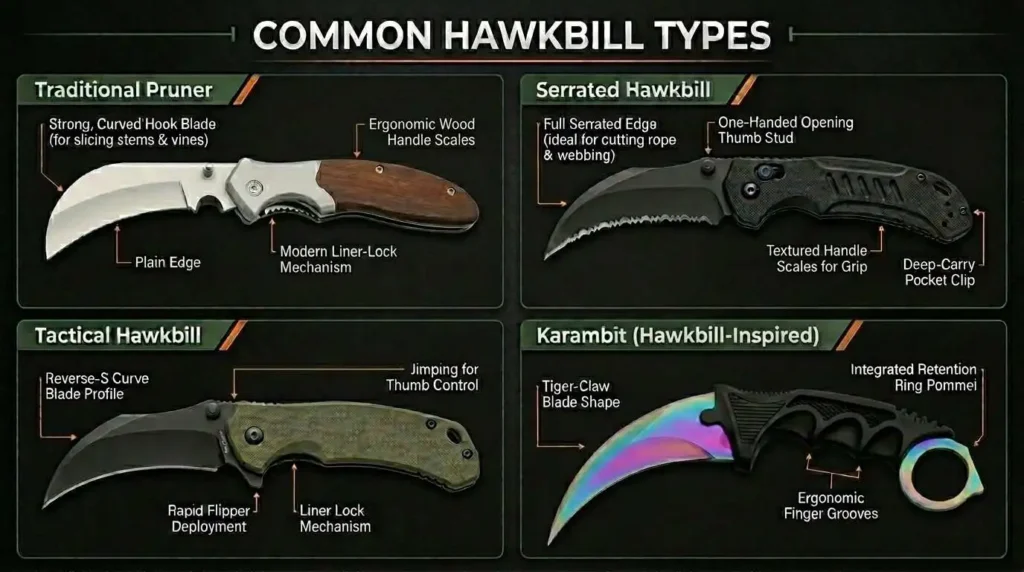
The hawkbill turns up in several distinct flavors. The traditional hawkbill pruner knife is the slip-joint pocketknife pattern handed down from Case, Schrade, and Remington, usually with nickel-silver bolsters and a single non-locking blade, still popular with gardeners and collectors.
The serrated hawkbill knife marries the hook to a serrated edge, and the combination is brutally effective on rope, webbing, and fibrous material, which is why it is so common on rescue and marine knives. The karambit hawkbill is the modern tactical interpretation: add a finger ring to a hooked blade and you get a karambit-adjacent folder built for retention and control. If that hybrid is what you are after, our karambit-style folders sit closest to the hawkbill in the curved-blade family. You will also find tactical hawkbill knives, automatic and OTF hawkbills, and compact mini hawkbill folders for low-profile carry. For collectors drawn to pattern-welded steel, a damascus hawkbill or hand-forged custom pairs the hook with layered steel, and the same metallurgy rules from the steel section apply.
Notable Hawkbill Knives
A handful of designs anchor the hawkbill’s reputation and are worth knowing as reference points, though none are required to appreciate the shape. The Spyderco Harpy is the classic modern serrated hawkbill folder and the knife most responsible for keeping the pattern alive in EDC. Spyderco’s Tasman Salt builds the same hook from rust-proof H1 steel, making it a cult favorite among sailors, divers, and anglers.
On the tactical side, the CRKT Provoke brought the hawkbill into the spotlight with its kinematic deploying mechanism and karambit-style ring, designed by Joe Caswell. For traditionalists, the Case hawkbill pruner carries the original American slip-joint heritage. In the trades, Klein (the 1550 series) and Milwaukee (the 48-22 hawkbill) dominate the electrician and utility market, and for value the Honey Badger Hawkbill punches above its price. Together they map how a rice-paddy tool became a 21st-century staple.
How to Sharpen a Hawkbill Knife
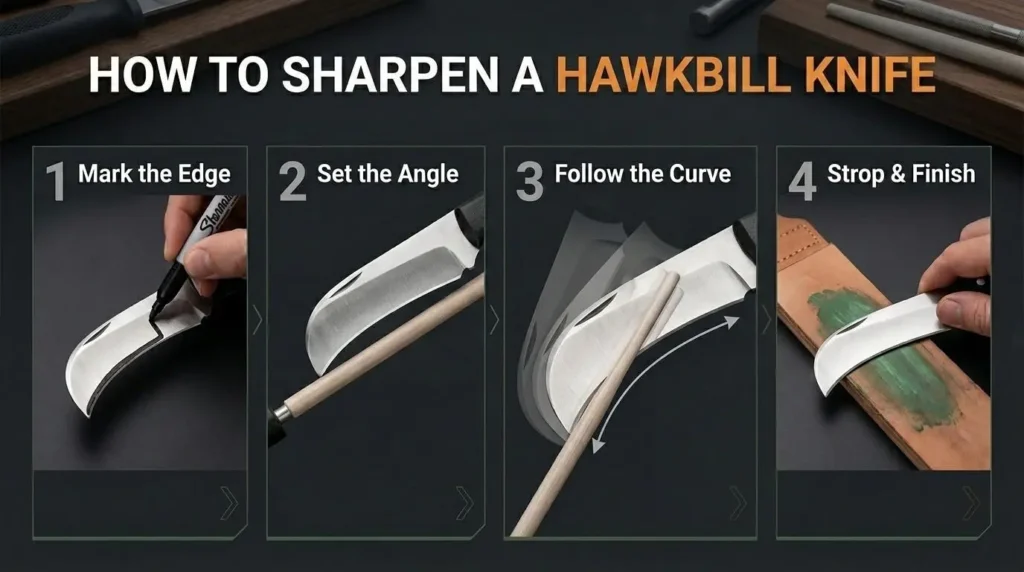
Here is the section nearly every other guide skips with a lazy “just sharpen it periodically.” Sharpening a hawkbill is the part that trips people up, and if you treat it like a normal knife you will make the edge worse. The reason comes back to the recurve from the anatomy section.
Why a flat stone fails. A normal blade lies flat against a bench stone and you grind the whole edge evenly. A hawkbill’s edge curves inward, so on a flat stone only the two ends of the curve touch the surface. The deepest part of the concave edge, the part doing most of your cutting, never makes contact. Push on regardless and you flatten the curve, destroy the profile, and end up with a dull blade that is no longer even a hawkbill. So no, you cannot properly sharpen a hawkbill on a flat stone alone.
What to use instead. You need a sharpener with a round or tapered profile that follows the curve into the belly of the edge: a round ceramic or diamond rod, a crock-stick or fixed-rod system (the rods on a Sharpmaker-style sharpener are ideal), or even the rounded corner of a bench stone for the deepest part. The goal is simple: keep steel in contact all the way along the concave edge, including the lowest point.
A simple step-by-step:
- Mark the entire bevel with a permanent marker. As you sharpen, the disappearing ink shows you exactly where you are removing steel and confirms you are reaching the deep part of the curve, not just the ends.
- Set your angle at roughly 20 degrees per side. Lock your wrist so the angle never drifts as you follow the curve.
- Start at the hook end and draw the rod (or draw the edge across the rod) following the concave curve, matching the rod to the shape of the edge so it rides down into the belly and back up.
- Work in smooth, even passes along the whole edge, checking that the marker is vanishing evenly from end to end, including the deepest point.
- Flip and repeat on the other side with the same number of strokes to keep the bevel even.
- Move to finer grits, then finish by stropping to remove the burr and polish the edge.
Keeping the hooked tip sharp. The inside of the hook is the trickiest spot and the easiest to neglect. Use the narrow end of a tapered rod or the tip of a ceramic stick to get right into the curve of the beak, and go gently. The tip is the thinnest part of the blade, so light pressure beats aggressive grinding, which rounds the point and dulls the very part that does your hooking cuts. Finish each session by carefully touching up the inside of the hook, and your hawkbill will stay sharp where it counts.
Steel Selection for Hawkbill Knives
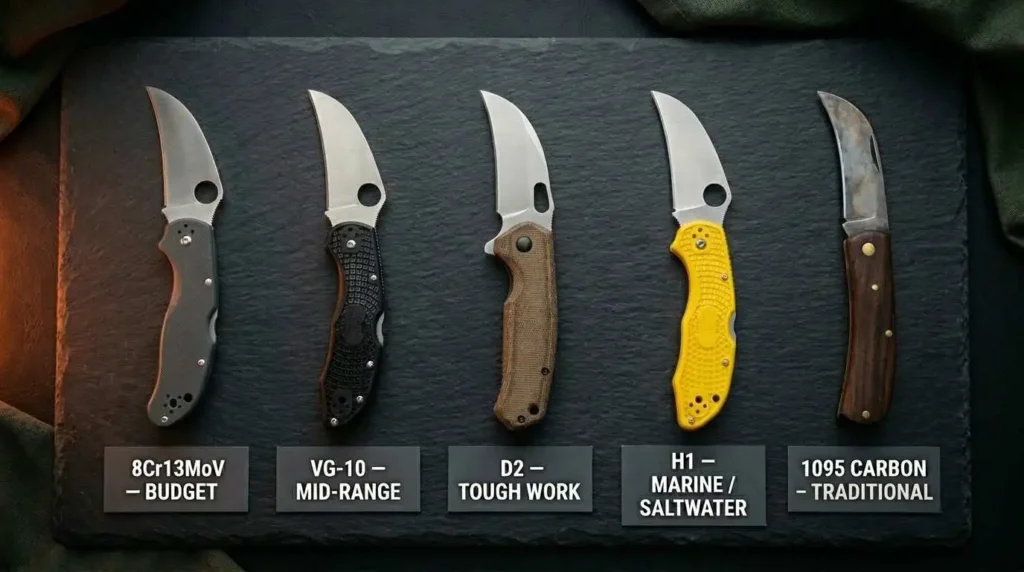
The right steel for a hawkbill depends on the same trade-off as any blade, with one extra factor: because so many hawkbills live in wet environments (marine work, plumbing, outdoor trades), corrosion resistance often matters more than usual.
Stainless steels are the common choice. Budget hawkbills usually run 8Cr13MoV or AUS-8, which sharpen easily and resist rust well enough for daily work. Step up and you find VG-10, 440C, and D2 (a semi-stainless tool steel), offering better edge retention for a blade that cuts abrasive material like rope and carpet all day. For genuine saltwater duty, H1 steel is nearly rust-proof, which is why the Tasman Salt is so popular with anglers and divers. Carbon steels like 1095 take a keen edge and resharpen easily, suiting traditional pruners, but they demand care to prevent rust. For pattern-welded blades, a damascus hawkbill pairs the hook with striking layered steel; our Damascus steel knife guide explains what the layering does and does not do for performance. Whatever the steel, most working hawkbills sit around 56 to 60 HRC.
Are Hawkbill Knives Legal?
In most places, a knife’s legality comes down to its mechanism and blade length, not its blade shape. A folding, non-locking hawkbill utility knife with a short blade is treated like any other folder and is generally unremarkable to carry, which is why they are standard issue in trades across the country.
The wrinkle with the hawkbill is perception rather than statute. Because the hooked, claw-like profile looks aggressive, and because karambit-style hawkbills are marketed for self-defense, some people assume the shape itself is restricted. It usually is not, but an intimidating-looking knife can draw more scrutiny. Fixed-blade hawkbills and anything with an automatic or assisted opening face the same rules any fixed or auto blade would.
The practical takeaway: judge legality by your local rules on length, locking, and opening mechanism, not by the word “hawkbill.” Knife laws vary widely by country, state, and even city, so this is general information rather than legal advice. The American Knife & Tool Institute keeps a useful, regularly updated state-by-state knife law resource that is a good starting point before you carry.
Hawkbill vs Other Blade Shapes
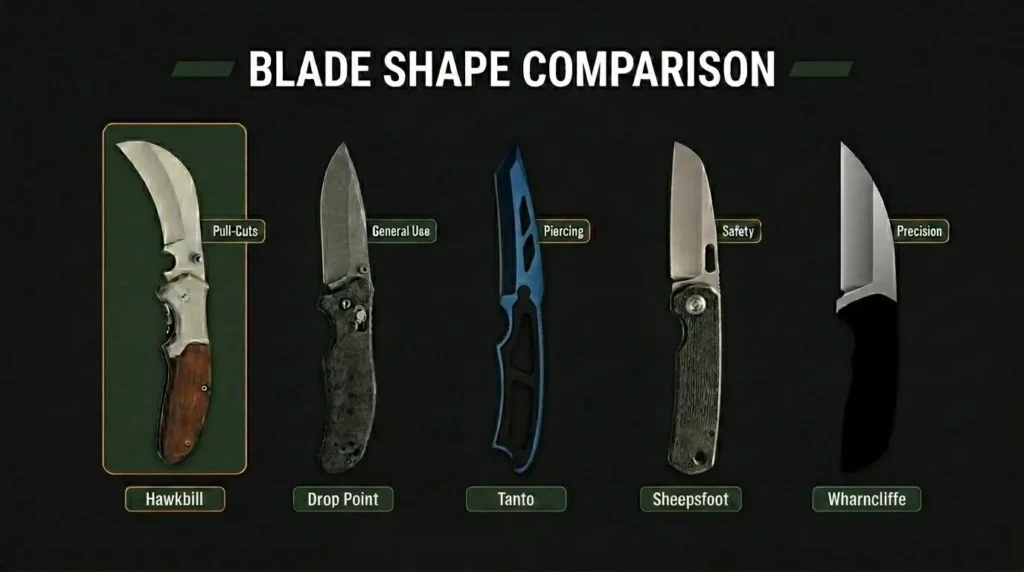
Quick orientation against the shapes people most often line up against the hawkbill. We are building dedicated head-to-head guides for these, but here is the short version.
Hawkbill vs karambit: the closest relatives. Both use a curved, hooked blade, but a true karambit adds a finger ring for retention and is built around defensive and tactical use, while the hawkbill is fundamentally a utility pull-cutter. Plenty of modern knives blur the line; browse the karambit-style folders to see the overlap.
Hawkbill vs wharncliffe: opposite philosophies of control. The hawkbill curves inward to bite and pull; the wharncliffe runs dead straight for push-cuts and detail. One traps material, the other slices flat.
Hawkbill vs drop point: specialist versus generalist. The drop point has a belly for slicing, skinning, and all-round outdoor work; the hawkbill trades all of that for biting pull-cuts.
Hawkbill vs tanto: the hawkbill point curves down and away for safe pulling, while the tanto drives a strong, reinforced point forward for piercing hard material. Almost mirror-image priorities.
Hawkbill vs sheepsfoot: both keep the point away from harm, but the sheepsfoot does it with a straight edge and a blunt nose, while the hawkbill does it with a concave edge and a hook.
Serrated vs plain hawkbill: serrations boost a hawkbill’s already strong grip on rope and webbing at the cost of harder sharpening; a plain edge is cleaner and easier to maintain. A dedicated comparison is coming.
If you want to see every profile side by side, including the spear point and the rest, head back to the knife blade types guide.
Hawkbill Knife Pros and Cons
No shape wins every job, and the hawkbill trades honestly. On the positive side: outstanding control on pulling cuts, a hooked tip that traps material and starts cuts effortlessly, exceptional performance on rope, cordage, carpet, and insulation, a safer point for working blind or freeing a person, and a genuinely specialized edge for trade and marine work.
On the negative side: poor at piercing and push-cuts, useless on a flat cutting board, no slicing belly, more awkward to sharpen than any straight edge, an aggressive look that can draw scrutiny, and a narrow range of jobs that makes it a poor only-knife.
Frequently Asked Questions
Are hawkbill knives good?
Yes, for the right user. If your cutting leans toward rope, cordage, cable, carpet, or pruning, the hawkbill’s pulling cut outperforms almost any other shape. It is the wrong pick only if you need a do-everything blade for food prep, skinning, or piercing.
What is a hawkbill knife used for?
Pull-cutting tough material: pruning, stripping electrical cable, scoring carpet and linoleum, trimming shingles, cutting rope and netting, and rescue cutting of seatbelts and clothing. The concave edge draws material in, and the hooked tip keeps the cut from slipping forward.
Why is it called a hawkbill knife?
Because the curved, downward-hooked blade resembles the beak of a hawk. The “hawksbill” spelling with an “s” is a common mix-up with the sea turtle of that name, but the two are unrelated; the knife is simply a hawk’s bill.
Can you sharpen a hawkbill on a regular stone?
Not properly. The concave edge only touches a flat stone at its ends, leaving the deepest part of the curve untouched and slowly flattening the profile. Use a round or tapered rod, a crock-stick system, or the rounded corner of a stone so the sharpener can follow the curve all the way into the belly of the edge.
Is a hawkbill knife good for self-defense?
The hooked blade has a slashing reputation because the curve pulls material into the cut, and some karambit-style hawkbills are marketed for defensive use. That said, this is a sensitive and heavily regulated area; carry laws differ everywhere, and capability is no substitute for training and legality. Treat any defensive use as a serious decision and confirm your local law first.
Are hawkbill knives legal?
In most places, yes. Legality depends on blade length, locking, and opening mechanism rather than the shape itself, so a short, non-locking folding hawkbill is generally unremarkable to carry. Fixed blades and automatics follow the same rules as any fixed or auto knife, and a few jurisdictions regulate specific styles, so always check your local rules first.
Final Take
The hawkbill is not a gardening relic that wandered into the modern world by accident. It is a purpose-built pull-cutter that does one motion better than any straight blade: hooking material, drawing it into a concave edge, and slicing through under complete control. That is wasted on a hunter and perfect for an electrician, a roofer, a floor layer, a sailor, or anyone whose day is full of rope, cable, and tough fibrous material.
Carry one if your cutting lives on the pull stroke, sharpen it with a rod that follows the curve instead of a flat stone, and pick a steel that matches how wet and abrasive your work gets. Used for what it was built to do, the hawkbill is one of the most quietly capable shapes you can put in your pocket. For the full lineup of profiles, head back to our knife blade types guide.