Gut Hook Knife: The Honest Guide to a Blade Half of Hunters Swear By (and Half Quietly Ignore)

Walk into any sporting goods store and you’ll find a wall of gut hook knives, each one promising to make field dressing faster, cleaner, and idiot-proof. Walk into a deer camp full of people who’ve actually dressed a hundred animals, and you’ll find half of them have never used the little hook on their blade, and the other half wouldn’t hunt without it.

That gap between the marketing and the camp is what this guide is about. We’ll cover what a gut hook blade actually is, how the geometry works, how to use one without ruining your meat, how to sharpen the one part of the knife nobody can keep sharp, and the question every other guide skips: whether you genuinely need one at all. No overselling, just the honest version. New to blade shapes? Start with our master guide to knife blade types and come back.

What Is a Gut Hook Knife?

A gut hook knife is a hunting knife with a small, sharpened, hook-shaped notch ground into the spine near the tip. The inside curve of that hook is the cutting edge. It’s designed for one job: opening the abdominal wall of a downed animal cleanly, like a zipper, without driving the main point into the organs underneath.

That’s the snippet-friendly version. The longer truth is that a guthook knife is really two tools sharing one piece of steel: a conventional belly for skinning and slicing, plus a specialized hook for that single unzipping motion. Everything good and bad about these knives comes from trying to do both jobs well at once. The hook is brilliant at its narrow task and slightly annoying everywhere else, which is why opinions on it run so hot.

Gut Hook Anatomy: The Geometry Nobody Explains
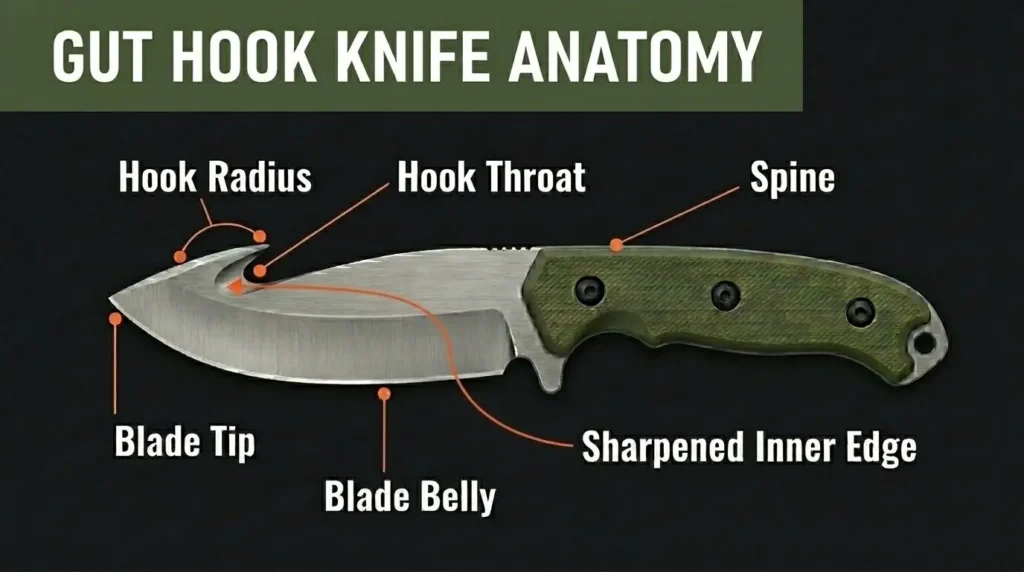
Gut hook knife anatomy diagram showing labeled parts including hook radius, hook throat, spine, blade tip, blade belly, and sharpened inner edge on an olive green handled hunting knife.

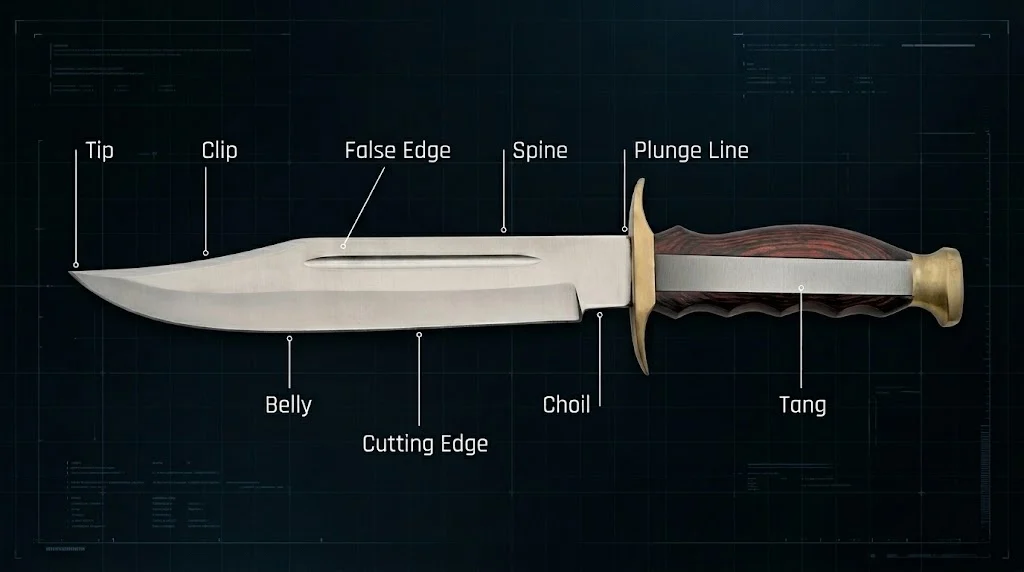
Most guides show you a photo and move on. If you want to use, sharpen, or buy one of these intelligently, you need to understand the shape, so here are the parts that matter, in plain terms.

The gut hook itself is the curved notch cut into the blade spine, usually within an inch or two of the tip. Its working dimension is the hook radius, which is how tight the curve is. A tight radius bites aggressively and is murder to sharpen; a more open radius is gentler and far easier to maintain. This single spec separates a hook you’ll love from one you’ll resent.

Inside that curve lives the sharpened inner edge, the concave cutting surface. This is the part that does the work, and critically, it is the only edge on the knife that faces inward and upward. That orientation is why a standard flat stone is useless on it (more on that later).

The mouth of the hook is the hook throat, the opening where hide and fur enter. A wide throat catches material easily but is more prone to snagging; a narrow throat is more controlled but fussier to feed.

Below all of this sits the rest of the knife: typically a drop point profile with a generous blade belly for skinning, often a full tang for strength, and sometimes a serrated spine section for rope and tough fibrous material. The handle usually carries finger grooves and a guard, because you’re working with bloody, slick hands and a blade pointed back toward you.

[INFOGRAPHIC: Labeled gut hook anatomy diagram showing hook radius, sharpened inner edge, hook throat, spine placement, blade belly, and tip | ALT: “Gut hook knife anatomy diagram labeling the hook radius, sharpened concave inner edge, hook throat, spine, and drop point blade belly”]

Understanding the gut hook design this way pays off immediately: when someone says a hook “snags” or “won’t stay sharp,” you’ll know they’re describing a tight radius and a narrow throat, not a defective knife.

Why Is It Called a Gut Hook? (A Short, Strange History)

The name is almost too literal: it’s a hook, and it’s for guts. But the origin story is better than the name suggests.

The most repeated account is that the feature didn’t start as a gutting tool at all. A custom knifemaker is said to have forged a hook onto the back of a blade in the mid-20th century so he could lift a hot pot off a campfire without burning himself. Later, he sharpened that hook and realized it was perfect for opening game. Whether or not that exact story is true, it captures something real: the gut hook was a clever repurposing, not a from-scratch invention, and it spread through custom makers before the big brands standardized it in the 1980s and ’90s.

So “gut hook” is descriptive of the job it eventually settled into, not a poetic name, just an honest one.

What Is a Gut Hook Knife Used For?

The primary answer is field dressing big game, but the gut hook knife uses list is longer than most hunters assume:

  • Opening the abdominal cavity of deer, elk, and similar game without puncturing the stomach or intestines.
  • Unzipping the hide along a limb during skinning, separating skin from muscle with a controlled pull.
  • Caping assistance, making clean directional cuts when preparing a trophy mount.
  • Cutting rope, cordage, or webbing in a pinch; the protected edge pulls through material safely.
  • Cutting fishing line or opening bait on fishing-specific models.
  • Emergency cutting: the same shape that protects intestines also makes a decent seatbelt or strap cutter, which is why a cousin of the gut hook shows up on rescue knives.

The thread running through all of these is controlled, edge-protected pulling cuts: situations where you want to slice through a surface layer without the tip diving into whatever is underneath. That’s the gut hook’s whole personality.

How to Use a Gut Hook Knife (Step by Step)
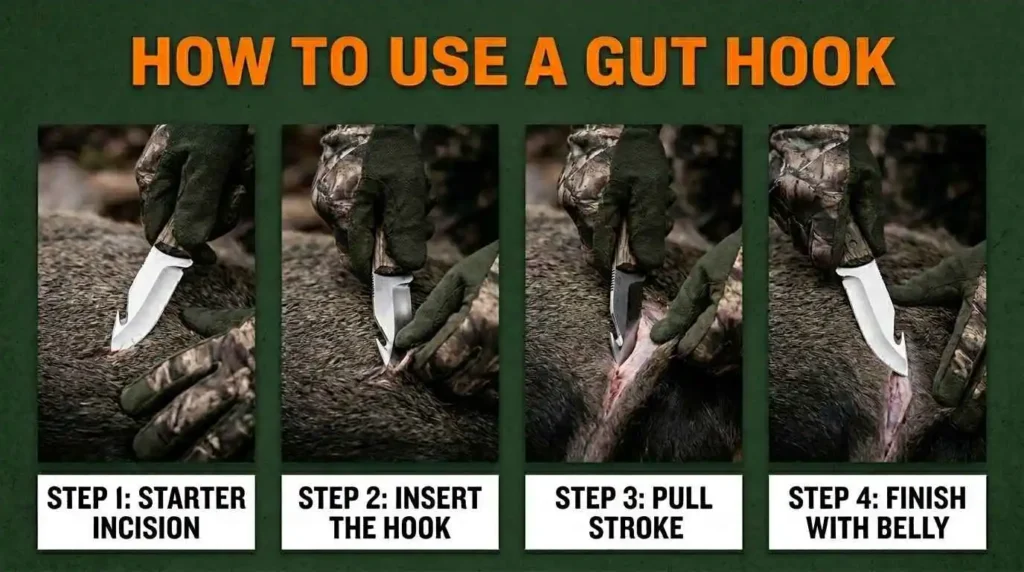
Step-by-step infographic demonstrating how to use a gut hook knife during field dressing, showing the starter incision, inserting the gut hook, performing the pull stroke, and completing the belly opening.

This is where almost every guide fails you. They say “use it like a zipper” and stop, as if that explains anything. It doesn’t. Here’s the actual mechanics, for a whitetail-sized animal, with the carcass on its back.

1. Make the starter incision with the main blade, not the hook. Pinch and lift the skin low on the belly, and use the point of your knife to open a small slit through the hide and abdominal wall, just big enough to insert the hook. This first cut is shallow and deliberate; you are cutting the wall, not the guts.

2. Insert the hook, edge facing up. Slide the sharpened inner edge into that slit so the hook is hooked under the abdominal wall, blade spine down against the skin, cutting edge facing up and away from the organs. Two fingers of your free hand can ride just ahead of the hook, between the hide and the entrails, as a guide and a guard.

3. Pull, don’t push. Draw the knife toward the sternum in one smooth motion. The hook’s geometry does the work: it catches the wall and slices it open from the inside, while the rounded back of the hook glides along without biting into anything below. Pull strokes only. A gut hook is built to cut on the pull; pushing it accomplishes nothing but frustration.

4. Control your depth. The reason the hook exists is depth control. Because the cutting edge sits inside the curve and the spine rides against the skin, the blade physically can’t plunge deep the way a point can. Let the tool do that job; don’t muscle it.

5. Switch back to the belly for the rest. Once the cavity is open, the hook’s job is essentially done. Use the main drop point edge, the same profile we cover in our drop point knife guide, for the heavier cutting, the diaphragm, and the rest of the process.

[INFOGRAPHIC: Four-panel sequence: starter incision, hook insertion with fingers as guide, pull stroke up the belly, switch to main blade | ALT: “Step-by-step how to use a gut hook knife for field dressing: starter incision, hook insertion, pull stroke, and finishing with the main blade”]

For the full field-dressing process beyond the opening cut, including organ removal, cooling, and food-safety steps, the National Deer Association’s field-dressing guide is a genuinely good, biologist-written walkthrough. The gut hook only owns the first cut; everything after is general technique.

Do You Actually Need a Gut Hook? The Honest Verdict
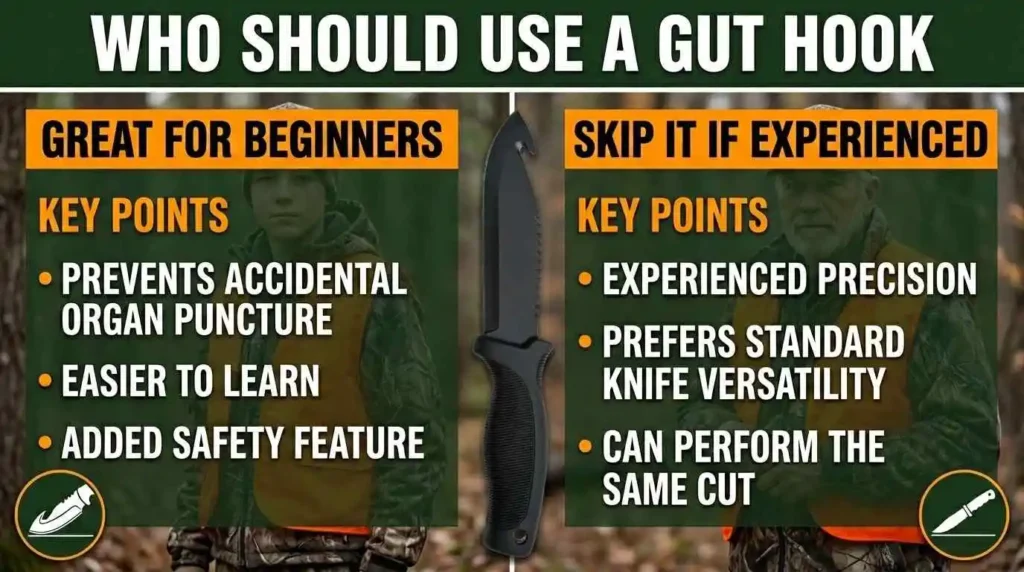
Infographic comparing who should use a gut hook knife, showing benefits for beginners such as preventing accidental organ puncture and added safety, versus reasons experienced hunters may prefer a standard hunting knife.

Here’s the section the marketing wants buried.

Are gut hooks worth it? It depends entirely on who you are, and pretending otherwise is how every other guide loses credibility. So let’s be honest about who benefits and who should skip it.

You’ll probably love a gut hook if:

  • You’re a newer hunter who hasn’t built the muscle memory to open a cavity by feel. The hook is training wheels in the best sense: it makes a clean opening hard to screw up.
  • You field-dress solo, often in poor light or cold, tired conditions where a controlled, low-risk cut matters more than speed.
  • You process a lot of deer-sized game and want to shave time off the one cut you repeat every single time.

You can comfortably skip it if:

  • You’re an experienced hunter with a steady hand. Plenty of veterans open a cavity faster and cleaner with a plain blade and two fingers as a guide than they ever could with a hook. As one longtime writer for BLADE Magazine put it after decades of hunting on three continents, he’d simply never needed one.
  • You value a simple, easy-to-maintain edge. The hook is the first thing to dull and the hardest thing to fix.
  • You mostly process small game or fish, where the hook is more in the way than in use.

Why do so many hunters quietly abandon their gut hooks? Three honest reasons, and they’re worth saying out loud. First, the hook snags on hide and hair if your radius is tight or your technique is off. Second, it dulls fast and most people never re-sharpen it, so it becomes dead weight. Third, and this is the big one, it’s genuinely hard to sharpen, so a lot of hooks live their whole lives as decoration. On hunting forums you’ll find the same refrain repeated for twenty years: “I have one, I never use it, I can’t keep it sharp.”

None of that makes the gut hook bad. It makes it specialized. A specialized tool used by the wrong person is a gimmick; used by the right person, it’s a quiet workhorse. The trick is knowing which person you are.

How to Sharpen a Gut Hook (The Part Everyone Gets Wrong)
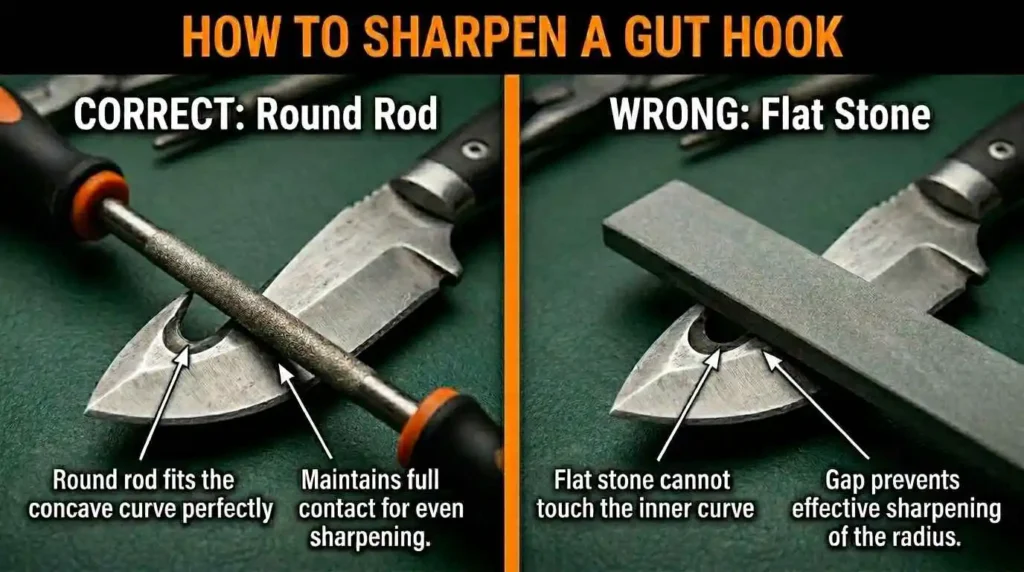
Infographic showing the correct way to sharpen a gut hook knife using a round sharpening rod compared to the incorrect use of a flat sharpening stone, highlighting proper contact with the gut hook's inner curve.

If there’s one section to bookmark, it’s this one, because how to sharpen a gut hook is the question the entire internet half-answers and then runs from.

The problem is geometry. The sharpened inner edge is concave and faces into a tight curve. A flat bench stone, the thing most people own, physically cannot reach inside that curve. Drag a gut hook across a flat stone and you’ll just round off the outside of the spine while the actual cutting edge stays dull. This is the single most common sharpening mistake, and it’s why so many hooks are hopeless.

You need a round or tapered abrasive that fits inside the hook. Your real options, from best to passable:

  • A tapered diamond rod (the kind sold for serrations) is the best general answer. The taper lets you match the rod’s diameter to your specific hook radius, and diamond cuts steel fast.
  • A round ceramic rod works well for maintenance and finishing. It’s slower than diamond but leaves a cleaner edge, and the small-diameter rods from sharpening kits fit most hooks.
  • A chainsaw file or small round file is the old-school field fix. It’s coarse and aggressive: fine for reprofiling a badly neglected hook, less ideal for a refined edge. Many older hunters keep exactly this in their kit.

The technique: seat the rod inside the hook so it matches the curve, then stroke only in the direction the edge faces. Draw the rod through the concave edge, lifting and repeating, always cutting one way. Match the existing edge angle (most hooks live around 20 to 25 degrees per side). Work slowly; you’re sharpening a tiny amount of steel in a confined space, and it’s easy to scratch the flats of the blade if you rush. A few passes, check for a burr on the inside, and you’re done.

[INFOGRAPHIC: Cross-section showing a round rod seated inside the concave hook edge vs a flat stone failing to reach it | ALT: “How to sharpen a gut hook: a round diamond or ceramic rod fits inside the concave inner edge, while a flat stone cannot reach it”]

What file to sharpen a gut hook with? If you’re buying one thing, buy a small tapered diamond rod. It handles the gut hook and any serrations on the spine, and it’s the difference between a hook that works for a decade and one that quits after a season.

How to Clean and Maintain the Hook

The hook throat is a trap. Its narrow concave shape collects blood, hair, fat, and tissue exactly where you can’t easily see or wipe it, and that trapped organic material is corrosive. On most knives, the gut hook is the first place rust appears, simply because it’s the hardest spot to clean and dry.

So after every use: flush the hook with warm water, then run a folded edge of paper towel, a pipe cleaner, or a small brush through the throat to clear it physically. Dry it completely (a damp hook is a rusting hook) and add a drop of light oil to the inside of the curve before storage.

This is also where blade steel matters. A stainless steel blade with good corrosion resistance forgives a rushed cleanup far better than carbon steel will; if you hunt in wet conditions or you know you won’t baby your gear, stainless is the sensible choice for a gut hook specifically, because the throat is going to take abuse no matter how careful you are.

Common Gut Hook Mistakes
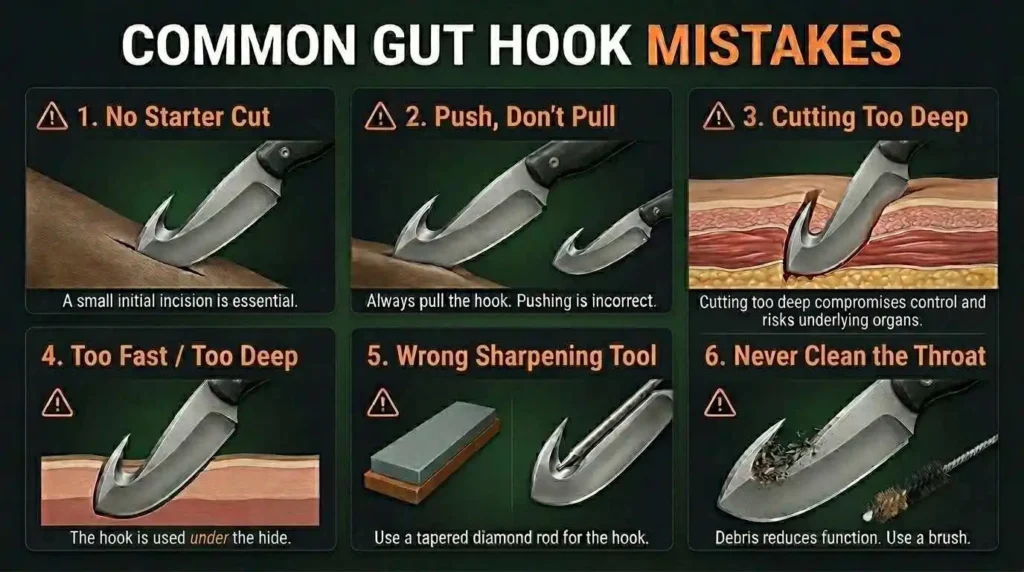
Educational infographic showing six common gut hook knife mistakes, including no starter cut, pushing instead of pulling, cutting too deep, moving too fast, using the wrong sharpening tool, and improper cleaning.

A quick honest list of the ways people misuse these knives:

  • Using the hook to make the starter cut. The hook can’t start its own incision cleanly: open the wall with the point first, then insert the hook.
  • Pushing instead of pulling. The geometry only cuts on the draw.
  • Going too deep or too fast and snagging the hide or nicking the paunch, the very thing the hook is supposed to prevent, defeated by impatience.
  • Sharpening on a flat stone and wondering why it stays dull.
  • Never cleaning the throat, then blaming the knife when it rusts.

Most “the gut hook is useless” complaints trace back to one of these five, not to the tool.

Gut Hook Variants and Alternatives
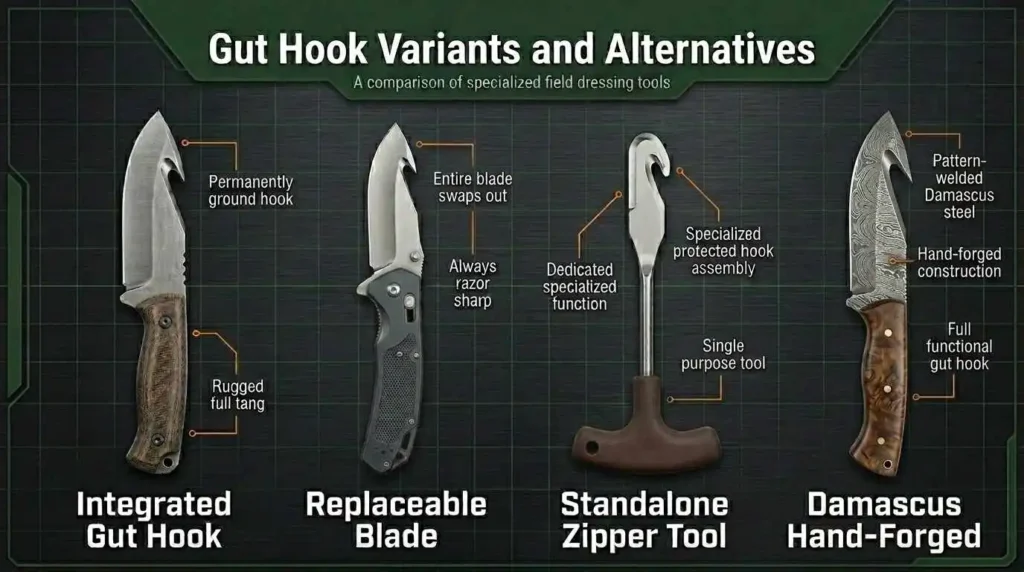
Gut hook knife variants and alternatives comparison chart showing four types of field dressing tools: integrated gut hook knife, replaceable blade knife, standalone zipper tool, and Damascus hand-forged gut hook knife.

Not every gut hook blade is the same, and there are alternatives worth knowing.

Drop point with integrated gut hook. The most common configuration: a drop point skinner with the hook ground into the spine. This is the “do everything” hunting knife and the default mental image of a gut hook.

Replaceable-blade gut hooks. A growing category, and an honest answer to the sharpening problem: instead of maintaining the hook, you swap in a fresh blade. If the concave-edge sharpening described above sounds like more trouble than you want, this is the pragmatic workaround that a lot of hunters have quietly migrated to. No shame in it.

Standalone gut hook tools. A small, dedicated hook, sometimes called a “zipper,” separate from your main knife. Cheap, single-purpose, and easy to add to a kit if you want the function without committing your main blade to the shape.

Damascus and hand-forged gut hooks. For collectors and hunters who want a knife with character, a Damascus steel or hand forged gut hook delivers the pattern-welded look along with the function. Worth knowing that the beauty is in the steel and the maker’s work; the hook geometry follows the same rules regardless of how pretty the billet is.

Gut hook blade blanks and bolo models. If you make your own knives, gut hook blanks let you build a custom handle around a pre-ground hook, a popular entry into knifemaking. And occasionally you’ll see the hook added to a big bolo-style blade, for hunters who want chopping power and a gut hook in one heavy tool.

Where the Gut Hook Sits Among Blade Shapes

The gut hook isn’t really a blade shape in the way the others are: it’s a feature added to a shape, usually a drop point. But it belongs in the wider family of curved, edge-protected profiles, and seeing it in context helps.

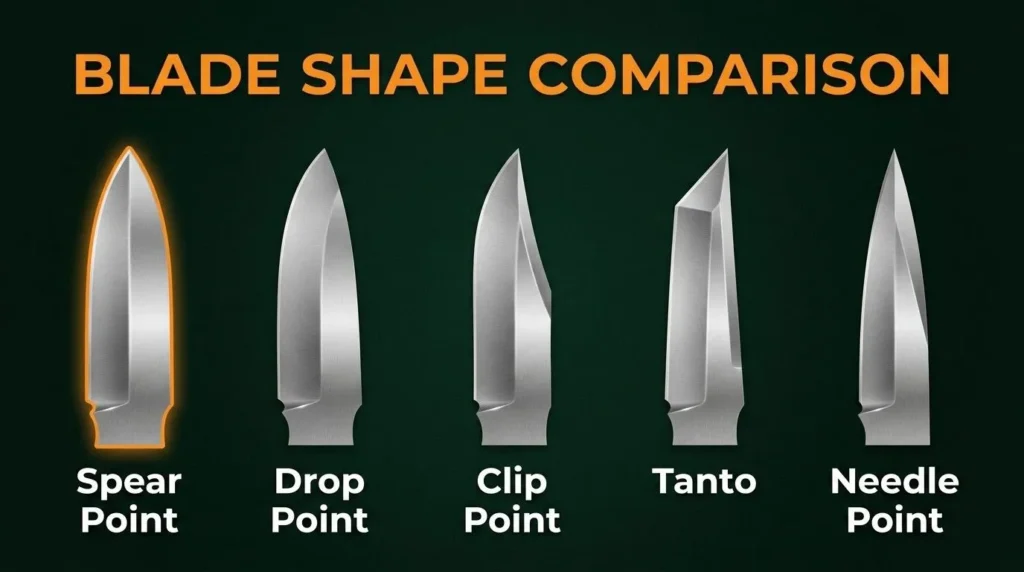
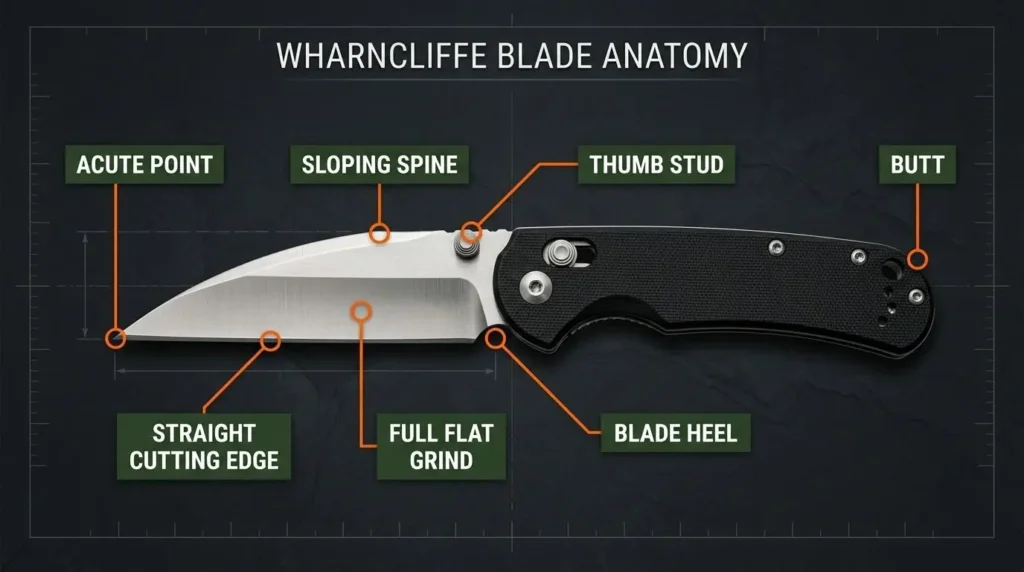
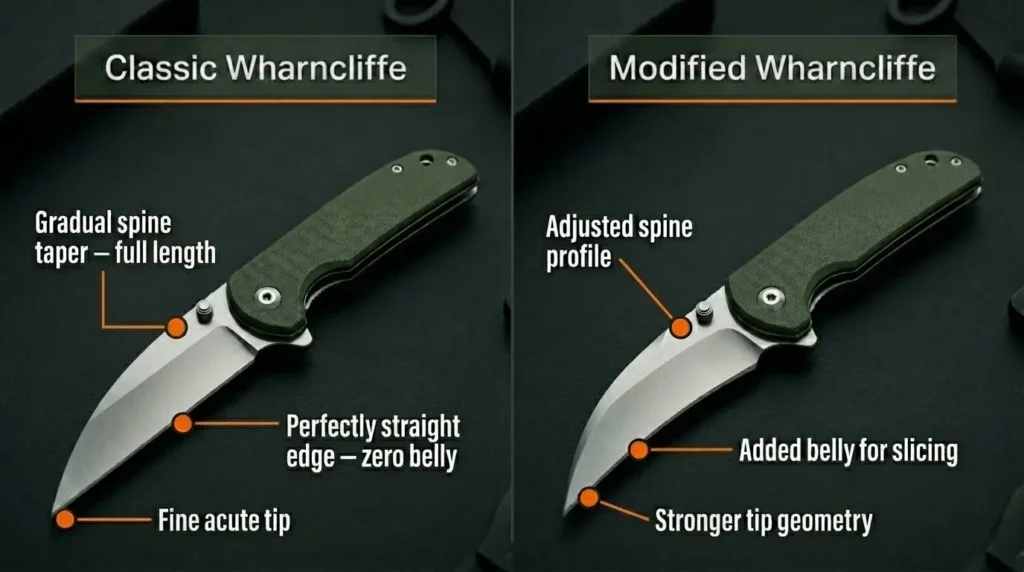
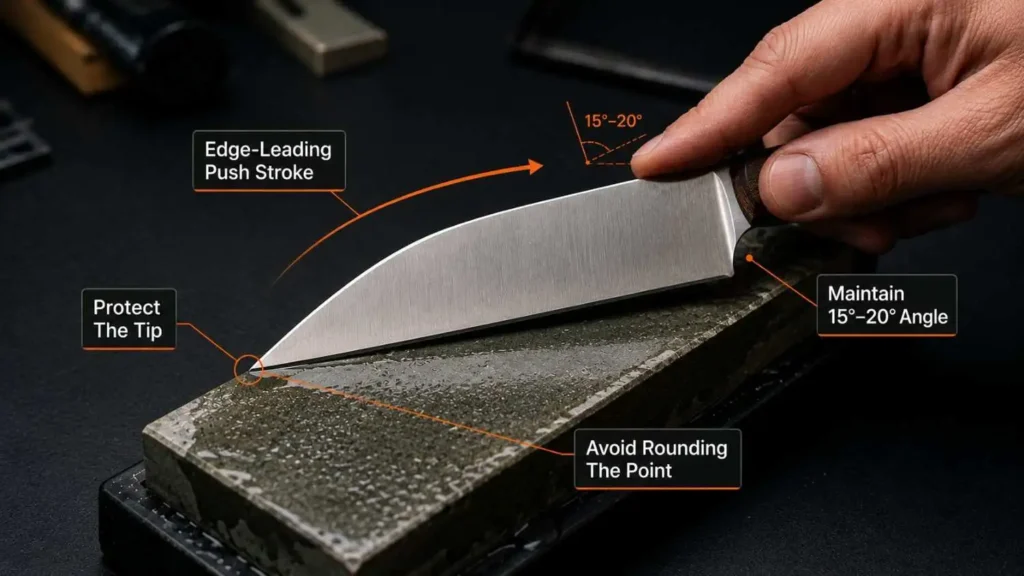
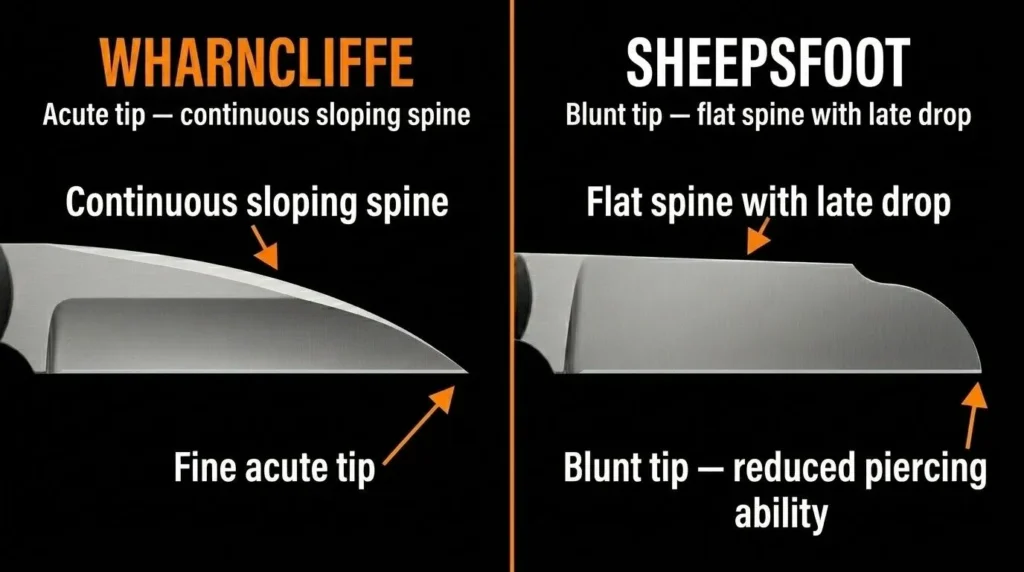
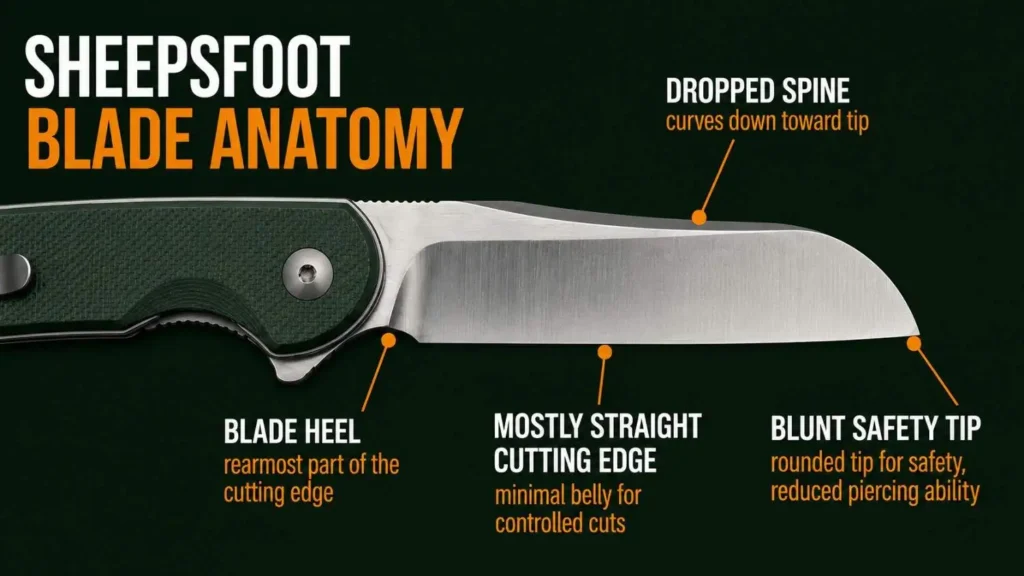
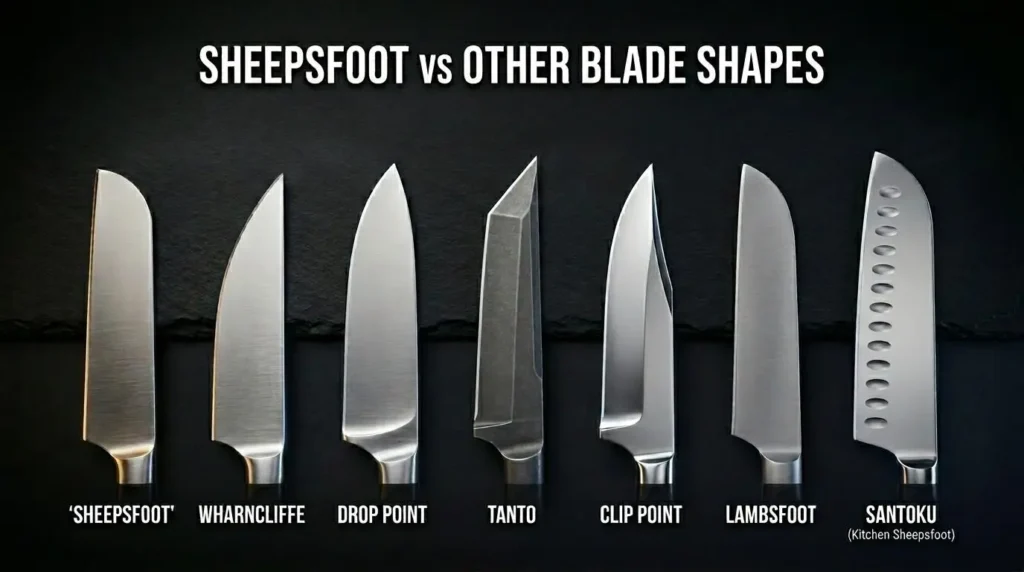
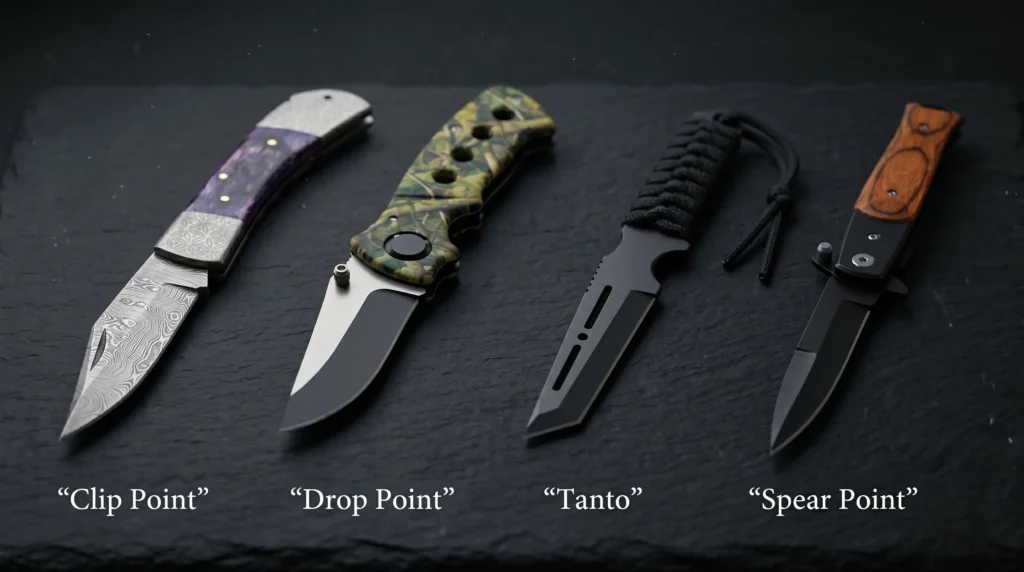
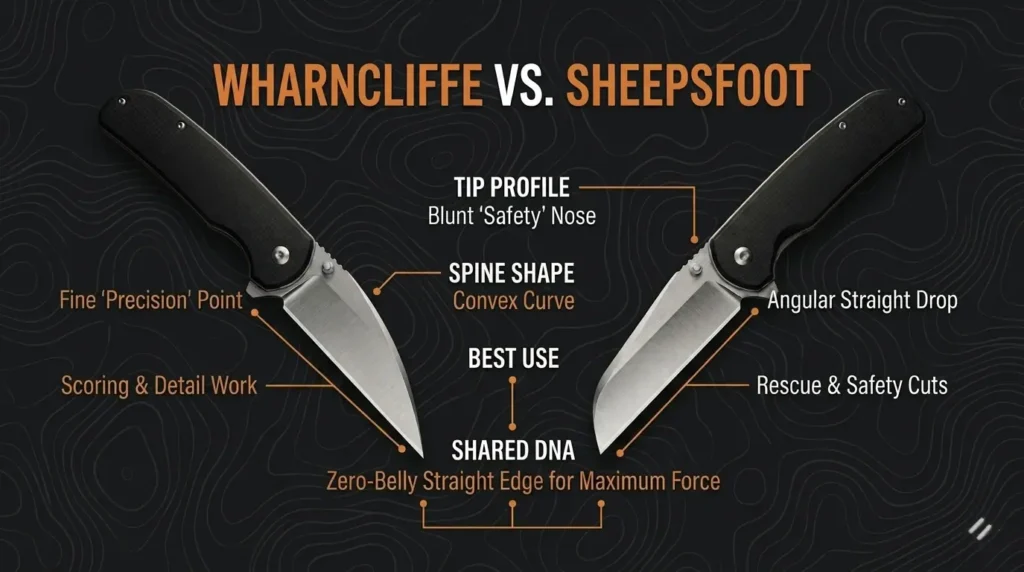
The concave cutting edge of a gut hook has a close cousin in the hawkbill, whose entire edge curves inward for the same pull-cutting logic. For straight, controlled cuts without a piercing tip, the sheepsfoot and wharncliffe take the opposite approach. And for the piercing and detail work a gut hook can’t do, the clip point, spear point, and tanto each have their own answer. The full map of how these relate lives in our knife blade types pillar.

Gut Hook vs Other Blades (Quick Answers)
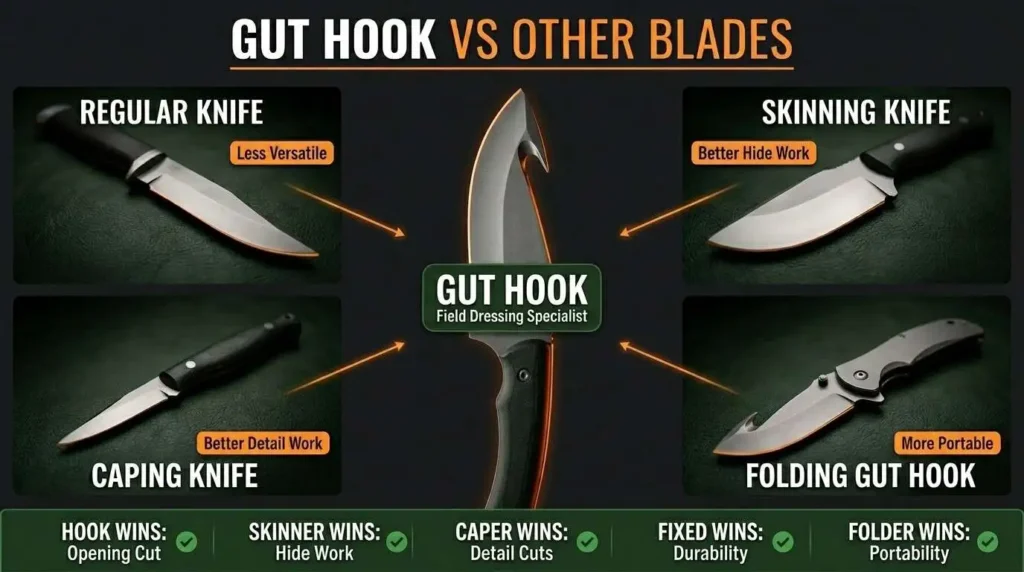
Comparison chart showing a gut hook knife versus regular knife, skinning knife, caping knife, and folding gut hook, highlighting field dressing, hide work, detail cuts, durability, and portability benefits.

Full head-to-head comparisons are coming in their own posts, but here are the short answers:

  • Gut hook vs a regular knife: A regular blade is more versatile and far easier to sharpen; the gut hook only wins on the single field-dressing opening cut.
  • Gut hook vs drop point: Most gut hooks are drop points with a hook added: the hook is a bonus feature, not a replacement for the drop point’s all-around utility. See our drop point guide.
  • Gut hook vs a dedicated skinning knife: A pure skinner has a sweeping belly optimized for separating hide; the gut hook trades a little skinning finesse for the unzipping feature.
  • Gut hook vs caping knife: Caping favors a small, fine point for detail work; the gut hook is too coarse for serious caping.
  • Gut hook vs replaceable-blade tool: Integrated hooks reward maintenance; replaceable-blade tools skip maintenance entirely at the cost of buying refills.
  • Fixed vs folding gut hook: Fixed blades are stronger and easier to clean; folders trade some of both for portability. (We’ll give this one a full breakdown in a dedicated comparison.)

FREQUENTLY ASKED QUESTIONS

What is a gut hook used for?

Opening the abdominal cavity of game during field dressing without puncturing the organs, plus skinning assistance and general controlled pull-cuts.

Why is it called a gut hook?

Because it’s a hook used to open the gut. The feature reportedly began as a hook for lifting pots off a campfire before being sharpened and repurposed for game.

Are gut hook knives good?

Yes, for the right user. New hunters and solo field-dressers benefit most. Experienced hunters with a steady hand often don’t need one, and that’s a legitimate choice, not a failure.

Why don’t some hunters use gut hooks?

Three reasons: they can snag, they dull quickly, and they’re hard to sharpen. Used correctly and maintained, none of those are dealbreakers, but neglected, the hook becomes dead weight.

How do you sharpen a gut hook?

With a round or tapered abrasive (diamond rod, ceramic rod, or small round file) that fits inside the concave edge. A flat stone cannot reach it. Stroke in the direction the edge faces and match the existing angle.

Can I use a flat sharpening stone on a gut hook?

No, the concave inner edge requires a rounded abrasive. A flat stone only rounds the spine and leaves the cutting edge dull.

What blade steel is best for a gut hook?

Stainless steel is the practical pick because the hook throat traps moisture and rusts first; good corrosion resistance forgives imperfect cleaning.

Final Take

A gut hook knife is neither the must-have miracle the packaging claims nor the useless gimmick the forum cynics dismiss. It’s a specialized feature that does one narrow job, opening a cavity with controlled, low-risk pull-cuts, better than a plain blade, and does almost everything else slightly worse.

If you’re newer to field dressing, hunt solo, or just want insurance against a slipped cut, a gut hook earns its place. If you’ve got a steady hand and a decade of dressed deer behind you, you can skip it without missing anything, and you’ll have one less concave edge to sharpen. Either way, now you know how to use it, how to keep it sharp, and how to decide honestly. That’s more than most guides will give you.

When you’re ready to see how the gut hook fits into the bigger picture of blade design, head back to our complete guide to knife blade types and shapes.

What Is a Trailing Point Knife? Uses, Pros, Cons & Buying Guide

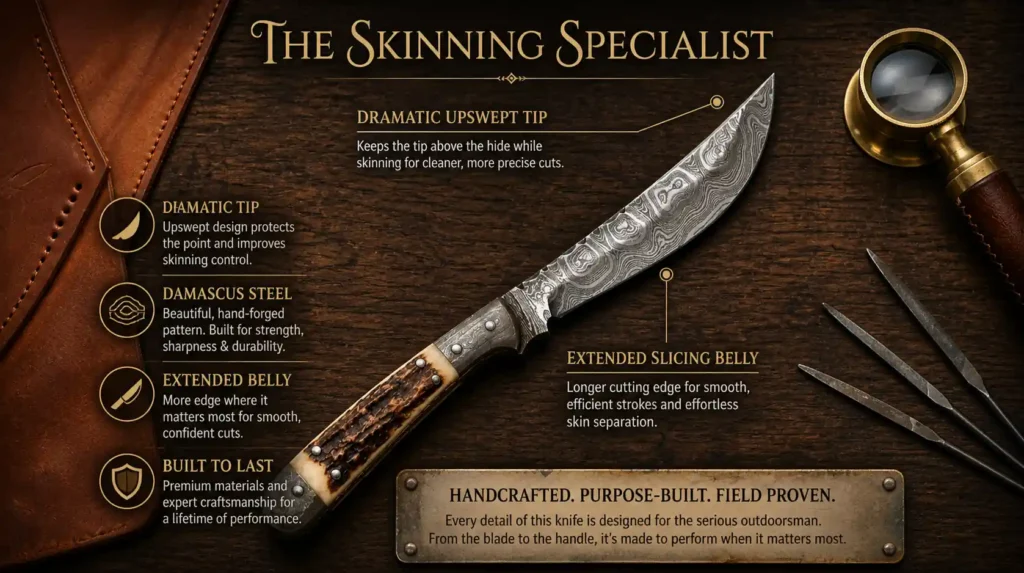
A trailing point knife is a blade whose spine sweeps upward from the handle so the tip “trails” higher than the spine where it leaves the handle. That upsweep stretches the cutting edge into a long, deep belly — which is why this profile is the default on skinning and fillet knives. You’ll also hear it called an upswept or Persian blade.

This guide covers what a trailing point is, what it’s actually good at, how its geometry creates both its strengths and its one real weakness, the best steels and sizes, common mistakes, and how to sharpen and use it properly. It’s part of our larger guide to knife blade types and shapes.
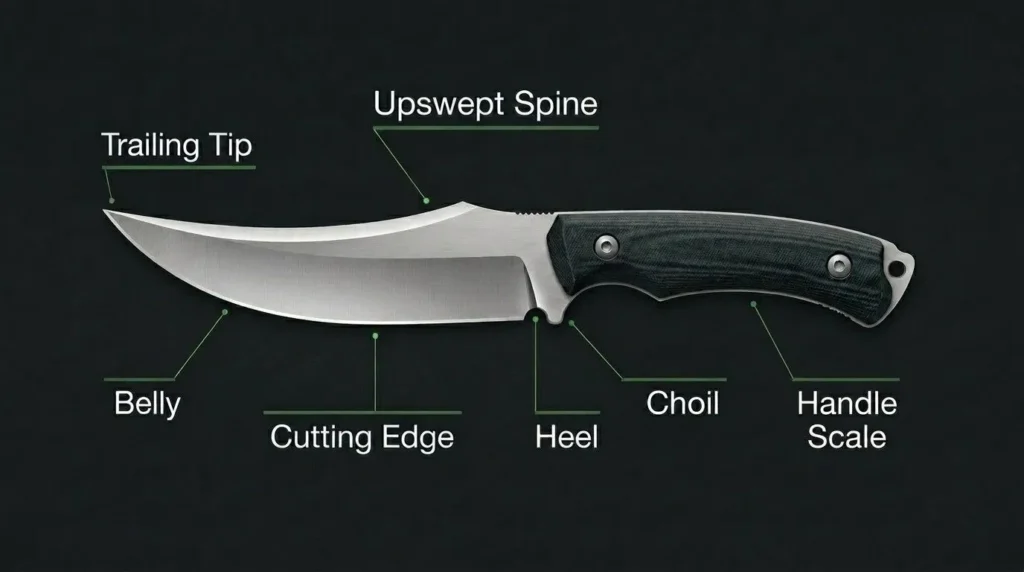
Quick Answer: A trailing point knife has an upswept spine that raises the tip and lengthens the belly. Best for slicing, skinning, caping, and filleting. The trade-off is a thin, unsupported tip that isn’t built for prying or hard work.

What Is a Trailing Point Knife?

A trailing point is defined by one feature: the spine rises as it travels toward the tip, finishing above the line it started on at the handle. Everything else follows from that single choice.

Raising the spine does one thing mechanically — it lengthens the curve of the edge. That creates three working advantages:

  • A long, deep belly that puts more continuous cutting edge into every stroke
  • A raised tip that stays up and out of the way during long belly cuts
  • A lightweight blade, because the upsweep removes steel rather than adding it

That long belly is the whole point. When you draw a trailing point through a hide or a fish fillet, more edge passes through the cut per stroke than on almost any other shape — which is why hunters, anglers, and butchers reach for it. The cost of that geometry shows up at the tip, and we’ll be honest about it below.

Best For / Not Best For

Best ForNot Best For
Skinning and caping gamePrying, twisting, or batoning
Filleting and processing fishPiercing tough or hard materials
Long, sweeping slicing cutsHeavy bushcraft and wood work
Butchering and breaking down meatEDC where you need a durable tip
Collectors who value the upswept linesSelf-defense or hard-use carry

If you want a strong tip and do-everything versatility, a drop point or clip point suits you better. The trailing point is a specialist, and it’s at its best when you let it specialize.

How the Trailing Point Compares (Quick Routers)

We keep head-to-head breakdowns in their own dedicated guides so each gets the room it deserves. The one-line version:

  • Trailing point vs drop point: the drop point lowers and strengthens the tip; the trailing point raises it for more belly. Full comparison coming soon.
  • Trailing point vs clip point: the clip point thins the tip for piercing; the trailing point sweeps the edge up for slicing. Full comparison coming soon.
  • Trailing point vs spear point: the spear point is symmetric and tip-centered; the trailing point is all belly. Full comparison coming soon.

For the whole family — including the tip-strong tanto, the straight-edged sheepsfoot and wharncliffe, and the hooked hawkbill — see the pillar guide.

Pros and Cons

ProsCons
Long, deep belly — excellent for slicingThin, unsupported tip that bends or breaks easily
Raised tip stays clear during belly cutsPoor at piercing, prying, and hard-target work
Maximum continuous edge per strokeAwkward to sheath — the upswept tip catches
Lightweight and fast in the handHarder to sharpen than a straight-edged blade
Distinctive, elegant blade profileA specialist, not a do-everything tool

Anatomy of a Trailing Point Blade

Trailing point knife anatomy diagram showing trailing tip, upswept spine, belly, cutting edge, heel, choil, and handle scale.

Seven working parts. Knowing them is the difference between buying a knife and buying the right knife.

  1. Upswept Spine. The unsharpened top edge that rises from the handle toward the tip. How aggressively it climbs controls how deep the belly and how raised the point.
  2. Trailing Tip. Where spine and edge meet, sitting higher than the spine’s origin at the handle. The thinnest, least-supported part of the blade and the first thing to break if you misuse the knife.
  3. Belly. The long curved cutting edge, deeper than on almost any other shape. This is the defining feature.
  4. Heel. The edge nearest the handle. On a skinner, this is the part you should work with most more on that below.
  5. Cutting Edge. Runs from the heel through the flat working section and sweeps up into the belly toward the point.
  6. Choil. A small unsharpened notch between edge and handle that lets you sharpen the full edge without rounding the heel.
  7. Tang. The steel running into the handle. On a serious fixed-blade skinner, full tang is non-negotiable lateral force during skinning needs a joint that won’t fail.

Why the Tip Is the Weak Point

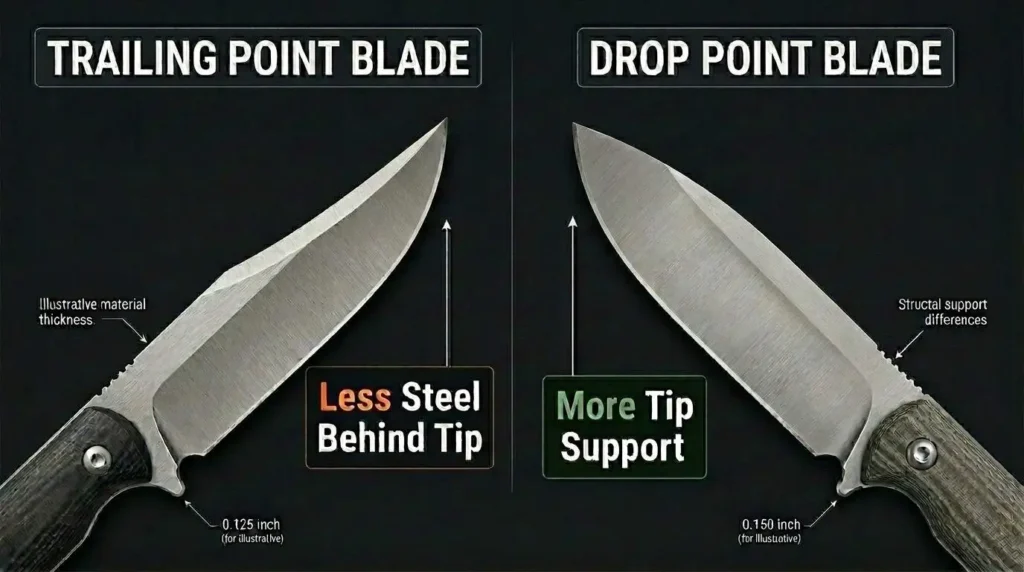
Trailing point knife vs drop point knife blade comparison showing tip shape, cutting profile, and tip support differences.

Every source that mentions a trailing point repeats the same warning “the tip is fragile” and stops. Here’s the part they leave out: why.

The upsweep that creates the long belly does it by removing steel from behind the point. On a drop point, the spine slopes down and adds mass behind the tip, propping it up. On a trailing point, the spine climbs away from the tip, so the point is left thin, high, and unsupported — a fine, exposed peak with very little steel backing it.

That’s not a flaw. It’s the unavoidable cost of the geometry that makes the blade slice so well. A trailing point tip will bend or snap if you pry, twist, drill, or stab into anything hard — and it’s also why these blades are awkward to sheath, since the raised tip has to be guided in rather than dropped. The fix isn’t to avoid the shape; it’s to buy the right steel and keep the tip out of jobs it was never built for.

A Brief History

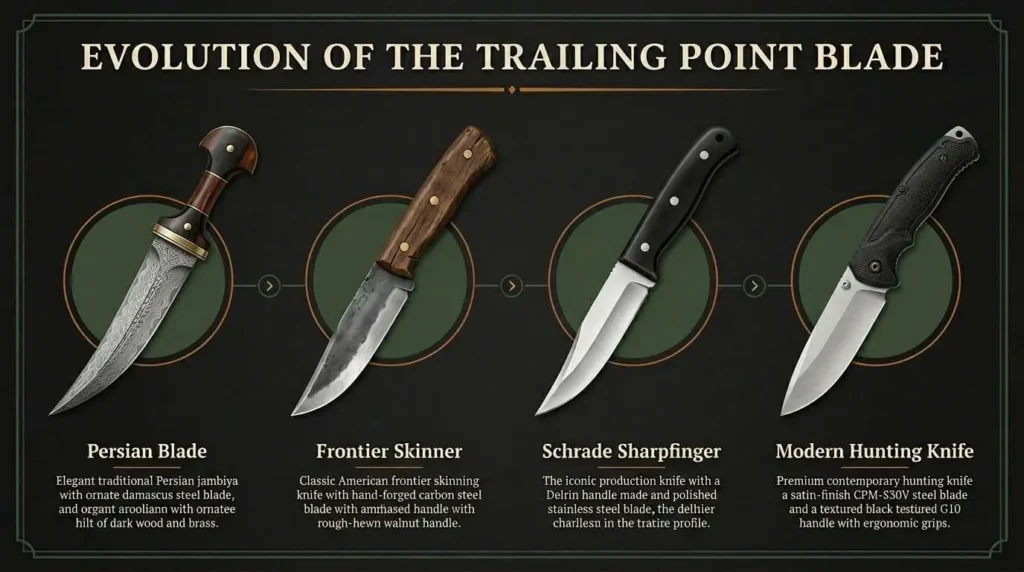
Evolution of the trailing point knife blade from traditional Persian blades to modern hunting knives, showing the development of the trailing point design over time.

The trailing point’s upswept curve is one of the oldest functional blade ideas in cutlery. It descends from the scimitar family — the curved, belly-forward blades of the Persian and broader Middle Eastern tradition — which is why the profile is still called a Persian blade today. The curve was prized for the same reason it is now: a longer arc of edge sweeping through a draw cut.

As the shape moved into working knives, it found two homes. Butchers adopted the large upswept cimeter for breaking down carcasses, where the long belly slices and the raised tip stays clear of bone. Outdoorsmen adopted it for skinning — the frontier skinning knife leaned on the upswept belly to separate hide cleanly without puncturing it.

In the modern era, the Schrade Old Timer 152OT Sharpfinger became the production knife most people picture when they hear “trailing point” — a compact, hump-spined skinner that sold by the millions. The Buck 113 Ranger Skinner carried the same tradition, and the upswept skinning pattern lives on in the Nessmuk-style blades favored by bushcrafters. That hand-forging heritage continues today in custom shops producing layered Damascus skinners and fillet knives, where the long sweeping belly shows off the pattern like no other geometry.

Trailing Point Variations

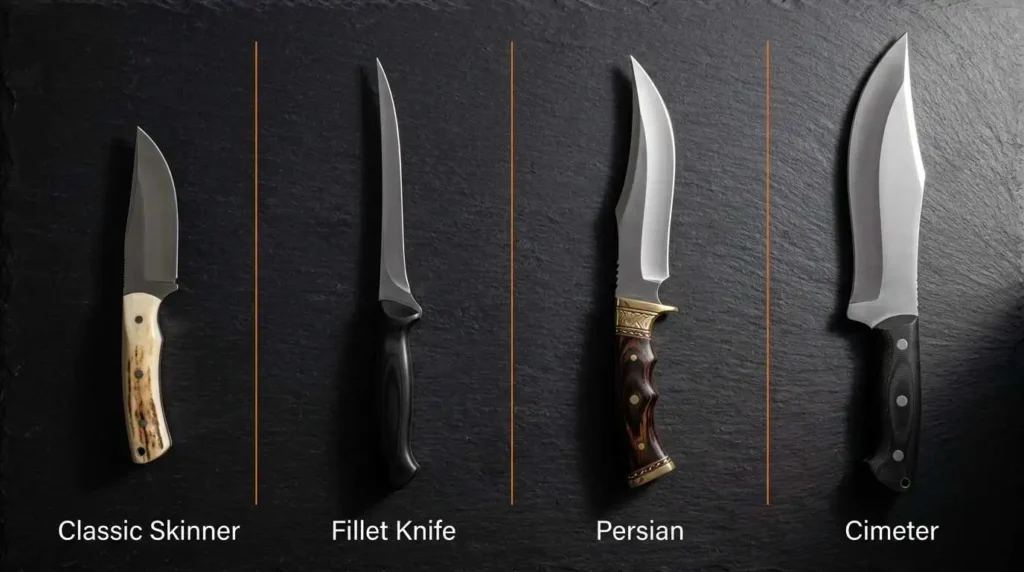
Types of trailing point knives including classic skinner, fillet knife, Persian blade, and cimeter knife, showcasing different trailing point blade designs and uses.

“Trailing point” isn’t one shape; it’s a family defined by how aggressively the spine climbs.

  • Classic Skinner. Moderate upsweep, deep belly, compact blade. The default hunting form.
  • Fillet. Long, thin, and flexible — the flex rides bone and lifts skin, which is why most fillet knives are trailing points.
  • Persian. A dramatic, decorative upsweep. Common on collector pieces and some EDC folders.
  • Butcher’s Cimeter. A large, long-bellied trailing point for breaking down meat in long slicing pulls.
  • Modified. A gentle rise that adds belly without leaving the tip as exposed — a nod toward everyday durability.

Grind Variations

On a thin-tipped blade, the grind matters as much as the profile.

  • Hollow. Razor-thin, superb at fine slicing and skinning — the traditional skinner grind, and the most fragile.
  • Flat. The balanced middle ground and a safe default.
  • Scandi. Easy to maintain and tough at the edge, but less common here.
  • Convex. The strongest geometry and kindest to a delicate tip, at the cost of harder freehand sharpening.

What Is a Trailing Point Blade Used For?

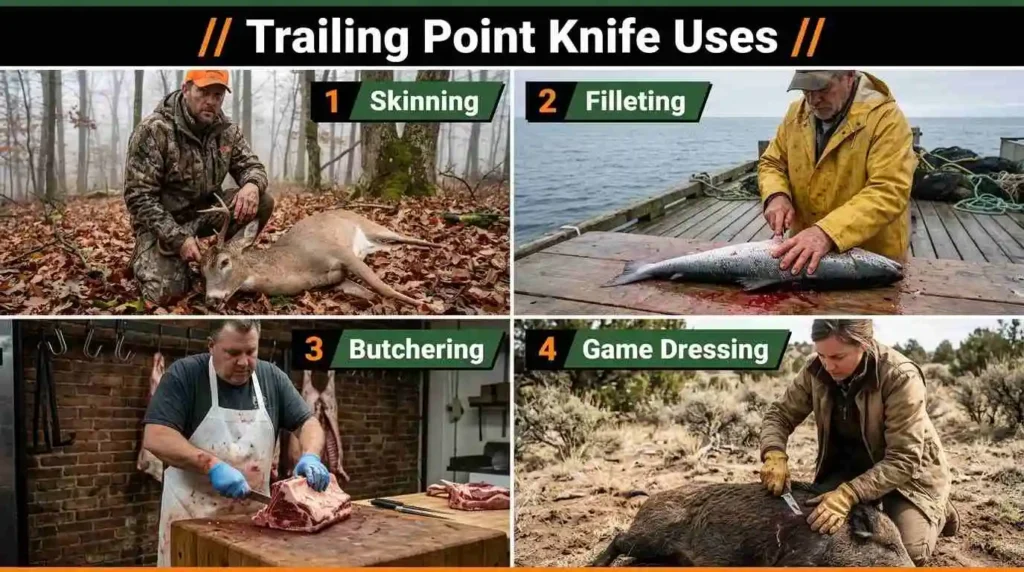
A trailing point handles skinning, caping, filleting, butchering, and any task built around long, sweeping slicing cuts — anywhere edge length and slicing control matter more than tip strength.

  • Skinning. The deep belly separates hide in long clean pulls, and the raised tip stays clear of the meat.
  • Filleting. A thin, flexible blade rides the backbone and lifts skin off a fillet better than any straight edge.
  • Caping. The fine raised tip handles delicate detail work around the head and cape of game.
  • Butchering. The long cimeter belly breaks down large cuts in efficient slicing strokes.
  • General slicing. Anywhere a long draw cut beats a short chopping one.

For piercing, prying, or batoning, reach for a drop point or clip point instead — loading the tip is how a trailing point breaks.

Trailing Point Knife by Use Case

Trailing point knife uses for skinning, filleting, butchering, and game dressing in hunting, fishing, and meat preparation.

Hunting (Skinning & Caping)

The trailing point’s home turf. Look for a 3.5 – 4.5 inch blade on a full tang, with a deep belly and a tough steel CPM 3V, S35VN, MagnaCut, or hand-forged 1095 + 15N20 Damascus. Keep it stiff; skinning is about control, not flex.

Fishing (Filleting)

Look for a longer 6 – 9 inch blade with noticeable flex and a corrosion-resistant steel fillet knives stay wet, so stainless matters, and a medium hardness in the mid-to-upper 50s HRC keeps the flex. The belly is what lets you lift a clean fillet off the bone.

Butchering

Look for a long-bellied cimeter, 8 inches or more, in a tough stainless that shrugs off acidic contact and frequent washing. Length and belly are the priorities; tip strength is irrelevant for slicing meat off bone.

EDC, Pocket & Folding Knives

Honest answer: a trailing point is a poor everyday-carry choice. Trailing point pocket and folding knives exist the Kershaw Outright is a well-known example but the fragile tip struggles with the prying and scraping real carry demands. If you love the look, treat it as a dedicated slicer and keep a sturdier blade for hard tasks.

Self-Defense

The trailing point was not designed as a defensive blade, and its thin tip and slicing bias make it a poor fit. Far more important than shape is whether your knife is legal where you live and whether you’re trained. This isn’t legal or tactical advice see our guide to choosing a blade shape.

How to Actually Use a Trailing Point Knife

This is where most owners go wrong, because the marketing works against them. Listings sell the “sharp upswept tip” as the headline feature but on a skinner, the tip should rarely touch the hide at all.

The professional technique is the opposite of what the tip-forward marketing implies:

  1. Work off the belly and heel, not the point. The curved belly does the cutting on a long draw stroke, and skinning technique leans on the heel of the blade letting the tip lead is how beginners puncture hide and ruin a pelt.
  2. Draw the blade toward you in a sweeping motion. A trailing point is a pull-cut tool. Set the belly against the material and draw back, letting the long edge slice through in one continuous arc.
  3. Use the raised tip as a guide, not a digger. The whole reason the tip is lifted up and out of the way is so it doesn’t snag the meat while the belly works. Don’t force the point into anything.
  4. For filleting, let the flex do the steering. Lay the blade flat against the backbone and let the flexible spine follow the bone while the edge lifts the fillet.

Master the draw cut and the trailing point feels effortless. Fight its geometry by leading with the tip, and you’ll snap the point and blame the knife.

Best Steel for a Trailing Point Knife

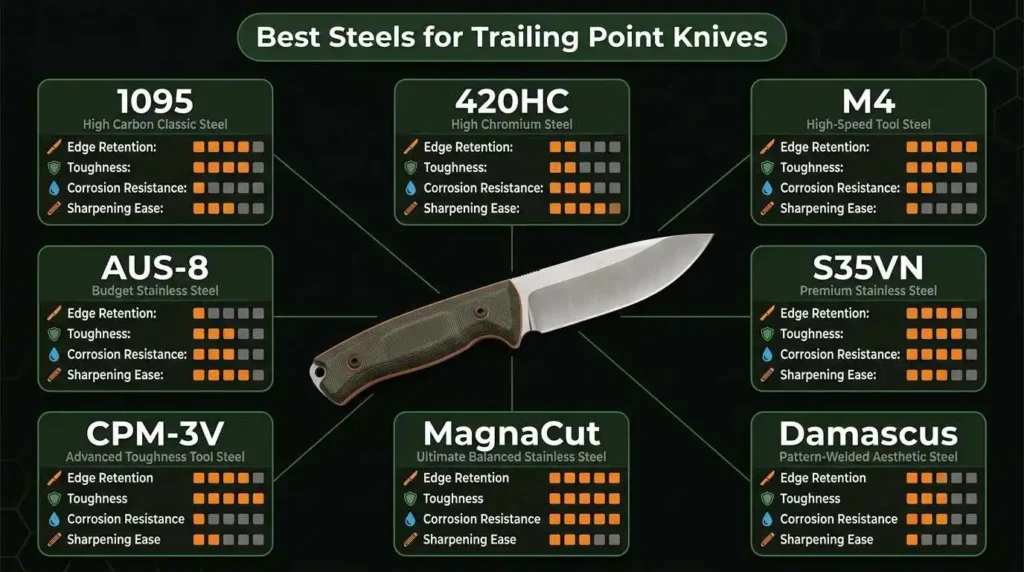
Best steels for trailing point knives comparison chart featuring 1095, 420HC, AUS-8, CPM-3V, MagnaCut, M4, S35VN, and Damascus steel with edge retention, toughness, corrosion resistance, and sharpening ratings.

Steel matters more on a trailing point than on most shapes, because the unsupported tip has little margin for error. Soft steel rounds the point off; brittle steel snaps it. The right priority order is toughness first, then edge retention, then corrosion except on fillet knives, where corrosion resistance jumps to the top because the blade lives in water.

SteelEdge RetentionToughnessCorrosionSharpeningBest ForTier
1095 (carbon)GoodExcellentPoorEasySkinners, traditional$
420HCFairGoodExcellentVery easyBudget fillet/skinner$
AUS-8GoodGoodVery goodEasyFillet knives$$
D2Very goodModerateModerateModerateAll-around skinner$$
S35VNExcellentGoodExcellentHardPremium skinner$$$
CPM 3VVery goodOutstandingModerateModerateHard-use trailing point$$$
MagnaCutExcellentExcellentExcellentModeratePremium all-purpose$$$$
Damascus (1095 + 15N20)Very goodExcellentModerateModerateHand-forged skinners$$$

1095 is the classic skinner steel tough, takes a screaming edge, patinas with use. Oil it. For fillet knives, prioritize corrosion resistance and flex: 420HC or AUS-8 in the mid-50s HRC.

CPM 3V is the safest pick if you want a trailing point that survives the occasional misuse without losing its tip. MagnaCut is the modern do-everything answer — high edge retention plus toughness and corrosion resistance; for the metallurgy, see Larrin Thomas at Knife Steel Nerds, who designed it.

Damascus. True pattern-welded Damascus (1095 + 15N20) gives high-carbon performance with layered toughness, and the long belly is where the pattern shines. See our Damascus knife guide to tell real from fake: real Damascus shows pattern into the bevel and rusts without care; fakes show pattern only on the flat (etched stainless) and never rust.

Best Steel by User Type

User TypeBest Steel Choice
Beginner420HC — forgiving, low maintenance
Angler (filleting)AUS-8 / 420HC — corrosion + flex
Hunter (skinning)S35VN / MagnaCut / Damascus — retention + toughness
Hard-use outdoorsCPM 3V — outstanding toughness
Traditional / heritage1095 — classic skinner steel
CollectorDamascus — pattern shines on the long belly

How to Choose Your Trailing Point Knife

Six questions, in order:

  1. Primary use case? Skinning, filleting, butchering, or collecting. The trailing point is a specialist match it to one job.
  2. Fixed or folding? Fixed for skinning, filleting, and butchering. Folding only if you want the look and accept the tip’s limits.
  3. Blade length? Skinner: 3.5–4.5″. Fillet: 6–9″. Cimeter: 8″+.
  4. How much flex? Stiff for skinning and butchering; flexible for filleting fish.
  5. What steel? Carbon (1095) if you’ll oil it; stainless (AUS-8, S35VN, MagnaCut) for low maintenance and wet work; Damascus for character. Prioritize toughness so the tip survives.
  6. Hand-forged or production? Production gives consistency and warranty; hand-forged gives unique craftsmanship and a belly that shows the steel, with more care required.

Common Buying Mistakes

  1. Buying a trailing point as a do-everything knife. It isn’t one. It’s a slicer. Pair it with a drop point for general tasks.
  2. Expecting the tip to handle hard work. The unsupported point is the first thing to break. If you need to pry or pierce, this is the wrong blade.
  3. Ignoring flex when buying a fillet knife. A stiff blade can’t ride the backbone. Match flex to the fish you process.
  4. Choosing carbon steel for a fillet knife. Carbon rusts fast in wet, salty conditions. Use a corrosion-resistant stainless for fish.
  5. Buying fake Damascus. Etched stainless looks the part but isn’t pattern-welded. Check for layers in the bevel.

How to Sharpen a Trailing Point Knife

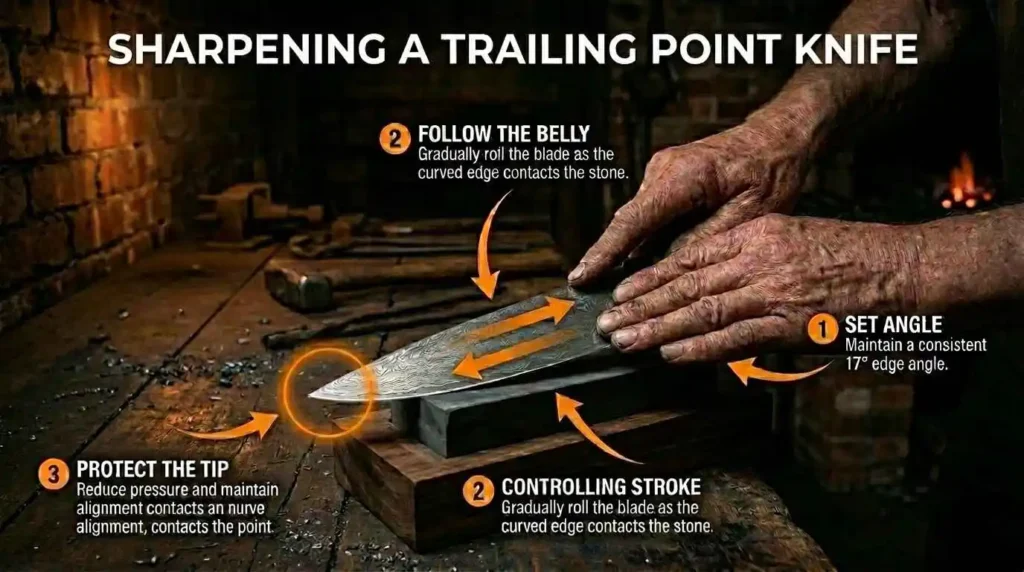
How to sharpen a trailing point knife by maintaining the correct angle, following the curved belly, controlling the sharpening stroke, and protecting the tip.

The continuous belly sweeping up into a raised tip is genuinely harder to sharpen than a straight edge — which is why so many trailing points end up with a rounded, dull point. The fix is controlling your angle through the whole curve.

  1. Set your angle. 15–20 degrees per side. Skinners and fillet blades lean toward the lower, finer end for slicing; 17° is a safe middle.
  2. Start at the heel. Hold your angle and pull the edge from the heel through the straight working section, matching strokes on each side.
  3. Roll through the belly the key step. As the edge begins to curve upward, slowly lift the handle and rotate the blade so the contact point keeps moving along the belly at the same angle. The longer belly means a longer, smoother roll than any other shape.
  4. Finish the tip with light pressure. The raised tip rounds off faster than anything else on the blade. Fewer passes, lighter touch, more rotation as the belly tightens.
  5. Support flexible fillet blades. A flexible blade flexes away from the stone and ruins your angle. Back it with a finger or use a guided system so the edge meets the abrasive cleanly.
  6. Strop to finish. Five to ten light passes per side on a leather strop with compound.

For carbon and Damascus blades, wipe dry and apply a thin coat of food-safe mineral or camellia oil when you’re done.

Knife law varies by state, county, and city, but the trailing point shape itself is almost never the legal issue blade length, fixed vs. folding, and how you carry are what matter. Most trailing points are fixed-blade skinning and fillet knives carried openly in a hunting or fishing context, which is the least restricted scenario in most places.

The American Knife & Tool Institute (AKTI) maintains a state-by-state breakdown worth checking before you carry. This is not legal advice — check your local laws before carrying any knife.

Caring for Your Trailing Point Knife

  • Clean after every use. Hide, blood, and especially fish and saltwater are corrosive. Wash with warm water and dry immediately.
  • Oil carbon and Damascus blades. A thin film of food-safe mineral or camellia oil after each use, especially for wet work.
  • Guide the tip into the sheath. The raised point catches easily roll it in rather than forcing it, and consider a kydex sheath molded to the blade.
  • Never pry or twist with the tip. It’s the single most-broken part of any trailing point. Keep it out of hard tasks entirely.
  • Store outside the sheath long-term. Leather holds moisture against the steel. Use a knife roll or display for storage.

Frequently Asked Questions (FAQs)

What is a trailing point knife used for?

Skinning, caping, filleting, butchering, and any task built around long slicing cuts. The deep belly and raised tip make it a specialist slicer rather than a general-purpose blade.

What is the benefit of a trailing point blade?

A long, deep belly that puts more cutting edge into every stroke, plus a raised tip that stays clear of the material during long slicing pulls. That’s why it dominates skinning and fillet knives.

Are trailing point knives good?

Yes — for slicing, skinning, and filleting. No, if you want one knife for prying, piercing, or hard outdoor work. It’s a specialist, and excellent at its specialty.

Why is it called a trailing point?

Because the tip “trails” higher than the spine where it leaves the handle. The upswept spine carries the point up and back, so it sits above the blade’s starting line.

Why do trailing point tips break?

The upsweep that creates the long belly does it by removing steel from behind the point, leaving the tip thin and unsupported. Pry, twist, or stab with it and it bends or snaps. Buy tough steel and keep the tip out of hard jobs.

How do you sharpen a trailing point knife?

Set 15–20° per side, sharpen the heel and flat first, then roll the blade through the belly while keeping the angle constant, and finish the raised tip with light pressure. Support flexible fillet blades so they don’t flex away from the stone.

Is a trailing point good for hunting?

Yes — for skinning and caping it’s one of the best shapes there is. For field tasks that need a strong tip, pair it with a drop point.

Is a trailing point good for EDC?

Not really. The fragile tip struggles with everyday prying and scraping. Carry it as a dedicated slicer if you love the profile, but keep a sturdier blade for hard tasks.

Is a trailing point good for self-defense?

It wasn’t designed for it. The thin tip and slicing bias make it a poor defensive choice, and blade shape matters far less than legal carry rules and training. This is not legal or tactical advice.

Is a fillet knife a trailing point?

Usually, yes. Most fillet knives use a trailing point because the long belly and raised tip are ideal for lifting skin and riding the backbone of a fish.

What knives use a trailing point blade?

Skinning knives, fillet knives, butcher’s cimeters, Nessmuk-style bushcraft skinners, and some Persian-style EDC folders. The Schrade Sharpfinger and Buck 113 Ranger are the classic production examples.

What’s the best steel for a trailing point knife?

For skinners: CPM 3V or MagnaCut for toughness, or 1095/Damascus for traditional carbon. For fillet knives: a corrosion-resistant stainless like AUS-8 or 420HC, since the blade stays wet.

What’s the difference between a trailing point and a drop point?

In one line: the drop point lowers and reinforces the tip for strength, while the trailing point raises it for a longer slicing belly.

Conclusion

The trailing point isn’t the strongest blade shape, and it isn’t the most versatile. It’s the most belly-forward, slicing-focused profile in knife-making which is why hunters skinning game, anglers filleting fish, and butchers breaking down meat keep reaching for it.

Buy it for what it does best, choose a steel that protects the tip, work off the belly instead of the point, and a trailing point will out-slice anything else in your kit. Ask it to pry and it’ll break but that was never its job.

To see where it fits among the other shapes, read the full knife blade types guide, or compare it with the drop point, clip point, and spear point.

Hawkbill Knife: What the Hooked Blade Is Actually For (and Who Should Carry One)

Most people meet a hawkbill knife and file it away as a one-trick relic. They see a blade that curves downward like a claw, decide it must be a gardening leftover, and reach for something straighter. Then they watch an electrician strip a cable in one clean pull, or a roofer score a shingle without nicking the felt beneath it, and the hooked blade suddenly looks less like a relic and more like the right tool used by people who cut for a living.

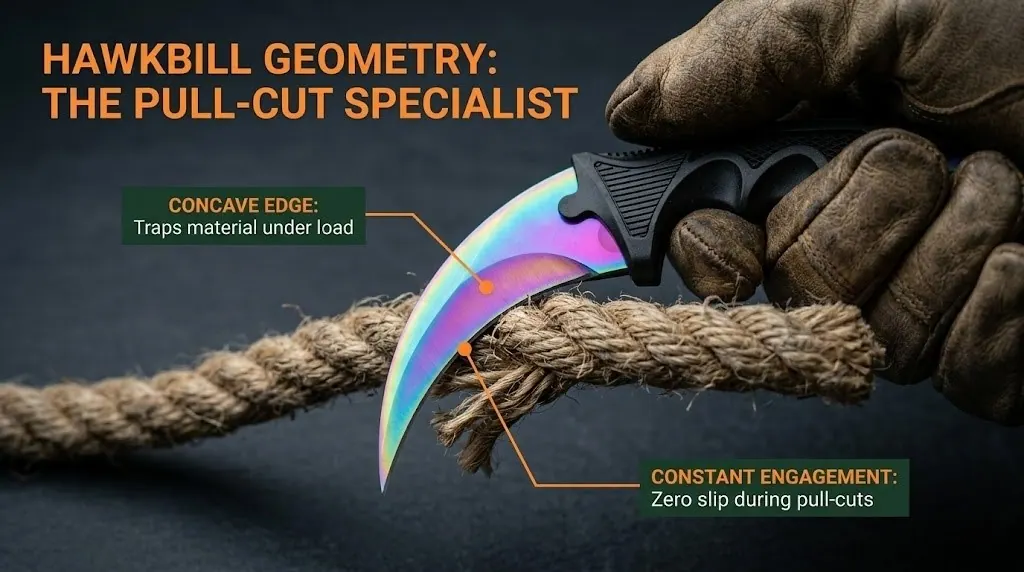
That misread happens because the hawkbill works backward from what we expect. A normal knife pushes a cut away from you. A hawkbill pulls the material into the deepest part of the curve and slices as you draw it back, so the blade bites and holds instead of skating off. Once you understand that single idea, every strength and weakness of the shape falls into place.

This guide covers the geometry, the history (including the naming mix-up almost everyone gets wrong), who actually carries one, the steel that matters, and how to sharpen the part that trips people up. For the full map of every common profile, our knife blade types pillar guide shows where the hawkbill sits in the larger family.

What Is a Hawkbill Knife?

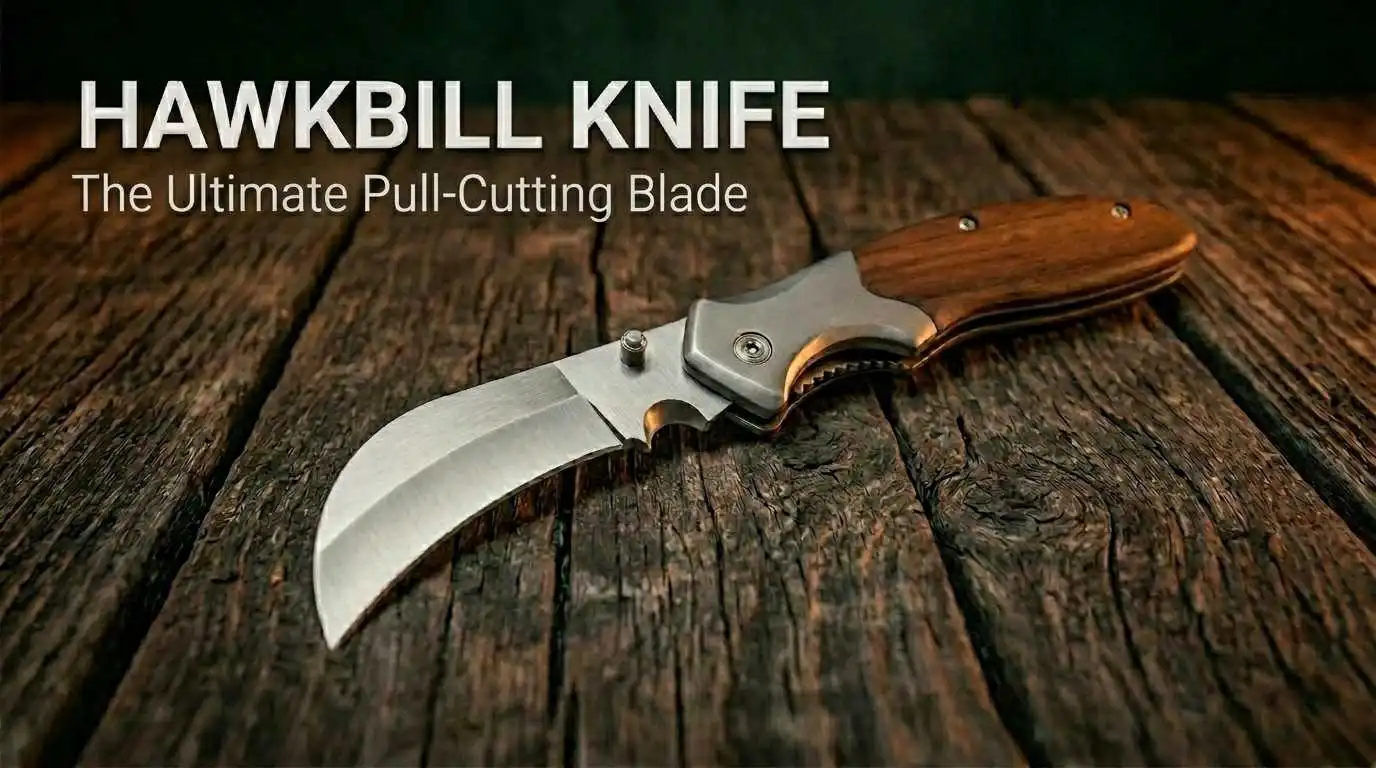
A hawkbill knife is a blade with a concave cutting edge and a downward-hooked point, shaped like the beak of a bird of prey. The edge curves inward rather than outward, so the knife cuts on the pull stroke, drawing material into the hook and slicing through it under control rather than pushing the edge forward.

That one description explains the whole tool: inward curve for biting pull-cuts, hooked tip for trapping and starting a cut, almost no flat belly for slicing on a board. Every advantage and limitation of the hawkbill blade flows from that geometry.

You will see the term written several ways across catalogs and listings: hawkbill blade, hawkbill knives, hawkbill blades, and the spaced spelling hawk bill knife. They all describe the same profile. One spelling worth flagging is hawksbill knife with an “s,” which is a common slip because the hawksbill is also a species of sea turtle. The blade has nothing to do with the turtle; it is named for a hawk’s beak. People who do not know the proper name often search for a “hook knife” or “hooked blade knife” instead, and they are all describing this same curved tool.

Hawkbill Blade Anatomy: Understanding the Hooked Geometry

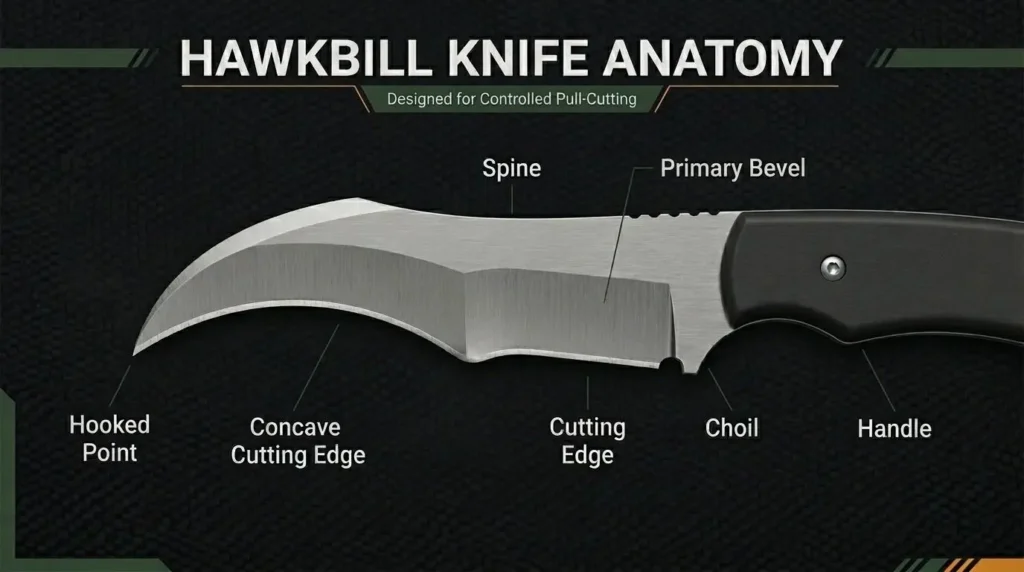
Hawkbill knife anatomy diagram showing the hooked point, concave cutting edge, cutting edge, choil, handle, spine, and primary bevel

The hawkbill blade shape comes down to a few features that set it apart from every other profile.

The concave cutting edge. The edge curves inward, like the inside of a shallow bowl. This is the heart of the design: anything you pull into it gets funneled toward the lowest point of the curve and held there while you slice, instead of sliding away the way it would off a straight or convex edge. This is what makes a hawkbill so good at cutting rope, cordage, and anything that wants to roll off a normal blade.

The hooked, downward point. The tip drops below the spine and curves back toward the edge, forming the “beak.” That hook traps material so a cut cannot escape forward, and lets you start a cut by hooking into a surface and drawing back. It also keeps the point angled away from whatever sits beyond your cut, which matters more than it sounds for trade and rescue work.

The recurve. The technical name for the inward-curving edge is a recurve. You will see the word in knife forums constantly, and it is the single most important term for understanding why a hawkbill sharpens differently from everything else. A recurve edge does not sit flat against a bench stone, and that one fact drives the entire sharpening section below.

Minimal belly. A hawkbill has almost no convex “belly,” the gentle outward curve a drop point knife uses for slicing and skinning. That is a deliberate trade: it gives up flat-surface slicing to gain biting, controlled pull-cuts.

Why It’s Called a Hawkbill (History and the Naming Mix-Up)

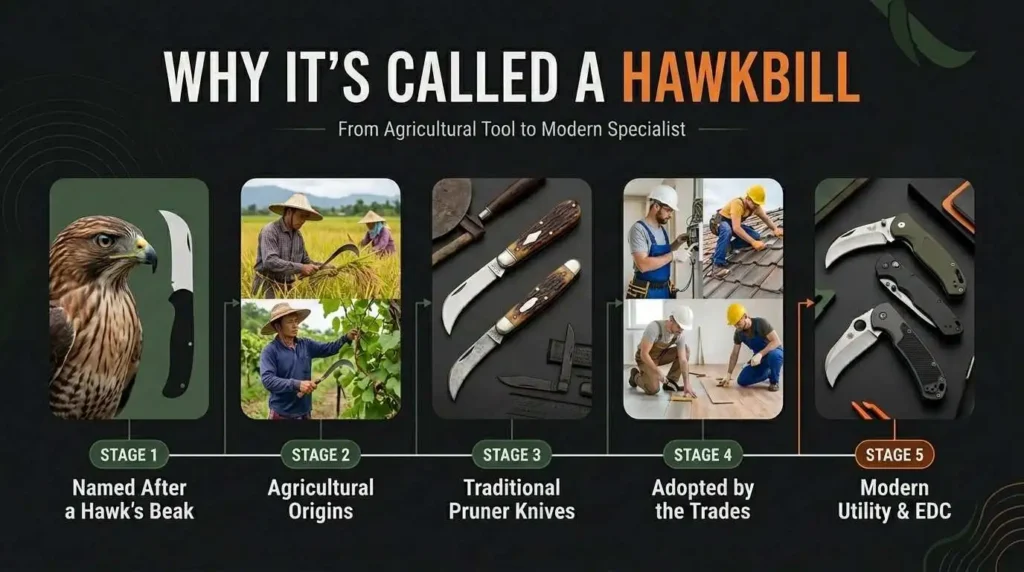
Infographic explaining why a hawkbill knife is called a hawkbill, showing its evolution from a hawk's beak-inspired design and agricultural pruning tool to a modern utility and everyday carry (EDC) knife used in various trades.

The hawkbill is named for the obvious: its profile mirrors the short, hooked beak of a hawk or other raptor. That is the whole story behind the name, and it is worth stating plainly because the spelling “hawksbill” sends people down the wrong path toward the sea turtle of the same name. They are unrelated. The blade is a hawk’s bill; the turtle is a separate animal that happens to share a hooked shape.

The shape itself is far older than the name, and its origins are agricultural. The earliest hawkbill-style blades likely emerged in Southeast Asia, where a hooked, pull-cutting edge was ideal for harvesting rice, managing vines, and pruning crops without bruising the plant. That heritage is why the hawkbill is still widely called a pruner knife or pruning knife today. The pulling cut slices cleanly through green stems while doing minimal damage to the surrounding plant, which is exactly what a gardener wants.

As the design spread to Europe and then America, traditional cutlery houses standardized it. Brands like Case, Schrade, and Remington produced hawkbill pruners on a large scale, cementing the slip-joint pruner as a recognizable American pocketknife pattern. From there the shape migrated into the trades, where electricians, roofers, and floor layers found that a blade built to pull-cut vines was just as good at pulling through insulation, shingles, and carpet. Its newest chapter is the tactical and EDC world, where designers borrowed the hook for karambit-style folders and rescue tools.

What Is a Hawkbill Knife Used For?

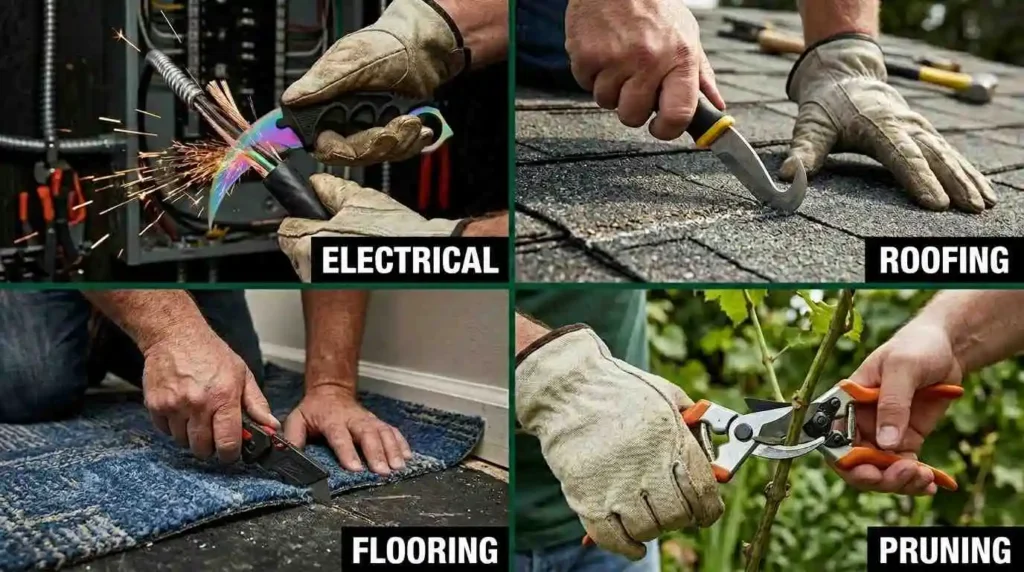
Collage showing hawkbill knife applications for electrical work, roofing, flooring installation, and garden pruning tasks

The hawkbill is a pull-cut specialist, and that makes it a favorite of people who cut the same tough materials all day. Here is where the hook genuinely outperforms.

Pruning, Gardening, and Landscaping

This is the original job, and the hawkbill still does it best. Drawing the concave edge through a stem or vine slices cleanly in one motion while the hook keeps the cut from slipping. Gardeners, landscapers, and growers reach for a hawkbill pruning knife for the same reason their ancestors did: it removes growth quickly without crushing what stays behind.

Hawkbill for Electricians

The hawkbill is one of the classic electrician’s blades. A hawkbill electrician knife strips and scores cable insulation with a controlled pull: you hook the blade under the jacket and draw it back, letting the curve cut while the downward point steers away from the conductors you are trying not to nick. That hooked tip is far safer than a straight point when you are working blind in a panel or crawlspace, because it is not pointing at your other hand. It is no accident that trade brands like Klein Tools and Milwaukee build hawkbill and slitting-blade knives specifically for linemen and electricians.

Hawkbill for Flooring and Carpet

Floor layers love the hawkbill because the hook scores carpet, vinyl, and linoleum from above without gouging the underlay or subfloor beneath. A straight blade has to be angled and tends to dive; the hawkbill’s curve lets you pull a shallow, accurate cut along a line while the point stays clear of the surface below. A dedicated hawkbill carpet knife or linoleum knife is standard issue in flooring work.

Hawkbill for Roofing

Roofers use the same logic on shingles. A hawkbill roofing knife trims asphalt shingles and underlayment with a pulling cut that slices the top layer without scoring the felt or membrane underneath, where a slip with a straight tip could mean a leak later.

Hawkbill for EDC and Utility

As an everyday carry, the hawkbill is a niche but rewarding choice. A hawkbill EDC knife or hawkbill utility knife shines at pull-heavy tasks: slicing box strapping, cutting cordage and zip ties, breaking down packaging, and opening clamshell plastic. It is not the do-everything shape a clip point knife is, but for anyone whose cutting leans toward rope, cord, and strapping rather than food or fine detail, it earns its pocket space.

Rescue and First-Responder Use

The same trait that protects an electrician’s free hand makes the hawkbill a strong rescue blade. A hawkbill rescue knife cuts seatbelts, webbing, and clothing with a pulling motion while the hooked, inward tip dramatically reduces the risk of stabbing the person being freed. Many dedicated rescue tools use a blunted hawkbill or hooked belt-cutter for this reason, sharing the safety-first logic of the blunt-tipped sheepsfoot blade while keeping more of a working point.

Marine and Fishing Use

Commercial fishermen and sailors have long favored hawkbills for cutting line, net, and webbing. The hook reaches out, snags the line, and pulls it into the cut, far easier than sawing through a taut rope with a straight edge. Paired with a rust-proof steel, it becomes a specialized marine tool.

Where It Falls Short

An honest guide says where a shape struggles, and the hawkbill struggles predictably. It is poor at piercing and stabbing, because the point curves down and away rather than driving forward. It is bad at push-cuts and slicing on a flat board, since it has no usable belly and the tip digs into the cutting surface, which rules it out as a kitchen blade. It is awkward to sharpen compared with a straight edge, as we cover below. And it is not a carving tool the way a straight, fine-pointed blade is. Match the hawkbill to pulling cuts through tough material, and pair it with a more general blade for everything else. For broad outdoor versatility, a drop point knife remains the better all-rounder.

Hawkbill Variants and Types

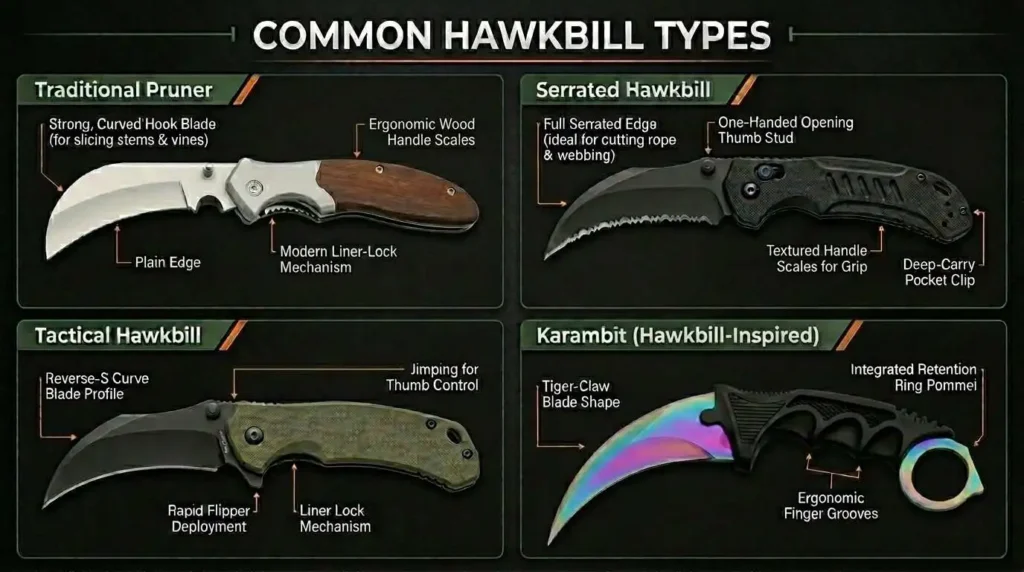
Infographic showcasing common hawkbill knife types, including traditional pruner, serrated hawkbill, tactical hawkbill, and karambit designs, with labeled features such as curved blades, locking mechanisms, ergonomic handles, pocket clips, and retention rings.

The hawkbill turns up in several distinct flavors. The traditional hawkbill pruner knife is the slip-joint pocketknife pattern handed down from Case, Schrade, and Remington, usually with nickel-silver bolsters and a single non-locking blade, still popular with gardeners and collectors.

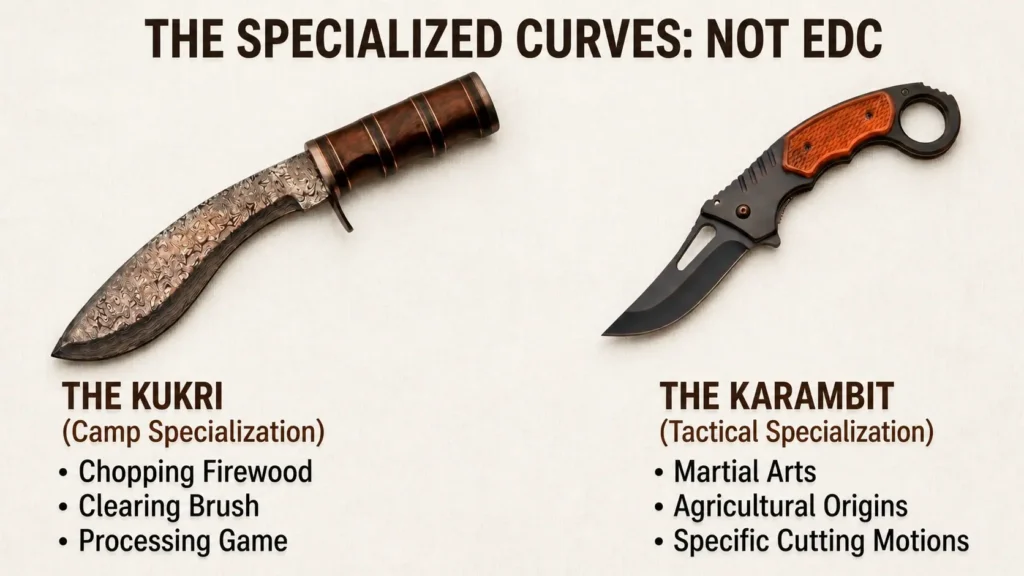
The serrated hawkbill knife marries the hook to a serrated edge, and the combination is brutally effective on rope, webbing, and fibrous material, which is why it is so common on rescue and marine knives. The karambit hawkbill is the modern tactical interpretation: add a finger ring to a hooked blade and you get a karambit-adjacent folder built for retention and control. If that hybrid is what you are after, our karambit-style folders sit closest to the hawkbill in the curved-blade family. You will also find tactical hawkbill knives, automatic and OTF hawkbills, and compact mini hawkbill folders for low-profile carry. For collectors drawn to pattern-welded steel, a damascus hawkbill or hand-forged custom pairs the hook with layered steel, and the same metallurgy rules from the steel section apply.

Notable Hawkbill Knives

A handful of designs anchor the hawkbill’s reputation and are worth knowing as reference points, though none are required to appreciate the shape. The Spyderco Harpy is the classic modern serrated hawkbill folder and the knife most responsible for keeping the pattern alive in EDC. Spyderco’s Tasman Salt builds the same hook from rust-proof H1 steel, making it a cult favorite among sailors, divers, and anglers.

On the tactical side, the CRKT Provoke brought the hawkbill into the spotlight with its kinematic deploying mechanism and karambit-style ring, designed by Joe Caswell. For traditionalists, the Case hawkbill pruner carries the original American slip-joint heritage. In the trades, Klein (the 1550 series) and Milwaukee (the 48-22 hawkbill) dominate the electrician and utility market, and for value the Honey Badger Hawkbill punches above its price. Together they map how a rice-paddy tool became a 21st-century staple.

How to Sharpen a Hawkbill Knife

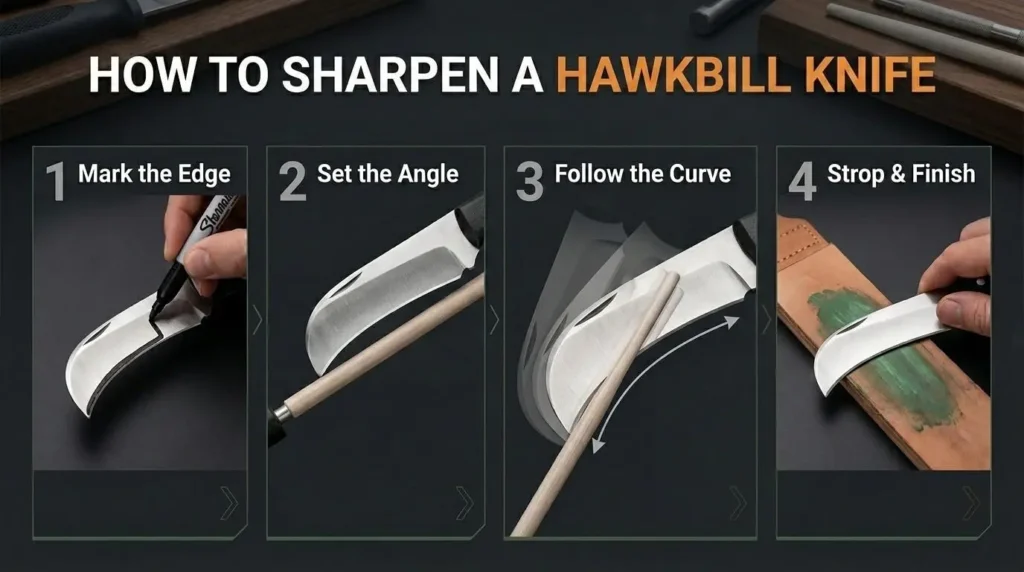
Step-by-step guide showing how to sharpen a hawkbill knife, including marking the edge, setting the sharpening angle, following the blade curve, and stropping for a sharp finish.

Here is the section nearly every other guide skips with a lazy “just sharpen it periodically.” Sharpening a hawkbill is the part that trips people up, and if you treat it like a normal knife you will make the edge worse. The reason comes back to the recurve from the anatomy section.

Why a flat stone fails. A normal blade lies flat against a bench stone and you grind the whole edge evenly. A hawkbill’s edge curves inward, so on a flat stone only the two ends of the curve touch the surface. The deepest part of the concave edge, the part doing most of your cutting, never makes contact. Push on regardless and you flatten the curve, destroy the profile, and end up with a dull blade that is no longer even a hawkbill. So no, you cannot properly sharpen a hawkbill on a flat stone alone.

What to use instead. You need a sharpener with a round or tapered profile that follows the curve into the belly of the edge: a round ceramic or diamond rod, a crock-stick or fixed-rod system (the rods on a Sharpmaker-style sharpener are ideal), or even the rounded corner of a bench stone for the deepest part. The goal is simple: keep steel in contact all the way along the concave edge, including the lowest point.

A simple step-by-step:

  1. Mark the entire bevel with a permanent marker. As you sharpen, the disappearing ink shows you exactly where you are removing steel and confirms you are reaching the deep part of the curve, not just the ends.
  2. Set your angle at roughly 20 degrees per side. Lock your wrist so the angle never drifts as you follow the curve.
  3. Start at the hook end and draw the rod (or draw the edge across the rod) following the concave curve, matching the rod to the shape of the edge so it rides down into the belly and back up.
  4. Work in smooth, even passes along the whole edge, checking that the marker is vanishing evenly from end to end, including the deepest point.
  5. Flip and repeat on the other side with the same number of strokes to keep the bevel even.
  6. Move to finer grits, then finish by stropping to remove the burr and polish the edge.

Keeping the hooked tip sharp. The inside of the hook is the trickiest spot and the easiest to neglect. Use the narrow end of a tapered rod or the tip of a ceramic stick to get right into the curve of the beak, and go gently. The tip is the thinnest part of the blade, so light pressure beats aggressive grinding, which rounds the point and dulls the very part that does your hooking cuts. Finish each session by carefully touching up the inside of the hook, and your hawkbill will stay sharp where it counts.

Steel Selection for Hawkbill Knives

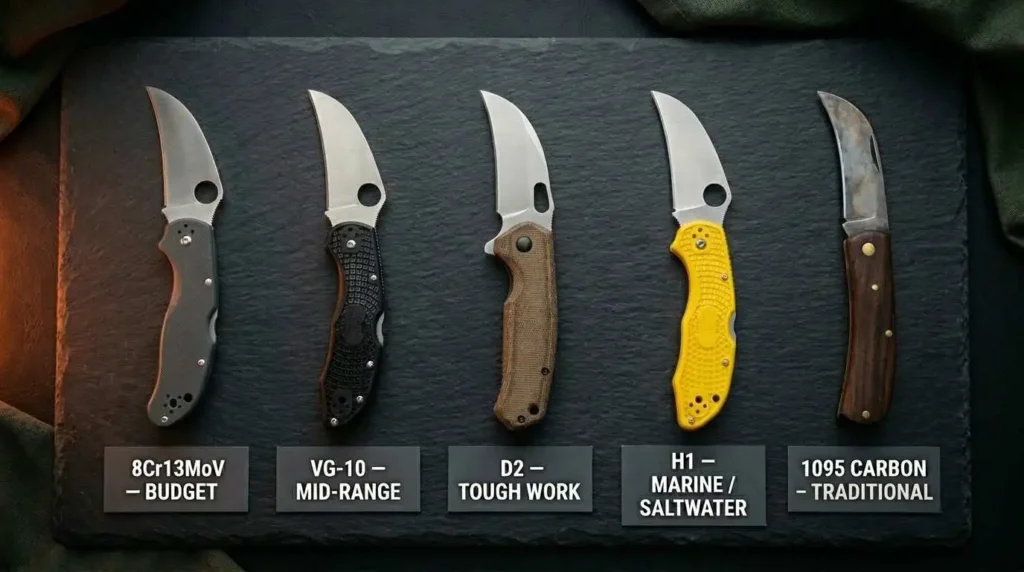
Comparison of popular knife steels including 8Cr13MoV, VG-10, D2, H1, and 1095 carbon steel, highlighting budget, mid-range, tough work, saltwater, and traditional knife applications.

The right steel for a hawkbill depends on the same trade-off as any blade, with one extra factor: because so many hawkbills live in wet environments (marine work, plumbing, outdoor trades), corrosion resistance often matters more than usual.

Stainless steels are the common choice. Budget hawkbills usually run 8Cr13MoV or AUS-8, which sharpen easily and resist rust well enough for daily work. Step up and you find VG-10, 440C, and D2 (a semi-stainless tool steel), offering better edge retention for a blade that cuts abrasive material like rope and carpet all day. For genuine saltwater duty, H1 steel is nearly rust-proof, which is why the Tasman Salt is so popular with anglers and divers. Carbon steels like 1095 take a keen edge and resharpen easily, suiting traditional pruners, but they demand care to prevent rust. For pattern-welded blades, a damascus hawkbill pairs the hook with striking layered steel; our Damascus steel knife guide explains what the layering does and does not do for performance. Whatever the steel, most working hawkbills sit around 56 to 60 HRC.

Are Hawkbill Knives Legal?

In most places, a knife’s legality comes down to its mechanism and blade length, not its blade shape. A folding, non-locking hawkbill utility knife with a short blade is treated like any other folder and is generally unremarkable to carry, which is why they are standard issue in trades across the country.

The wrinkle with the hawkbill is perception rather than statute. Because the hooked, claw-like profile looks aggressive, and because karambit-style hawkbills are marketed for self-defense, some people assume the shape itself is restricted. It usually is not, but an intimidating-looking knife can draw more scrutiny. Fixed-blade hawkbills and anything with an automatic or assisted opening face the same rules any fixed or auto blade would.

The practical takeaway: judge legality by your local rules on length, locking, and opening mechanism, not by the word “hawkbill.” Knife laws vary widely by country, state, and even city, so this is general information rather than legal advice. The American Knife & Tool Institute keeps a useful, regularly updated state-by-state knife law resource that is a good starting point before you carry.

Hawkbill vs Other Blade Shapes

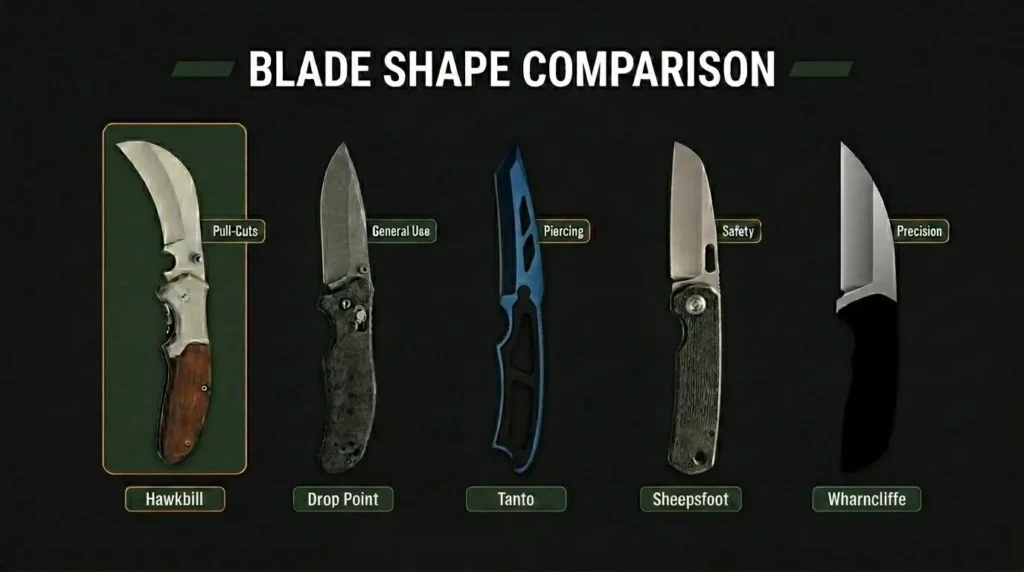
Infographic comparing popular knife blade shapes including hawkbill, drop point, tanto, sheepsfoot, and wharncliffe. The chart highlights each blade's primary use, such as pull cutting, general utility, piercing, safety cutting, and precision tasks.

Quick orientation against the shapes people most often line up against the hawkbill. We are building dedicated head-to-head guides for these, but here is the short version.

Hawkbill vs karambit: the closest relatives. Both use a curved, hooked blade, but a true karambit adds a finger ring for retention and is built around defensive and tactical use, while the hawkbill is fundamentally a utility pull-cutter. Plenty of modern knives blur the line; browse the karambit-style folders to see the overlap.

Hawkbill vs wharncliffe: opposite philosophies of control. The hawkbill curves inward to bite and pull; the wharncliffe runs dead straight for push-cuts and detail. One traps material, the other slices flat.

Hawkbill vs drop point: specialist versus generalist. The drop point has a belly for slicing, skinning, and all-round outdoor work; the hawkbill trades all of that for biting pull-cuts.

Hawkbill vs tanto: the hawkbill point curves down and away for safe pulling, while the tanto drives a strong, reinforced point forward for piercing hard material. Almost mirror-image priorities.

Hawkbill vs sheepsfoot: both keep the point away from harm, but the sheepsfoot does it with a straight edge and a blunt nose, while the hawkbill does it with a concave edge and a hook.

Serrated vs plain hawkbill: serrations boost a hawkbill’s already strong grip on rope and webbing at the cost of harder sharpening; a plain edge is cleaner and easier to maintain. A dedicated comparison is coming.

If you want to see every profile side by side, including the spear point and the rest, head back to the knife blade types guide.

Hawkbill Knife Pros and Cons

No shape wins every job, and the hawkbill trades honestly. On the positive side: outstanding control on pulling cuts, a hooked tip that traps material and starts cuts effortlessly, exceptional performance on rope, cordage, carpet, and insulation, a safer point for working blind or freeing a person, and a genuinely specialized edge for trade and marine work.

On the negative side: poor at piercing and push-cuts, useless on a flat cutting board, no slicing belly, more awkward to sharpen than any straight edge, an aggressive look that can draw scrutiny, and a narrow range of jobs that makes it a poor only-knife.

Frequently Asked Questions

Are hawkbill knives good?

Yes, for the right user. If your cutting leans toward rope, cordage, cable, carpet, or pruning, the hawkbill’s pulling cut outperforms almost any other shape. It is the wrong pick only if you need a do-everything blade for food prep, skinning, or piercing.

What is a hawkbill knife used for?

Pull-cutting tough material: pruning, stripping electrical cable, scoring carpet and linoleum, trimming shingles, cutting rope and netting, and rescue cutting of seatbelts and clothing. The concave edge draws material in, and the hooked tip keeps the cut from slipping forward.

Why is it called a hawkbill knife?

Because the curved, downward-hooked blade resembles the beak of a hawk. The “hawksbill” spelling with an “s” is a common mix-up with the sea turtle of that name, but the two are unrelated; the knife is simply a hawk’s bill.

Can you sharpen a hawkbill on a regular stone?

Not properly. The concave edge only touches a flat stone at its ends, leaving the deepest part of the curve untouched and slowly flattening the profile. Use a round or tapered rod, a crock-stick system, or the rounded corner of a stone so the sharpener can follow the curve all the way into the belly of the edge.

Is a hawkbill knife good for self-defense?

The hooked blade has a slashing reputation because the curve pulls material into the cut, and some karambit-style hawkbills are marketed for defensive use. That said, this is a sensitive and heavily regulated area; carry laws differ everywhere, and capability is no substitute for training and legality. Treat any defensive use as a serious decision and confirm your local law first.

Are hawkbill knives legal?

In most places, yes. Legality depends on blade length, locking, and opening mechanism rather than the shape itself, so a short, non-locking folding hawkbill is generally unremarkable to carry. Fixed blades and automatics follow the same rules as any fixed or auto knife, and a few jurisdictions regulate specific styles, so always check your local rules first.

Final Take

The hawkbill is not a gardening relic that wandered into the modern world by accident. It is a purpose-built pull-cutter that does one motion better than any straight blade: hooking material, drawing it into a concave edge, and slicing through under complete control. That is wasted on a hunter and perfect for an electrician, a roofer, a floor layer, a sailor, or anyone whose day is full of rope, cable, and tough fibrous material.

Carry one if your cutting lives on the pull stroke, sharpen it with a rod that follows the curve instead of a flat stone, and pick a steel that matches how wet and abrasive your work gets. Used for what it was built to do, the hawkbill is one of the most quietly capable shapes you can put in your pocket. For the full lineup of profiles, head back to our knife blade types guide.

Spear Point Knife: The Blade Built to Pierce Without Giving Up the Cut

A spear point blade is one of the oldest ideas in edged tools, and one of the most misunderstood on the modern knife counter. People see the symmetrical, centered tip and assume one of two things: either it is a dagger they cannot carry, or it is a generic “pointy knife” with no real specialty. Both miss what the shape is actually built to do.

The spear point exists to solve a specific problem: how do you get a strong, controllable piercing tip without throwing away your ability to slice? Most tip-heavy designs sacrifice the cutting edge to get the point. The spear point refuses that trade-off, it puts the tip dead-center on the blade’s long axis so force drives straight through, then keeps just enough belly to do real cutting work.

This guide covers the geometry, the single-edge versus double-edge question that decides whether your knife is legal, the history from ancient spearheads to the Swiss Army Knife, the steels that matter, and how to sharpen a symmetrical edge. For the bigger picture across every common profile, our knife blade types pillar guide maps where the spear point sits in the larger family.

Quick Answer: A spear point knife has a symmetrical blade with the tip aligned to the centerline, where the spine and edge slope toward the point at matching angles. It is best for piercing, thrusting, throwing, and balanced EDC tasks because it combines a strong, controllable tip with enough belly for everyday slicing.

What Is a Spear Point Blade?

A spear point blade is a symmetrical profile where the tip sits exactly on the centerline of the blade’s long axis, with the spine and the cutting edge rising and falling at matching angles to meet at that point. The tip lines up with the middle of the blade, not above it like a clip point or below it like a drop point.

That symmetry is the whole spear point blade shape, and everything the design does well comes from it. Because the point is centered, force travels straight down the spine and out through the tip with nothing pulling it off-axis, an excellent piercing and thrusting geometry. At the same time, the lower edge keeps a small belly, so the knife can still slice, score, and handle ordinary cutting jobs.You will see the name written two ways: spear point and the one-word spearpoint. They mean the same thing. “Spear point” describes where the tip sits, not how many edges are sharpened, a detail that matters enormously, and one we get to next.

Spear Point Blade Anatomy: Understanding the Geometry

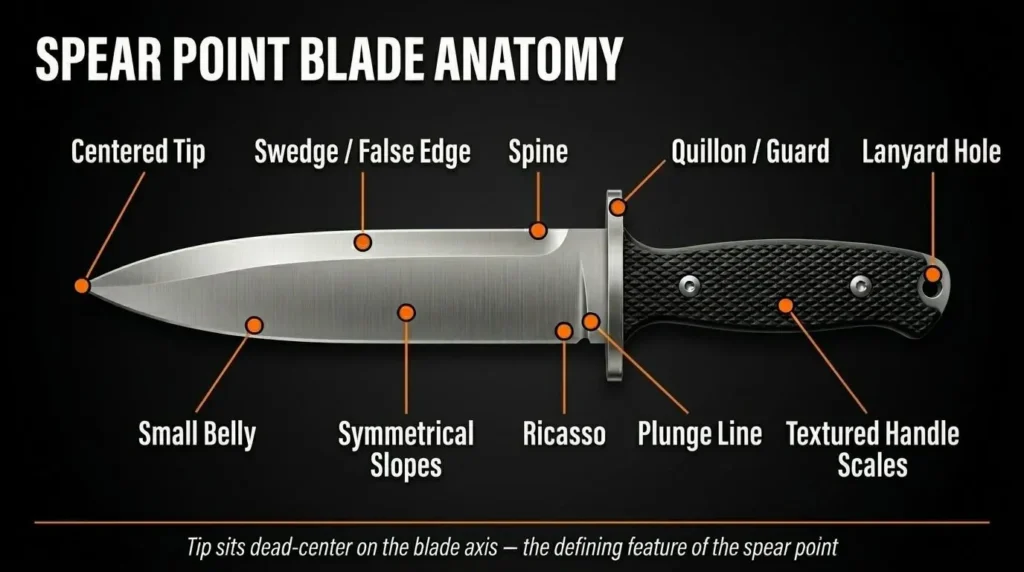
Spear point blade anatomy infographic showing centered tip, swedge false edge, spine, quillon guard, ricasso, plunge line, textured handle scales, lanyard hole, and symmetrical blade geometry on a tactical fixed blade knife.

The spear point blade is defined by a few features that set it apart.

The centered tip. The point sits on the blade’s central axis, halfway between spine and edge. A drop point lowers the tip below the spine; a clip point raises it; the spear point puts it dead center. That alignment gives the design its straight-line piercing strength and its natural, controllable feel.

The symmetrical slopes. The spine curves down and the edge curves up to meet at the tip, mirroring each other, which is what makes the profile look like a spearhead and behave like a thrusting tool.

The small belly. Below the tip, the edge keeps a modest curved section: smaller than the deep belly on a drop point or skinner, but enough for slicing and general cutting. Its size is the main thing that varies between one spear point and another.

The swedge or second edge. The top slope is often ground thin. Left unsharpened, it is a swedge (or false edge) that lightens the tip and improves penetration. Sharpened, the knife becomes double-edged, and the legal and practical picture changes completely.

It is a profile engineered to drive a strong tip straight into a target while keeping just enough edge to remain a useful cutter.

Single-Edge vs Double-Edge Spear Points

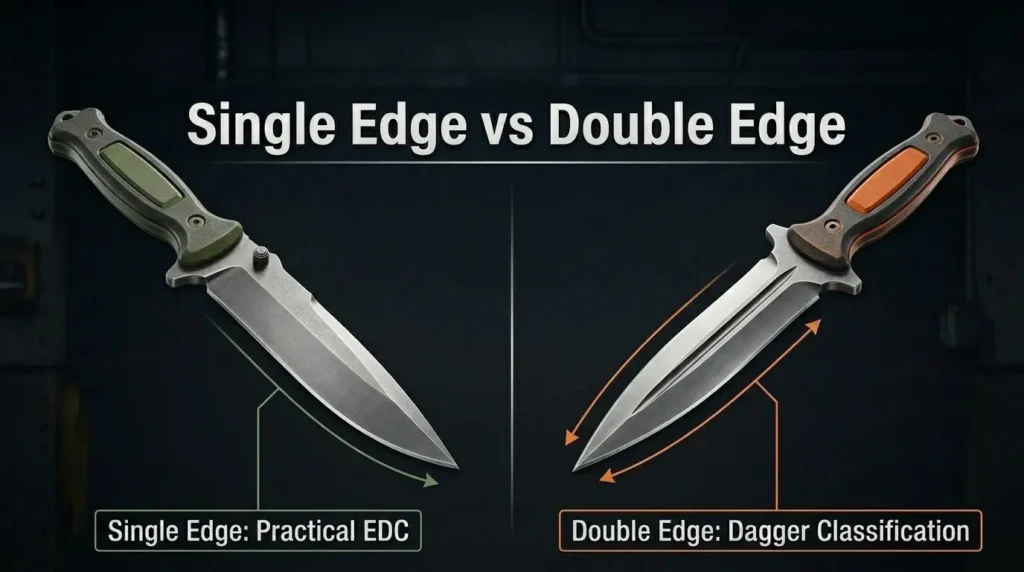
Educational comparison graphic showing single edge vs double edge spear point knives, highlighting practical EDC single-edge blade design versus double-edge dagger classification with labeled blade anatomy differences.

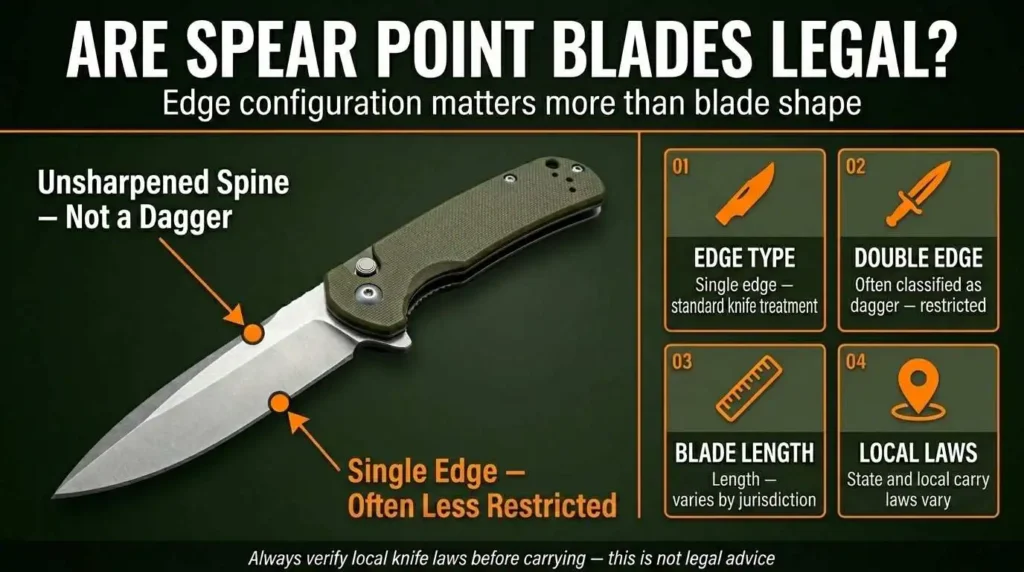
This is the section most blade guides skip, and the single most important thing to understand before you buy a spear point. A spear point is a shape, it says nothing about how many edges are sharpened. The same symmetrical profile is built two completely different ways.

Single-edge spear point. One sharpened edge along the bottom, the top slope left as an unsharpened swedge. This is the practical, everyday version. It still pierces well because the tip is centered and the spine is thinned, but it behaves like a normal working knife: you can rest a thumb on the spine for control, and in most places it carries the same legal status as any single-edged blade. The main blade on a classic Swiss Army Knife is a single-edge spear point, which tells you how useful the shape is for ordinary tasks.

Double-edge spear point. Both slopes sharpened, giving two cutting edges that meet at the centered tip. It cuts on the draw and the push and pierces aggressively. It is also, in many jurisdictions, the point at which a spear point legally becomes a dagger. That is the whole fork in the road. For EDC, utility, camping, or kitchen work, you almost certainly want the single-edge version. If you are drawn to the double-edge version, understand the legal picture first, the second edge is what triggers most knife restrictions.

Is a Spear Point the Same as a Dagger?

Not exactly, and the distinction trips up a lot of buyers. A dagger is a symmetrical, double-edged blade built primarily for thrusting, often with little or no usable belly. A spear point is a shape defined by its centered tip and matching slopes. The overlap is real: a double-edged spear point with a slim profile is essentially a dagger, and many daggers are spear points by geometry.

The practical difference comes down to that second edge. A single-edge spear point with a working belly (a Swiss Army Knife blade, a modern EDC folder) is a knife in every ordinary sense and is treated as one. A fully double-edged spear point with a slim profile and minimal belly is a dagger, regulated accordingly in many regions.

So the honest answer: a spear point can be a dagger, but most sold for everyday use are not. The shape is the family; the dagger is one branch of it. For a full breakdown, see our spear point vs dagger comparison (coming soon).

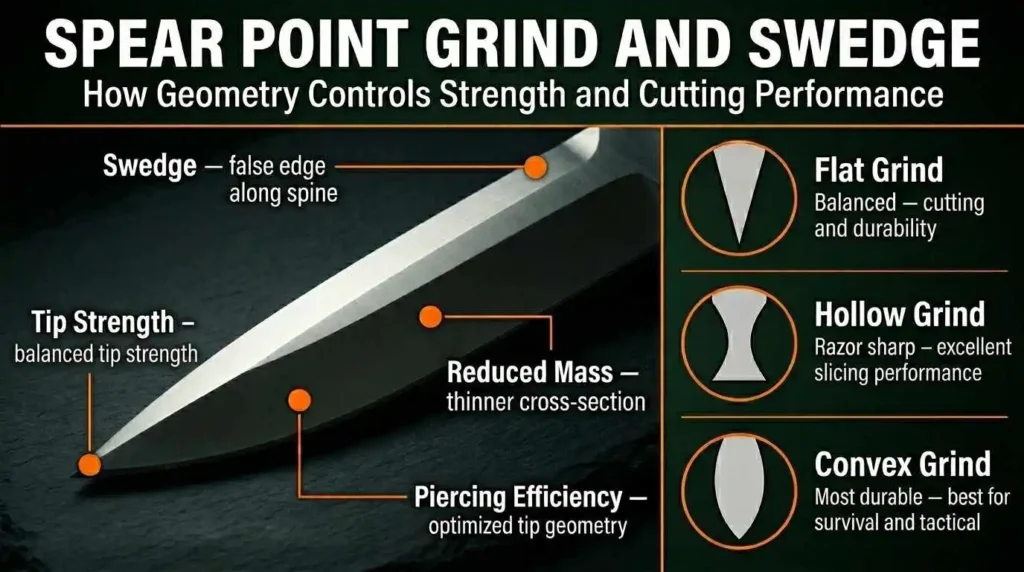
Spear Point Grind and Swedge

Spear point grind and swedge infographic showing false edge swedge, tip strength, piercing efficiency, reduced mass, and comparison of flat grind, hollow grind, and convex grind blade geometry for knife performance.

The profile is only half the story. The grind decides how the spear point cuts and how much tip strength that centered point really has.

The swedge. The top slope is frequently ground down to thin the spine as it nears the tip. Left unsharpened, this swedge reduces mass behind the point and helps the blade penetrate more easily, without removing strength lower down the spine. Makers like Rick Hinderer build a signature top swedge into their spear point designs for exactly this reason: better piercing, tough tip. It is one of the most under-explained features on the shape, and one of the most functional.

Grind type. A flat grind is most common on quality working spear points, balancing edge strength and slicing. A hollow grind thins the edge for a keener cut but leaves the tip more fragile, a real concern on a blade built around piercing. A convex grind gives the most durable geometry behind the point but is harder to sharpen freehand. A spear point with a thinned swedge and a flat grind is the versatile, do-everything build.

Spear Point Blade History

The name is as literal as it gets. The shape descends directly from the spearhead, one of humanity’s oldest tools. A spearhead is symmetrical for a reason: a point on the centerline drives straight and true when thrust. Scaled down onto a knife blade, that geometry became the spear point. Through antiquity and the medieval period the symmetrical, double-edged blade was everywhere, from short thrusting weapons to the daggers carried alongside swords. Only later, as restrictive knife laws spread and everyday needs shifted toward utility over combat, did the double-edged version fall out of common carry and the single-edge spear point become the practical survivor.

That survivor shows up in one place almost everyone has handled: the main blade of a traditional Swiss Army Knife is a spear point, and on slip-joint pocketknives the same small symmetrical blade is known as a pen blade, named for the days it trimmed quill pens. That hand-forging tradition survives in custom shops producing pattern-welded steel, the same craft documented by the American Bladesmith Society, where a centered tip and mirrored grinds are still forged by hand.

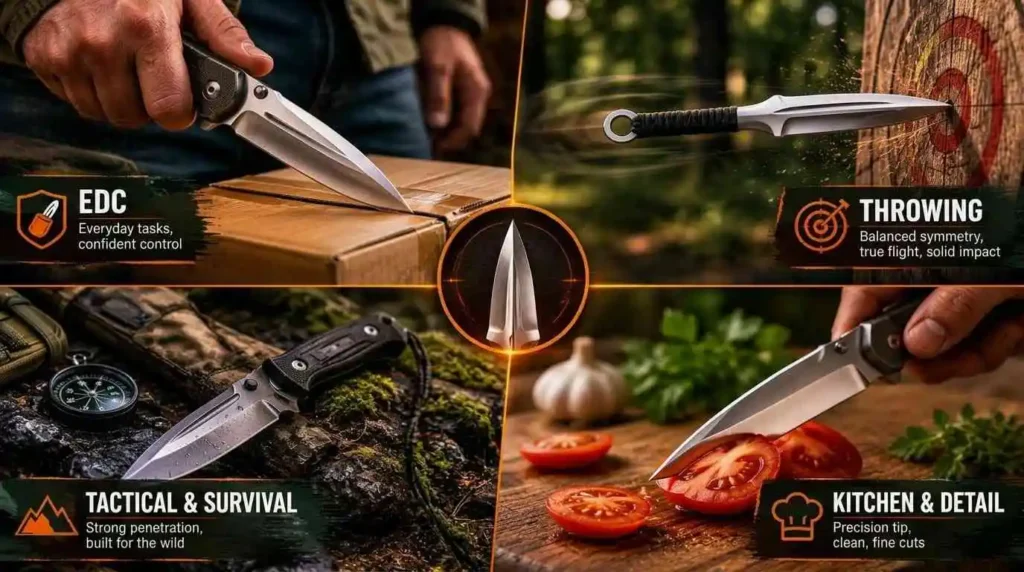
What Is a Spear Point Blade Used For?

Educational spear point knife use cases infographic showing EDC tasks, knife throwing, tactical survival applications, and precision kitchen cutting to highlight spear point blade versatility and practical performance.

The centered tip and symmetrical profile make the spear point one of the better blade shapes for tasks that reward a strong, precise point without abandoning the cutting edge. Here is how it breaks down by user.

Spear Point for EDC

For everyday carry, a single-edge spear point is a strong all-rounder. The centered tip gives confident piercing for boxes, blister packs, and zip ties, and the small belly handles slicing and food tasks. Because the point sits on the centerline, the knife indexes intuitively and fine tip work feels controlled. A small or mini spear point folder makes an easy, unintimidating pocket knife, a capable do-everything EDC blade, if not the deepest slicer in the drawer.

Spear Point Throwing Knives

This is where the geometry is not just useful but ideal. A throwing knife needs to rotate predictably and strike point-first despite small inconsistencies in the throw, and symmetry makes that possible. With the tip on the centerline and weight distributed evenly around it, a spear point throwing knife flies true and bites reliably, which is why a huge share of dedicated throwing knives use this profile. If throwing is your interest, the spear point is the default answer.

Spear Point for Hunting, Tactical, and Survival

A spear point can serve as a hunting knife, with caveats: the strong centered tip pierces well, but for skinning and field-dressing a deep belly is what keeps the edge on the hide, so a drop point knife out-skins it, and a double-edged spear point is a liability near a hide or gut cavity. Where the shape truly shines is tactical and survival use. A spear point fixed blade gives straight-line penetration and a tough, controllable tip, with a long history in boot knives, dive knives, and combat blades. For a spear point camping or survival knife, the single-edge build keeps your options open, the piercing tip plus a spine you can rest a hand on, while a double-edged version sacrifices batoning and any task needing spine pressure.

Spear Point in the Kitchen and for Self-Defense

A spear point paring knife is a smaller but real niche, using the precise centered tip for peeling, trimming, coring, and detail work while the modest belly handles fine slicing. It manages light whittling too, though a single-edge build is essential there, since you cannot safely brace a thumb on a sharpened spine. As for self-defense: the shape’s reputation comes from its spearhead ancestry, and double-edged versions cut on both push and draw. But capability and legality are different questions, and double-edged blades carry real legal weight. Before considering any blade for self-defense, understand your local laws and the legal section below, and treat carry as a personal responsibility.

Spear Point Variations You Should Know

“Spear point” is a family, not a single shape. Beyond the single-edge and double-edge builds covered above, a few variants are worth knowing:

  • Modified spear point. Production tweaks: a slightly raised or lowered tip, a longer swedge, or a deeper belly to improve slicing.
  • Pen blade. A small spear point used as the primary or secondary blade on slip-joint and multi-tool knives. Compact, friendly, genuinely useful for light tasks.
  • Needle point. A close relative, not the same thing. It narrows to a much finer, sharper, weaker tip built purely for piercing; a spear point keeps more steel behind the point for a stronger, more durable tip. Needle point is the specialist piercer, spear point the balanced one.

Damascus and Hand-Forged Spear Points

The spear point’s mirrored geometry is a natural showcase for pattern-welded steel. Because both slopes are visible and symmetrical, the flowing layers of a hand-forged Damascus blade read cleanly across the whole profile, and the centered tip becomes a focal point for the pattern. A hand-forged Damascus spear point pairs the shape’s straight-line strength with the edge-holding and toughness of layered high-carbon construction.

A true Damascus spear point is forged, not etched: alternating layers of high-carbon and nickel steel folded so the pattern runs all the way through the blade. To tell real from fake before buying any patterned blade, our complete guide to Damascus steel knives walks through the honest tests, and our Damascus knife collection shows what hand-layered steel looks like across working profiles.

Steel Selection for Spear Point Knives

Knife steel selection infographic comparing Damascus 15N20, D2 tool steel, 154CM 14C28N, and premium S30V S35VN M390 steels, highlighting edge retention, stainless balance, heat treatment, and blade performance characteristics.

Because the spear point lives and dies by its tip, steel choice matters more than on a forgiving, deep-bellied blade. A thin, centered point under stress wants steel that resists chipping and holds an edge.

  • High-carbon (1095, and the 1095 / 15N20 pairing in Damascus). Tough, takes a screaming edge, easy to resharpen, needs care against rust. The classic forged-blade choice.
  • D2. Semi-stainless tool steel with excellent edge retention and good toughness, a popular middle ground.
  • 154CM and 14C28N. Stainless steels balancing sharpness, edge retention, and corrosion resistance, common on quality production spear points.
  • Premium stainless (S30V, S35VN, M390-class). Outstanding edge retention for users who want to sharpen less often.

Prioritize toughness and edge retention so the tip survives the piercing work the shape is built for. Heat treatment and hardness (HRC) matter as much as the alloy name.

How to Sharpen a Spear Point Knife

Sharpening a spear point is straightforward once you account for its symmetry, with one wrinkle most guides ignore: on a double-edged spear point you maintain two edges that meet at the tip, and both must stay consistent or the point drifts off-center.

Set your edge angle. Most spear points sharpen well at roughly 17 to 20 degrees per side, slightly more obtuse for a hard-use piercing blade, slightly more acute for a fine slicer.

Work the edge in zones, and match both sides. Maintain your angle through the straight section near the heel, then sweep up through the curved belly so the tip gets the same attention. Because the profile is symmetrical, alternate sides evenly with the same stroke count; uneven sharpening pushes the centered tip off-axis and ruins the very thing that makes the shape work.

Mind the swedge or second edge. On a single-edge spear point, leave the unsharpened swedge alone. On a double-edge spear point, sharpen the top edge to match the bottom so both meet cleanly at the point.

Protect the tip. Finish with light, edge-trailing strokes and avoid heavy pressure right at the point, where thin steel rounds off easily. A regular bench stone handles a spear point fine; the discipline is consistency, not special tools.

Spear point blade legality infographic explaining single edge knife laws, unsharpened spine design, blade length restrictions, edge configuration, and local carry laws for legal spear point folding knives.

This is the part of the spear point story that genuinely matters, and the part most guides wave away in a single line.

The shape itself, a centered tip with symmetrical slopes, is not what regulations target. What gets regulated is the second edge. A single-edge spear point is, in most places, treated like any other single-edged knife and judged by ordinary blade-length and carry rules. A double-edged spear point is frequently classified as a dagger or dirk, and double-edged blades face the tightest restrictions: some jurisdictions limit them, some ban concealed carry, some prohibit them outright. The same shape can be legal in one build and restricted in another, depending on whether both edges are sharpened, blade length, and where you are. Automatic and out-the-front mechanisms add another layer of rules.

We are not lawyers, and this is not legal advice. Knife laws vary widely by country, state, and even city, and they change. Before you carry any spear point, especially a double-edged one, check your local statutes. Our responsible ownership and legal compliance page covers the principles, and for jurisdiction-specific rules a resource like Knife Up’s state-by-state knife law overview is a useful starting point.

Spear Point vs Other Blade Shapes

Knife blade shape comparison infographic showing spear point, drop point, clip point, tanto, and needle point blade profiles for understanding blade geometry, design differences, and practical knife uses.

The full head-to-head breakdowns are getting their own dedicated comparison guides. Here is the short version with links to where those deep dives live.

  • Spear point vs drop point. A drop point lowers the tip and adds a deep slicing belly; the spear point centers the tip for straighter piercing and keeps less belly. Drop point for hunting and slicing, spear point for piercing and balance. Full spear point vs drop point comparison coming soon.
  • Spear point vs clip point. A clip point raises and thins the tip for fast, fine piercing; the spear point’s centered tip is stronger and symmetrical. Breakdown coming soon.
  • Spear point vs tanto. A tanto puts a reinforced angular tip ahead of a straight edge for hard-target piercing with little belly; the spear point pierces with more finesse and keeps a usable belly. Coming soon.
  • Spear point vs needle point. Same family: needle point is a finer, weaker, pure-piercing tip; the spear point keeps more steel behind the point. Guide coming soon.
  • Spear point vs sheepsfoot. Opposite philosophies, the sheepsfoot removes the point for control; the spear point is all about it. Coming soon.
  • Spear point vs wharncliffe. The wharncliffe is a straight-edge precision slicer with a low, fine tip; the spear point is a centered piercer. Coming soon.

Spear Point Blade Pros and Cons (Advantages and Disadvantages)

ProsCons
Strong, centered tip drives straight for piercingSmaller belly than a drop point limits long slicing
Symmetrical balance feels natural and controllableDouble-edge versions can’t choke up on the spine
Excellent for throwing thanks to even weightThin, fine tip can chip under prying or hard use
Single-edge build keeps it legally simple in most areasDouble-edge build triggers dagger restrictions
Versatile EDC: pierces well, still slicesNot the best skinner or dedicated detail blade
Showcases hand-forged Damascus patterns beautifullyRarely the single best tool at any one task

Frequently Asked Questions

What is a spear point knife good for?

A spear point knife is good for piercing, thrusting, throwing, fine tip work, and balanced everyday carry. The centered tip drives straight and stays controllable, while the small belly handles ordinary slicing and light food prep. It is a strong all-rounder rather than a specialist.

Are spear point knives good?

Yes, for the right user. They offer a strong, precise piercing tip, a naturally balanced feel because the point sits on the centerline, and real versatility, since a single-edge spear point both pierces and slices. They are less ideal if your main job is skinning or deep slicing, where a drop point wins.

Why is it called a spear point?

Because the shape mirrors a spearhead: symmetrical, with the tip centered on the long axis so force drives straight through on a thrust. When that ancient geometry was scaled down onto a knife, the name came with it.

Is a spear point blade legal?

A single-edge spear point is generally treated like any other single-edged knife. A double-edged spear point is often classified as a dagger and faces tighter restrictions. Laws vary by location and change, so always check your local statutes before carrying one.

Can you baton with a spear point?

A single-edge spear point can handle light batoning since you have an unsharpened spine to strike. A double-edged spear point is a poor choice because both edges are sharp with no safe spine to hammer. For serious batoning, a sturdy single-edge fixed blade is better.

Is a spear point good for skinning?

It can skin, but it is not the best choice. Skinning rewards a deep, continuous belly that stays on the hide through long draws, the drop point’s strength. A spear point’s smaller belly and centered tip make accidental punctures more likely near a hide or gut cavity.

Final Take

The spear point is one of the most honest shapes on the knife rack, as long as you understand what it is. It is not a watered-down dagger or a generic pointy blade; it is a deliberate balance: a centered, strong tip for piercing and throwing, paired with just enough belly to stay a real cutter. Get the single-edge version and you have a versatile, legally straightforward EDC blade with a tip you can trust; the double-edge version is a specialist piercing tool that comes with real legal homework. If you value a straight-driving tip and a knife that feels balanced in the hand, the spear point belongs on your shortlist. If your day is mostly slicing, skinning, or detail cutting, one of its siblings will serve you better, and the knife blade types pillar guide will point you to the right one.

Wharncliffe Knife: What the Straight Edge Is Actually For (and Who Should Carry One)

Most people meet the wharncliffe blade and quietly write it off. They see a knife with no belly, a spine that ramps straight down to the point, and they assume something is missing. Then they spend an afternoon trimming leather, scoring drywall on a flat bench, or making a long, dead-straight cut that any curved blade would have wandered off, and the wharncliffe suddenly makes complete sense.

That misread happens because most guides describe the shape in a sentence and move on. The wharncliffe is not a knife with the curve sanded off. It is a deliberate piece of geometry built around one idea: a perfectly straight edge that puts every millimeter of steel in contact with your work, with a fine point for detail and almost no risk of the edge rolling away mid-cut. Once you see what that trade buys, the shape stops looking incomplete and starts looking purpose-built.

This guide covers the geometry, the genuine history (including the naming argument nobody settles), who actually carries one, the steel that matters, how to sharpen the one tricky part, and where the wharncliffe earns its keep versus where it does not. For the full map of every common shape, our knife blade types pillar guide shows where the wharncliffe sits in the larger family. This is the deep dive.

What Is a Wharncliffe Knife?

A wharncliffe knife is a blade with a completely straight cutting edge and a spine that slopes gradually downward from the handle to meet that edge at a fine, acute point. There is no belly and no upward curve. The result is a blade engineered for controlled, precise cutting rather than sweeping or rocking cuts.

That single description explains everything the shape does well and everything it cannot do. Flat edge for control, descending spine for a keen tip, no belly for slicing efficiency. Every strength and every limitation of the wharncliffe blade flows from that one geometric decision.

You will see the term written a few ways across catalogs: wharncliffe blade, wharncliffe knife, and the plurals wharncliffe blades and wharncliffe knives. They all describe the same profile. It is closely related to the sheepsfoot blade but with one important difference we will get to in a moment.

Wharncliffe Blade Anatomy: Understanding the Geometry

Detailed Wharncliffe blade anatomy infographic labeling acute point, sloping spine, straight cutting edge, thumb stud, blade heel, and full flat grind on an EDC folding knife.

The wharncliffe blade shape comes down to four features that separate it from every other profile.

The straight cutting edge. The edge runs flat from heel to tip with no curve at all. On a flat surface, the entire edge touches the material at once, which is what gives the wharncliffe its signature control on push cuts and long straight slices. There is no belly to roll through a cut, which is a deliberate trade, not an oversight.

The sloping spine. This is the defining feature and the thing that separates a wharncliffe from a sheepsfoot. The spine starts straight along the top of the blade and descends in a long, gentle taper toward the tip. On a sheepsfoot, that drop happens late and steeply, leaving a blunt nose. On a wharncliffe, it begins early and runs the length of the blade, driving the spine all the way down to a true point.

The acute point. Where the sloping spine meets the straight edge, the wharncliffe forms a fine, low-set point. Unlike the sheepsfoot’s blunt false tip, this point pierces and handles detail work. It also sits low, near the centerline of the blade, which keeps it controllable. The catch is that this fine tip is the thinnest, most fragile part of the knife, and it has direct consequences for how you sharpen it.

The grind. The classic wharncliffe wears a full flat grind, which suits its role as a controlled slicer and adds strength behind the edge. But the shape works with several grinds, and the choice changes how the blade behaves.

Wharncliffe Grind Types

The grind sitting on a wharncliffe edge matters more than people expect. A full flat grind is the traditional choice and the best all-rounder, balancing slicing ability with a durable edge. A hollow grind thins the edge dramatically for cleaner, more aggressive slicing, which is why several modern tactical wharncliffes use it, at the cost of a slightly more delicate edge. A scandi grind is popular on bushcraft-leaning fixed blades and is exceptionally easy to maintain on a flat stone. A chisel grind, ground on one side only, appears on some utility and Japanese-influenced patterns and gives the thinnest, sharpest edge of all, though it cuts with a slight bias.

Whichever grind you choose, the straight edge makes a wharncliffe genuinely simple to sharpen, with one exception at the tip that we will cover in detail below.

Wharncliffe Blade History (and the Naming Question)

Wharncliffe blade history timeline infographic showing the evolution of straight-edge pocket knives from 1820s Sheffield designs to modern EDC tactical folders.

The wharncliffe is one of the few blade shapes named after a person rather than a function, and the story sits squarely in the golden age of Sheffield cutlery. Around the 1820s, James Archibald Stuart-Wortley-Mackenzie, the 1st Baron Wharncliffe, is credited with discussing a new blade design that would give the folding knives of the day, then a recent innovation, a strong, controllable straight edge. He took the idea to the renowned Sheffield firm Joseph Rodgers & Sons, who brought it to life, and the pattern carried his title forward as the wharncliffe.

That is the popular account, and it is worth knowing there is a competing one. Some sources argue the name traces instead to Wharncliffe Wood in southern Yorkshire, near the lord’s estate, rather than the man directly. Both explanations point to the same family and the same region, so the truth may simply be that the place named the title and the title named the blade. Either way, the wharncliffe pattern was a Sheffield creation, and traditional wharncliffe knives still carry that slip-joint, gentleman’s-knife heritage.

The shape rose and faded in popularity for over a century, surviving as a staple in traditional multi-blade folders. Its modern revival came from an unexpected direction. In the 1990s, self-defense instructor Michael Janich, founder of Martial Blade Concepts, argued that the straight edge and forward-driving point made the wharncliffe unusually effective and controllable, and partnered with Spyderco to produce the Ronin and then its folding successor, the Yojimbo. That collaboration dragged a nearly two-century-old gentleman’s pattern into the modern EDC and tactical world, where it has stayed ever since.

What Is a Wharncliffe Blade Used For?

Sheepsfoot knife use cases infographic showing box and utility work, leathercraft cutting, everyday carry EDC setup, and whittling woodworking tasks with a folding sheepsfoot blade.

The wharncliffe is a precision specialist. Here is where the straight edge genuinely outperforms.

Wharncliffe for EDC

A wharncliffe EDC knife is an excellent everyday choice for anyone whose daily cutting leans toward utility and detail rather than the outdoors. Opening mail and packages, breaking down boxes, cutting tape and zip ties, trimming loose threads, the wharncliffe handles all of it with more control than a drop point and a less aggressive look than a tanto. The low, fine point excels at the small, fiddly punctures EDC throws at you, like starting a cut in shrink wrap or popping a staple. Most wharncliffe pocket knives and wharncliffe folding knives land in the practical 3-inch range, and compact mini wharncliffe folders make a tidy, low-profile carry.

Wharncliffe Utility and Box Work

This is the shape’s home turf. A wharncliffe utility knife slices clean on a flat surface because the whole edge contacts at once, scoring cardboard, drywall, gasket material, and packaging far more cleanly than a curved blade that only touches in a small arc. Warehouse and trade workers who open and break down material all day get real mileage out of the straight edge.

Wharncliffe for Leathercraft

Leatherworkers prize the wharncliffe for the same reason a straightedge and a sharp blade beat scissors: dead-straight, repeatable cuts. Trimming straps, skiving edges, cutting welts, and following a ruler all reward an edge with no belly to drift off the line. The fine point gets into corners and tight curves that a rounded tip cannot reach, which makes it a quiet favorite for wallet and sheath makers.

Wharncliffe for Whittling and Woodworking

It is fitting that one of the wharncliffe’s best modern jobs is close to its original one. The early pattern was conceived partly for woodwork, and the straight edge still shines at whittling, fine carving, and detail work where you push the edge in controlled passes and steer with the low tip. It is not a chopper or a roughing tool, but for clean, deliberate cuts in wood it is hard to beat.

Rescue and First-Responder Use

Like the sheepsfoot, the wharncliffe is valued as a rescue knife because the low, controllable point cuts seatbelts, clothing, and webbing with reduced risk of jabbing the person being freed. First responders who want a bit more piercing ability than a fully blunt sheepsfoot, while keeping the straight slicing edge, often reach for a wharncliffe or modified wharncliffe.

Where It Falls Short

An honest guide says where a shape struggles. The wharncliffe has no belly, so it is poor at the rolling, sweeping cuts that skinning and food prep depend on, and it does not bore or drill as comfortably as a curved tip. For hunting, field dressing, and general bushcraft, a drop point knife is simply the better tool. The fine tip is also vulnerable to lateral stress, so prying is a quick way to snap a point. Match the wharncliffe to controlled cutting, and pair it with a sturdier blade if your day includes rough outdoor work.

The Modified Wharncliffe and Other Variants

Classic vs modified Wharncliffe blade comparison infographic showing gradual spine taper, straight edge geometry, fine acute tip, adjusted spine profile, added belly for slicing, and stronger tip design on folding knives.

The classic wharncliffe is flat from heel to tip, which is perfect for push cuts but gives up some efficiency on draw cuts. The modified wharncliffe is the refinement. It adds a subtle, sloping belly near the tip to improve slicing while preserving the straight working edge and the forward point. Many modern designs, including reinterpretations on platforms like the Rick Hinderer XM-18, also leave more steel behind the point to address the fragility of the traditional fine tip.

It is also worth clearing up the reverse wharncliffe, a term people confuse with the reverse tanto. A reverse wharncliffe flips the geometry so the spine drops near the handle and the point rides high, the inverse of the standard layout. If you are sorting out the broader point-up family, our tanto knife guide breaks down the reverse tanto, which is a different shape entirely despite the similar name.

Notable Wharncliffe Knives

A few designs anchor the wharncliffe’s modern reputation and are worth knowing as reference points. The Spyderco Yojimbo 2 is the most influential, the folding result of Michael Janich’s collaboration with Spyderco, and the knife most responsible for the shape’s tactical revival. Spyderco’s Lil’ Native Wharncliffe brought the profile to a popular compact EDC platform with a full-flat-ground blade. On the custom and hard-use side, the Hinderer XM-18 wharncliffe is a benchmark for a reinforced, modern interpretation. And for traditionalists, classic Sheffield slip-joint patterns and the close-cousin sheepsfoot carry the original gentleman’s-knife lineage. None of these are required to appreciate the shape, but together they map how a 19th-century idea became a 21st-century staple.

How to Sharpen a Wharncliffe Blade

Wharncliffe knife sharpening tutorial showing correct 15 to 20 degree sharpening angle on whetstone with edge-leading push stroke technique.

Here is the section every other guide skips. They all tell you a wharncliffe is “easy to sharpen because the edge is straight,” and they are half right. The straight edge is genuinely simple. The problem is the tip, and if you sharpen a wharncliffe the way you sharpen a normal blade, you will round off the point and ruin the profile over time. This is the single most common wharncliffe sharpening mistake, and the fix is straightforward once you understand the cause.

Why the tip rounds off. When you sharpen by pulling the blade toward you and letting the tip run off the end of the stone, you apply extra pressure right at the point and remove more steel there than anywhere else. Do that repeatedly and the once-sharp wharncliffe point slowly turns into a curve. It is the same way an old, over-sharpened sheepsfoot ends up looking like a spey blade.

The fix: sharpen tip-first with push strokes. Set the tip end of the edge on the stone and push away from yourself, working from the tip back toward the heel, rather than dragging the blade toward you and running off the point. Keeping the tip planted and pushing into the stone protects the point instead of grinding it away. Many experienced sharpeners do the last half-inch at the tip first, then blend the rest of the straight edge into it, stopping short of the point so they never drag across it.

A simple step-by-step:

  1. Mark the entire edge with a permanent marker. This shows you exactly where you are removing steel and confirms you are hitting the whole bevel.
  2. Set your angle. A wharncliffe sharpens well at roughly 18 to 20 degrees per side, which is about 36 to 40 degrees inclusive. A guided system or the slots on a fixed-angle sharpener make this consistent.
  3. Start at the tip and push the edge away from you along the stone, keeping steady, even pressure and a locked wrist so the angle never changes.
  4. Work back toward the heel in overlapping passes, checking that the marker is disappearing evenly.
  5. Flip and repeat on the other side, matching your stroke count.
  6. Move to finer grits, then finish on a strop to refine the edge.

Because the edge is dead straight, a simple flat bench stone is all you need, no following a curve. Just keep the angle locked and never let the tip run off the end of your sharpener. Get that one habit right and a wharncliffe is one of the easiest blades you will ever maintain.

Steel Selection for Wharncliffe Knives

The right steel depends on whether you value corrosion resistance, edge retention, or easy maintenance, and the wharncliffe’s fine tip adds one extra consideration.

Carbon steels like 1095, 1084, and 5160 are traditional choices, offering excellent toughness and an easy-to-sharpen edge, at the cost of needing care to prevent rust. Stainless steels like AUS-8, 154CM, VG-10, D2, Sandvik 12C27, and premium CPM S30V give strong corrosion resistance and good edge retention, which suits a knife that lives in a pocket. Most quality wharncliffe knives land around 56 to 62 HRC. There is a real trade-off at the tip: harder steel (60-plus HRC) holds an edge longer but is more brittle, and on a thin wharncliffe point, brittleness shows up as chipping. If you use the tip hard, slightly tougher steel at a moderate hardness will serve you better.

For those drawn to pattern-welded blades, a damascus wharncliffe knife pairs the shape’s clean lines with striking layered steel, and the same metallurgy rules still apply. Our Damascus steel knife guide explains what the layering does and does not do for performance, which is worth reading before you judge a blade by its pattern.

Wharncliffe knife legality guide infographic explaining blade length under 3 inches, non-locking slip joint mechanism, local knife laws, and legal carry considerations for Wharncliffe folding knives.

This is another area competitors ignore, and it is one where the wharncliffe genuinely stands out. In most places, a knife’s legality depends on its mechanism and blade length rather than the blade shape itself, but the wharncliffe pairs unusually well with the strictest carry rules.

In the United Kingdom, for example, you can generally carry a folding knife without needing a specific reason only if it is non-locking and has a cutting edge under 3 inches (7.62 cm). That is exactly the territory where the wharncliffe shines: it adapts perfectly to a non-locking slip-joint mechanism, and its controlled, low point makes a compact “UK-friendly” carry that is practical without being aggressive. A wharncliffe slip joint is one of the most popular UK-legal EDC formats for that reason, and several makers build sub-3-inch wharncliffe slip joints specifically for that market.

That said, knife laws vary widely by country, state, and even city, and lock type, opening mechanism, and intent can all matter. This is general information, not legal advice, so always confirm the current rules where you live and travel before you carry. For UK readers, the official guidance on buying and carrying knives is the authoritative starting point.

Wharncliffe vs Other Blade Shapes

Wharncliffe vs sheepsfoot blade comparison infographic showing blade profile differences, continuous sloping spine on Wharncliffe knife, flat spine with late drop on sheepsfoot knife, and tip geometry comparison for cutting performance.

Quick orientation against the shapes people most often compare it to. We are building dedicated head-to-head guides for these, but here is the short version.

Wharncliffe vs sheepsfoot: nearly the same idea, but the wharncliffe’s spine slopes the full length of the blade to a true, usable point, while the sheepsfoot drops late to a blunt, safety-first tip. Choose wharncliffe when you need the point; choose sheepsfoot when you want zero piercing risk.

Wharncliffe vs drop point: opposite philosophies. The wharncliffe is flat and precise; the drop point has a belly built for slicing, skinning, and general outdoor work. Detail versus versatility.

Wharncliffe vs tanto: both are strong-point shapes, but the tanto concentrates strength in a high, angular tip for piercing hard material, while the wharncliffe keeps a low, fine point and a continuous straight edge for control.

Wharncliffe vs clip point: the clip point gives you a fine tip plus a belly, making it more of a generalist, where the wharncliffe is the dedicated straight-cut specialist.

Wharncliffe vs lambsfoot: very close cousins from the same British tradition; the lambsfoot’s spine curves more gently and the point sits a touch higher, but in daily use they are near-interchangeable.

Wharncliffe Blade Pros and Cons

No shape wins every job, and the wharncliffe trades honestly.

On the positive side: outstanding control on straight and push cuts, full-edge contact on flat surfaces, a fine forward point that handles detail work and small punctures, an exceptionally easy edge to sharpen once you protect the tip, a clean non-threatening look, and a profile that adapts beautifully to UK-legal slip-joint carry.

On the negative side: no belly, so it is weak at sweeping, rolling, and skinning cuts; a fine tip that chips or rounds if you pry with it or sharpen it carelessly; limited bushcraft and food-prep utility; and a look some traditional buyers find unusual at first glance.

Frequently Asked Questions

Are wharncliffe knives good?

Yes, for the right user. If your cutting is mostly utility, detail, and straight-line work, a wharncliffe gives you more control than almost any other shape. It is the wrong pick only if you mainly skin, field-dress, or need a do-everything outdoor blade.

What is the benefit of a wharncliffe blade?

Control. The straight edge contacts your work along its full length, so cuts go exactly where you aim them, and the low point handles fine detail. That makes it ideal for leatherwork, whittling, box work, and precise EDC tasks.

Why is it called a wharncliffe?

It takes its name from the 1st Baron Wharncliffe, who is credited with the design’s creation in 1820s Sheffield, though some sources tie the name to Wharncliffe Wood in Yorkshire near his estate. Both point to the same family and region.

Is a wharncliffe good for self-defense?

Some instructors, notably Michael Janich, have built defensive systems around the shape because of its control and forward point. That said, this is a sensitive and heavily regulated area, carry laws differ everywhere, and capability is no substitute for training and legality. Treat any defensive use as a serious decision and check your local law first.

Can you sharpen a wharncliffe on a regular stone?

Yes. Because the edge is straight, a flat bench stone is ideal. The only rule is to push from the tip back rather than dragging the blade and running off the point, which is what rounds the tip over time.

What is a reverse wharncliffe?

It inverts the standard layout so the spine drops near the handle and the point sits high. It is a distinct shape from the reverse tanto, despite the similar naming.

Final Take

The wharncliffe is not a knife with something missing. It is a knife with something specific to offer: a straight edge that gives you control most blades cannot, and a fine point that handles detail most straight edges lack. That combination is wasted on a hunter and perfect for a leatherworker, an electrician, a whittler, or anyone who values clean, deliberate cuts over rough versatility.

Carry one if your work lives on flat surfaces and straight lines, sharpen it tip-first to keep that point sharp, and match the steel to whether you fear rust or chasing the stone. Used for what it was built to do, the wharncliffe is one of the most quietly capable shapes you can put in your pocket. For the full lineup of profiles and where each one fits, head back to our knife blade types guide.

Sheepsfoot Knife: What It’s Actually Made For (and Who Should Carry One)

The sheepsfoot knife gets dismissed a lot. People see the blunt tip, decide it looks incomplete, and reach for something pointier. Then they end up cutting a seatbelt, opening fifty boxes a day, or working with rope on a moving deck, and suddenly the pointier knife is the wrong tool.

Most blade guides describe a sheepsfoot in two sentences and move on. That is exactly why people misjudge it. The shape is not a watered-down knife with the tip cut off. It is a deliberate piece of geometry built around one principle: maximum cutting control with zero piercing risk. Once you understand what that trade-off actually buys you, the sheepsfoot stops looking strange and starts looking obvious, for the right user.

This guide covers the geometry, the real history, who actually uses these knives, the steel choices that matter, and an honest look at where the sheepsfoot earns its keep versus where it does not. For the bigger picture across every common shape, our knife blade types pillar guide maps where the sheepsfoot sits in the larger family. This is the deep dive.

What Is a Sheepsfoot Knife?

A sheepsfoot knife is a blade profile with a perfectly straight cutting edge and a dull, gently curving spine that drops down to meet the edge at a blunt, rounded tip. The result is a false point: the tip exists geometrically but has no piercing capability.

That is the whole sheepsfoot blade shape right there. Flat edge for slicing, dropped spine for safety, no functional point. Everything the sheepsfoot does well, and everything it cannot do, comes from that one decision.

You will see the same word spelled three ways: sheepsfoot, sheep foot, and sheepfoot. They are identical. The one-word spelling is the most common and the one most catalogs use.

Sheepsfoot Blade Anatomy: Understanding the Geometry

Sheepsfoot blade anatomy infographic showing dropped spine, blade heel, mostly straight cutting edge, and blunt safety tip on a folding sheepsfoot knife, explaining blade geometry for controlled cutting and safe utility use.

The sheepsfoot blade shape is defined by four features that set it apart from every other profile.

The straight edge. Unlike a drop point or clip point, the cutting edge does not curve. It runs flat from heel to tip. This eliminates the belly most knives have and changes how the blade behaves on a cutting surface: every part of the edge touches at the same time, which is exactly what you want for push cuts and controlled slicing.

The dropped spine. The spine starts straight along the top of the blade and curves downward to meet the edge. A steeper drop gives you the squared-off classic sheepsfoot. A gentler drop gives you something closer to a wharncliffe.

The false point. Where the spine meets the edge, you get a tip, but it is blunt. Depending on the maker, this can be a 90-degree corner (useful for striking a ferro rod) or a softly rounded curve (preferred for rescue work where any sharp corner is a liability).

The grind. Sheepsfoot blades work with almost every grind type. A flat grind gives balanced cutting performance. A chisel grind, common on Japanese and traditional patterns, gives a thinner, more aggressive edge for slicing. The straight edge makes all of these easier to sharpen than curved profiles.

This blade is engineered to slice with maximum control while making it physically difficult to puncture anything you did not mean to.

Sheepsfoot Blade History

Historical timeline infographic showing the evolution of the sheepsfoot knife from 1700s shepherd tools to modern EDC and rescue pocket knives.

The name is literal. In the 1700s, shepherds needed a knife that could trim overgrown hoof material from sheep without slipping and injuring the animal. A straight edge gave them controlled cutting power against tough hoof. The dropped, rounded tip meant a startled animal could not get jabbed by a slipped knife. The shape worked, the name stuck, and the design spread well beyond livestock.

Sailors picked it up for the same reason: a pointy knife on a rocking deck is a problem. Cutting frozen rope, working around fragile sails, breaking up jams in pulleys, every one of those tasks rewards a flat slicing edge and punishes a pointed tip. The sheepsfoot became the standard maritime blade for several centuries, and there is a popular story that ship captains broke the points off their crewmen’s knives to prevent fights and accidents on board.

By the early 20th century, the shape was a fixture in folding pocket knives across Europe and America. The traditional American stockman pattern usually carries three blades, and one is almost always a sheepsfoot, designed specifically for the precision work a cattle rancher needs.

The modern revival came from two directions: rescue services adopting the shape for first-responder knives in the 1980s and 1990s, and custom makers like Rick Hinderer reinterpreting it for everyday carry in the 2000s. The sheepsfoot did not get popular again because it was new. It got popular because the original problem it solved has never gone away.

What Is a Sheepsfoot Blade Used For?

Sheepsfoot folding knife cutting a seatbelt strap in a rescue scenario, highlighting EMT, maritime, utility, and everyday carry applications.

The sheepsfoot is a specialist, not a generalist. Here is where it actually earns its place.

Sheepsfoot Rescue Knives and Emergency Services

EMTs, paramedics, firefighters, and search-and-rescue teams rely on sheepsfoot rescue knives for one specific reason: they cut seatbelts, clothing, and webbing without risking deeper injury to the person trapped inside. When you are slicing fabric across someone’s chest, a pointed tip is the last thing you want near skin. The flat edge does the cutting work; the blunt tip stays out of trouble. This is the single strongest case for the sheepsfoot, and it is why most purpose-built rescue knives use either this shape or its close cousin, the modified sheepsfoot.

Maritime and Sailing Use

Cutting rope, line, and rigging on a boat, especially under load or in bad weather, rewards a blade you can drag across material without the tip catching or piercing what is underneath: your other hand, a sail, or an inflatable. The straight edge gives even pressure across the cut. The blunt tip will not punch through fabric or hull material. This is the use case that defined the sheepsfoot knife for sailors across centuries.

Electricians, Tradespeople, and Box Work

Stripping wire jackets, scoring drywall, cutting cardboard, opening packaging, slicing tape and foam, these are all sheepsfoot utility knife tasks. The flat edge slices clean on a flat surface like a workbench or floor, much cleaner than a curved blade that only contacts material in a small arc. Tradespeople have carried sheepsfoot patterns for over a century for exactly this kind of work.

Sheepsfoot EDC Knives

Modern sheepsfoot folding knife displayed on a leather desk setup with straight edge blade design focused on precision cutting and control-oriented utility use.

A sheepsfoot EDC knife is a quietly excellent choice if your daily cutting tasks lean toward utility rather than outdoor or defensive use. Mail, packages, food prep, loose threads, broken zip ties, the sheepsfoot handles all of it with more control than a drop point and considerably less anxiety than a tanto. Pocket-friendly profiles in the 3-inch range are the most common form factor for sheepsfoot folding knives and sheepsfoot pocket knives.

It is also worth noting that a sheepsfoot does not look threatening. In professional settings or restrictive environments, that matters. A knife with a flat edge and a rounded tip draws far less reaction than something with a tactical clip point.

Sheepsfoot Kitchen Knives and the Santoku Connection

The Japanese santoku knife is, geometrically, a sheepsfoot. Straight edge, dropped spine, blunt tip, same DNA. Santoku translates roughly to “three virtues,” referring to its use on meat, fish, and vegetables. The reason it works so well in the kitchen is identical to why a sheepsfoot works at sea: a flat edge against a flat surface gives you clean, controlled, full-contact cuts every time. A sheepsfoot kitchen knife and a santoku are solving the same problem at different scales.

Sheepsfoot Fixed Blade and Folding Options

The shape works across formats. Sheepsfoot fixed blade knives are popular in maritime and rescue contexts where a locking mechanism is a liability. Sheepsfoot folding knives cover EDC, traditional patterns like the stockman and Barlow, and modern tactical folders. Sheepsfoot pocket knives in compact sizes are a strong option for anyone who wants a low-profile, non-threatening carry.

Bushcraft and Outdoors: Where It Falls Short

A sheepsfoot is not a good bushcraft blade. You cannot reliably bore a hole, field-dress an animal without awkward angles, or drill a fire-board notch the way you would with a drop point. If your primary use is hunting, skinning, or wilderness survival, a drop point knife handles those tasks far better.

A sheepsfoot can work as a secondary woods blade paired with a chopper or fixed-blade survival knife, but as a sole bushcraft tool, it is the wrong choice.

The Modified Sheepsfoot Blade

Side-by-side comparison infographic of classic vs modified sheepsfoot knife blades showing flat edge geometry, added belly curve, and cutting performance differences.

The classic sheepsfoot has a near-zero belly, completely flat from heel to tip. That works well for push cuts but loses some efficiency on draw cuts where a slight belly helps the blade roll through material.

The modified sheepsfoot blade is the refinement. Rick Hinderer popularized this evolution on his XM-18 platform, and it has since spread across the industry. The modification adds a subtle, sloping belly that improves slicing performance while preserving the dropped tip and the overall safety-first geometry. Hinderer also kept more steel behind the tip than traditional patterns, which were sometimes fragile at the point. The modern modified sheepsfoot is sturdier, slices better, and still will not accidentally puncture anything.

If you are shopping the modern market, you will see “modified sheepsfoot” listed on many EDC knives. It is not a different blade; it is a refined version of the same idea.

Sheepsfoot Blade Pros and Cons

No knife shape is perfect for every job, and the sheepsfoot trades capabilities honestly.

On the positive side: exceptional control on push cuts and draw cuts, no accidental punctures by design, easy to sharpen because the edge is straight, strong and durable tip from the thick steel behind the false point, excellent performance on flat cutting surfaces, and a non-threatening appearance that suits professional or restrictive environments.

On the negative side: no piercing ability at all, limited bushcraft utility, not a self-defense blade, and some users find the shape visually unfamiliar or unfinished-looking.

The trade-offs are clean. If your cutting tasks reward control and punish punctures, the sheepsfoot works. If you need to pierce, drill, or skin, it does not.

Damascus Sheepsfoot Knives

The sheepsfoot’s straight edge and broad blade face make it a natural canvas for Damascus steel. The flat geometry lets the pattern run uninterrupted across the entire blade, which means a damascus sheepsfoot knife tends to show off the steel pattern more dramatically than busier profiles like clip points or bowies, where curves break up the visual flow.

Practically, a damascus sheepsfoot combines the cutting characteristics of the shape with the toughness and edge retention of modern pattern-welded steel. Custom and hand forged sheepsfoot knives in Damascus have become a small but growing segment of the EDC and collector market. Because the shape is mechanically simple, no complex curves to forge around, it is also one of the more accessible profiles for makers working in Damascus.

You will find damascus sheepsfoot blades on slipjoint stockman knives, Barlows, and modern EDC folders. For fixed blades, the format works well as a utility or kitchen knife where visual appeal pairs with practical cutting performance.

Steel Selection for Sheepsfoot Knives

The right steel depends on what you are cutting and where.

For rescue and maritime use, prioritize corrosion resistance: saltwater, blood, and chemical exposure will damage carbon steel quickly. Look for 154CM, S35VN, CPM MagnaCut, or VG-10. MagnaCut has become a favorite for rescue and EDC sheepsfoot blades because it handles corrosion well without sacrificing toughness.

For everyday carry and utility work, you have more flexibility. S30V, S35VN, D2, and 154CM are solid mid-tier choices. Higher-end EDC sheepsfoots in M390 or 20CV push edge retention further but cost more and can be harder to sharpen in the field.

For traditional patterns and Damascus, carbon steel is often the right call. Options like 1095, 1084, or O1 sharpen to a keen edge and patina over time. They need more maintenance, but for collectors and traditional users, that is part of the appeal.

For sheepsfoot kitchen knives including santoku-style blades, high-carbon stainless options like AEB-L, 14C28N, or VG-10 give you slicing performance without rust concerns.

How to Sharpen a Sheepsfoot Blade

How to sharpen a sheepsfoot blade folding knife infographic showing 15–20 degree sharpening angle per side, straight edge sharpening technique, consistent edge contact, and 90-degree spine guide on a sharpening stone.

The sheepsfoot is one of the easiest blade shapes to sharpen. The straight edge means every part of the edge meets the stone at the same angle, every pass, with no belly to navigate.

Pick your bevel angle (15 to 20 degrees per side for most utility sheepsfoots), maintain it consistently, and work from heel to tip in even strokes. Because there is no belly, you will not need to lift the handle as you move along the edge. Chisel-ground sheepsfoot blades only need sharpening on one side, with a light deburring pass on the back.

The 90-degree spine on many modern sheepsfoot fixed blades is intentional. It is left sharp for scraping a ferro rod or processing tinder. Do not round it off when maintaining the blade.

A dedicated sharpening walkthrough is coming soon. The principle for now: straight edge, consistent angle, even pressure.

Sheepsfoot vs Other Blade Shapes

Each of these gets a dedicated comparison post. Here is the short version so you can place the sheepsfoot in the wider family.

Ultra-realistic comparison infographic showing Sheepsfoot, Wharncliffe, Drop Point, Tanto, Clip Point, Lambsfoot, and Santoku knife blade shapes side by side on a dark background.

Sheepsfoot vs Wharncliffe: Both have straight edges, but the wharncliffe’s spine slopes gradually to a sharper, more usable point, giving you some piercing ability the sheepsfoot lacks. A dedicated sheepsfoot vs wharncliffe comparison is coming soon.

Sheepsfoot vs Drop Point: The drop point trades the sheepsfoot’s no-puncture design for a usable, controllable point. Outdoor work, drop point wins. Utility cutting, sheepsfoot wins.

Sheepsfoot vs Tanto: Opposite philosophies. The tanto maximizes piercing strength with its reinforced angular tip. The sheepsfoot eliminates piercing entirely. They serve completely different users.

Sheepsfoot vs Clip Point: The clip point gives you a fine, precise tip for detail work. The sheepsfoot gives you control across the whole edge.

Sheepsfoot vs Lambsfoot: The closest cousin. The lambsfoot has a slightly curved edge versus the sheepsfoot’s fully straight edge, and a more rounded transition at the tip. It is a more traditional British pattern. Visually similar, subtly different in use.

Sheepsfoot vs Santoku: A santoku is a sheepsfoot. Same geometry, scaled up for kitchen use.

FREQUENTLY ASKED QUESTIONS

Why is it called a sheepsfoot blade?

The name comes from its original use trimming the hooves of sheep in the 1700s. The straight edge and blunt tip let shepherds work safely around the animals. Some sources also note that the blade’s side profile resembles a sheep’s hoof, which may have reinforced the name over time.

Are sheepsfoot knives good?

For utility cutting, rescue work, maritime use, EDC, and kitchen tasks, yes, they are excellent. For hunting, bushcraft, piercing, or self-defense, they are the wrong tool. The shape rewards the right user and frustrates the wrong one.

Is a sheepsfoot good for self-defense?

No. A sheepsfoot has no piercing ability and a controlled edge optimized for slicing flat material. It is not built for defensive use, and there are better blade shapes for that purpose if it is your priority.

Is a santoku a sheepsfoot?

Yes, geometrically. The santoku is a Japanese kitchen knife built on sheepsfoot principles, flat edge, dropped spine, blunt tip, scaled and refined for food prep. The two share the same design DNA.

Are sheepsfoot blades legal to carry?

Sheepsfoot blades are among the least legally restricted knife shapes because the geometry eliminates piercing capability, helping them avoid definitions that flag stabbing knives in many jurisdictions. Blade length and locking mechanisms still matter, so check your local laws.

What is the difference between a sheepsfoot and a modified sheepsfoot?

A traditional sheepsfoot has a fully flat edge. A modified sheepsfoot adds a subtle belly toward the tip for better slicing performance on draw cuts while keeping the dropped, blunt tip. The modified version is what most modern EDC knives ship with.

Can a sheepsfoot blade be used for whittling?

Yes, and it is one of the better profiles for it. The straight edge gives controlled, predictable cuts on softwood, and the blunt tip means a slipped knife will not stab your palm. It is the same control logic that makes it good for rescue work.

Final Take

The sheepsfoot knife is not trying to be a do-everything blade. It is a specialist that solves a specific cutting problem with deliberate geometry, and for the right user, it does that job better than anything else in the drawer. EMTs, sailors, electricians, EDC carriers, and anyone whose daily cutting tasks involve flat surfaces and zero tolerance for accidental punctures end up reaching for this shape and not looking back.

If your needs run toward outdoor work, hunting, or defensive use, you are better served by other profiles in our knife blade types pillar. But if controlled slicing is what your day actually demands, the sheepsfoot has been quietly earning its keep for three hundred years, and the modern versions are the best they have ever been.

Tanto Knife: What It’s Actually Good For (and Where It Falls Short)

Quick Answer

A tanto knife has a blade with two distinct edges meeting at an angle, creating a reinforced, almost flat-tipped point. The modern shape most Western buyers picture — the American tanto — was popularized by Cold Steel in the early 1980s as a tactical reinterpretation of the historical Japanese tantō, which had a more curved, flowing profile. American tantos excel at piercing hard materials, prying, and tip-abusive tasks. They are poor choices for food prep, fine slicing, or anything that benefits from a curved belly.

This post is part of our broader knife blade types and shapes pillar — see that guide for a side-by-side comparison across every common blade profile.

What Is a Tanto Knife?

A tanto knife is defined by its angular point: a primary cutting edge runs along the bottom of the blade and meets a shorter secondary edge near the tip, with the two edges converging at an obvious vertex. Instead of curving smoothly to a point like a drop point, the blade essentially “turns a corner.”

That single design decision changes everything about how the knife behaves. The tip is thick and braced by steel on both sides, which makes it unusually resistant to snapping under lateral or impact stress. The trade-off is that the blade has almost no belly — the gentle curve a knife uses to roll through a slice — so the tanto is one of the worst common blade shapes for food work and one of the best for piercing and hard-material cutting.

The name comes from the Japanese tantō (短刀), meaning “short blade,” but the historical Japanese tantō and the modern American tanto are different enough that conflating them causes most of the confusion in other guides. We’ll untangle that below.

Tanto Blade Anatomy & Profile

American Tanto knife anatomy diagram showing blade parts including tip, secondary edge, spine, grind, primary edge, minimal belly, and full tang handle construction on a tactical fixed blade knife.

The American tanto silhouette has eight features worth naming:

  1. Primary edge — the longer cutting edge running along the bottom of the blade.
  2. Secondary edge — the shorter angled edge running up to the tip. Does most of the piercing work.
  3. Vertex (the “corner”) — where the primary and secondary edges meet. The defining feature, and a common stress point on cheap steel.
  4. Tip — the actual point at the top of the secondary edge.
  5. Spine — usually straight, sometimes with a false edge or swedge.
  6. Belly — minimal to none. A feature, not a flaw, but it limits what the knife can do well.
  7. Grind — flat, sabre, hollow, or chisel; varies by maker. Determines how the knife slices versus pries.
  8. Tang — full tang on quality fixed blades, partial on budget knives. Always check.

The vertex is the single most argued-about part of the knife. Maintain it crisp during sharpening and the blade keeps its design intent. Round it off and you’ve essentially made a budget drop point.

What a Tanto Knife Is Best For

Tanto knife performance guide showing best uses for cardboard, leather, drywall, carpet, plastic strapping, and light prying, plus weak uses like food prep, skinning, whittling, fine slicing, and draw cuts.

A tanto earns its keep on hard materials and abuse tasks — any cut where you’d rather have a tip that refuses to break than one that slips in more elegantly.

Best ForNot Best For
Piercing cardboard, leather, plastic strappingFood prep — no belly for rocking cuts
Drywall scoring and cuttingDetail slicing and fine carving
Carpet cutting and seam workSkinning game (almost no curve)
Light prying on packaging cratesWhittling, bushcraft slicing
Penetrating tough exterior layersAnything requiring a draw cut
Hard-use utility on construction sitesLong, continuous slicing motions
Tactical / defensive contextsApple and cheese pocket knife tasks

If your daily use is mostly cardboard, boxes, and hard materials, a tanto handles it fine. If half your cutting is food, look at a drop point instead.

A Brief History of the Tanto

Evolution of the Tanto knife design comparing Traditional Japanese Tantō, American Tanto, and Reverse Tanto blades with features focused on tip strength, angular blade geometry, and everyday carry utility.

The tantō in Japanese sword culture is a short blade — typically 15–30 cm — historically worn alongside or in place of a wakizashi. Its profile is curved and continuous, often with no shinogi ridge line. It looks almost nothing like what most Americans now call a tanto.

The modern angular shape was largely defined by Lynn Thompson and Cold Steel in the early 1980s, starting with the original Tanto fixed blade and the later Recon Tanto. Thompson marketed the geometry hard, with promotional videos showing the tip punching through car doors and steel drums. Within a decade the angular “tanto” became one of the most recognizable tactical blade silhouettes in the world.

Subsequent makers — Spyderco, Benchmade, Microtech, Spartan Blades — refined the idea. A separate evolution, the reverse tanto, emerged as designers reimagined the angular cut on the spine instead of the edge.

So when someone says “tanto,” they may mean any of three different things: a historical Japanese dagger, an American tactical reinterpretation, or a modern reverse-tanto EDC blade. Each has a different purpose.

American Tanto vs Japanese Tanto

Comparison infographic of American Tanto vs Japanese Tantō knives highlighting differences in tip shape, blade belly, tactical use, historical purpose, and blade design evolution.

The two share a name and very little else.

FeatureAmerican TantoJapanese Tantō (historical)
Tip shapeAngular, two edges meeting at vertexCurved continuous point
BellyMinimal to noneGentle, continuous curve
Primary purposeTactical / hard-use cuttingEdged sidearm, ritual, light utility
Era1980s onwardHeian period onward (~10th century)
Geometry nameCompound angularOften hira-zukuri or shōbu-zukuri
Where you’ll see itMost modern “tanto” knivesAntique collections, traditional smiths

Both have legitimate histories. They are not the same blade. Calling an American tanto “the same shape samurai used” is a marketing line, not a fact.

Reverse Tanto vs American Tanto

American tanto vs reverse tanto comparison showing cutting edge angle, spine angle, tip strength, slicing performance, tactical use, and everyday carry suitability

The most under-explained comparison in the category. On an American tanto, the bottom edge has two segments meeting at an angle, while the top spine is usually straight. On a reverse tanto, it’s the opposite: the spine drops down to meet a continuous, flowing edge. The reverse tanto has a single cutting edge with mild belly — geometrically much closer to a wharncliffe than to an American tanto.

FeatureAmerican TantoReverse Tanto
Where the angle isOn the cutting edgeOn the spine
Number of edgesTwo distinct edge segmentsOne continuous edge
Tip strengthVery highHigh
Slicing performancePoorGood
EDC suitabilityNicheExcellent
Iconic exampleCold Steel Recon TantoBenchmade 940 Osborne
Best useTactical, hard-useDaily carry, controlled cutting

For a full deep-dive, see our tanto vs reverse tanto comparison.

Tanto vs Drop Point

A tanto and a drop point are opposite design philosophies. The drop point trades tip strength for belly and versatility. The tanto trades belly for tip strength.

TaskTantoDrop Point
Hunting / skinningPoorExcellent
Food prepPoorGood
EDC slicingBelow averageExcellent
Piercing hard materialExcellentGood
Prying / abuseExcellentFair
Self-defenseSpecializedCapable

If you’re choosing between them for general daily use, the drop point is the safer pick. If you specifically need tip strength or you mostly cut hard materials, the tanto earns its place. Full breakdown in our Tanto vs drop point and Drop point knife guide.

Tanto vs Clip Point

The clip point is built around a fine, controllable tip — the opposite of the tanto. Where the tanto resists tip damage by keeping steel behind the point, the clip point sharpens its tip to a needle for piercing precision at the cost of fragility. A clip point is a better skinner, a more elegant slicer, and a more precise piercer in light materials. A tanto is the better choice when you’d rather the tip not snap. See our clip point knife guide for the full breakdown.

Tanto vs Wharncliffe and Sheepsfoot

These three look superficially similar — all favor straight or near-straight edges over belly — but the geometry differs. A wharncliffe has a straight edge with a spine that gently curves down to meet it. A sheepsfoot has a straight edge and a sharply rounded spine. Neither has the angular vertex of an American tanto, and neither has a reinforced tip in the same way.

For controlled detail work or whittling, a wharncliffe or sheepsfoot is usually better than a tanto. For abuse-tolerance and piercing, the tanto wins. Full guides on the wharncliffe blade and sheepsfoot blade.

Fixed Blade vs Folding Tantos

Fixed-blade tantos lean hard-use: thicker stock, full tang, sheath carry. They’re the natural home for the original tactical concept — the Cold Steel Recon Tanto, the Spartan Akribis, the SOG SEAL. If your use case includes prying, batoning, or impact work, fixed blade is the only sensible choice.

Folding tantos cover the EDC and tactical-carry market. The geometry compromises slightly — the vertex is more exposed to chipping than a fixed blade’s, and the locking mechanism limits abuse the blade can absorb — but they’re far more practical to carry.

The honest version: buy a fixed-blade tanto if you’ll actually use it hard. Buy a folding tanto if you mostly want the silhouette and tip strength for moderate tasks.

Variants of the Tanto

The tanto family is broader than most buyers realize.

  • American tanto — the angular, two-edged silhouette Cold Steel popularized.
  • Japanese tantō (traditional) — curved historical short blade. Mostly custom and collector pieces.
  • Reverse tanto — angular spine, continuous edge. EDC darling.
  • Recurve tanto — primary edge has a slight inward curve. Aggressive slicer for a tanto.
  • Modified tanto — softened vertex with a small bevel between primary and secondary edges. Easier to sharpen, less distinctive.
  • Tanto karambit — hybrid: angular point on a karambit-style curved handle. Niche.
  • Hira-zukuri tanto — flat-ground traditional Japanese geometry, no ridge line.

Most modern tantos sold in the US are American tantos or reverse tantos. The rest are specialty buys.

Best Steel for a Tanto

Best steel for a tanto knife comparison showing CPM-3V, MagnaCut, AEB-L, S35VN, and D2 with toughness, edge retention, and best use ratings
The best steel for a tanto knife depends on use: CPM-3V for hard-use fixed blades, MagnaCut as the best all-rounder, AEB-L for easy sharpening, S35VN for EDC, and D2 for budget hard-use knives.

Tantos punish steel differently than slicers do. The tip and vertex see lateral and impact stress that a drop point’s tip never feels, which makes toughness more important than pure edge retention. See Knife Steel Nerds for in-depth metallurgy on any steel below.

SteelToughnessEdge RetentionBest Use
CPM-3VExcellentGoodHard-use fixed blades, tactical
CPM-MagnaCutVery goodVery goodBest modern all-rounder
AEB-LExcellentFairSharpening-friendly, budget builds
S35VNGoodGoodQuality EDC folding tantos
VG-10FairGoodMid-tier folders, traditional Japanese style
D2FairVery goodBudget hard-use; can be brittle
M390 / 20CVFairExcellentPremium EDC if abuse is light
AUS-8GoodFairInexpensive utility

Steel by user type:

BuyerRecommended Steel
Hard-use fixed blade ownerCPM-3V or MagnaCut
EDC carrierMagnaCut, S35VN, or 14C28N
Tactical / duty carryCPM-3V, MagnaCut
Collector / displayDamascus, traditional carbon steels
Budget buyerAUS-8 or 14C28N

Avoid pure high-wear, low-toughness steels (S90V, M398) on tantos meant for impact work — the vertex chips more easily than buyers expect. For premium pattern-welded options, see our damascus knife guide.

How to Sharpen a Tanto Knife

How to sharpen a Tanto knife infographic showing primary edge sharpening, secondary edge sharpening, and maintaining a crisp vertex angle on a tactical fixed blade using a whetstone.
Sharpen a tanto knife in separate stages: sharpen the primary edge, sharpen the secondary edge, and keep the vertex crisp without rounding the angle change.

Tantos aren’t actually hard to sharpen — they’re hard to sharpen intuitively. The mistake almost everyone makes is treating the edge like one continuous curve. It isn’t. It’s two separate edges that share a steel.

The mental model: sharpen the primary edge as you would a normal knife, then re-set your wrist and sharpen the secondary edge as a separate operation. Keep the vertex crisp.

On a Spyderco Sharpmaker. Set the rods at 40° inclusive. Run the primary edge in normal alternating strokes. Then lift the handle so the secondary edge contacts the rod at the same angle and run that edge for the same number of strokes. The V-rod geometry naturally tracks both bevels.

On bench stones. Same logic, more skill needed. Maintain a consistent angle on the primary edge, then rotate the knife to bring the secondary edge flat to the stone. Treat the vertex as the boundary between two cuts; do not let your stroke roll over it.

On guided systems or belt sanders. Most guided systems (KME, Wicked Edge) handle compound bevels if you reposition the clamp between edges. Belt sanders are forgiving but watch heat at the vertex.

Common errors. Rounding off the vertex (kills the design). Sharpening the secondary edge at a steeper angle than the primary (chips faster). Treating the whole thing as one curve (gradually erases the tanto profile).

Common Buying Mistakes

  • Buying a tanto for general EDC slicing. It will frustrate you within a week. Buy a reverse tanto or drop point instead.
  • Choosing M390 or S90V for a hard-use tanto. Excellent steels, wrong job. Toughness beats wear resistance on impact-prone tips.
  • Ignoring the grind. A sabre-ground tanto pries beautifully and slices poorly. A high-flat-ground tanto cuts better but won’t take the abuse. Match the grind to the use.
  • Mistaking the angular silhouette for “true Japanese.” Most American tantos are inspired by, not copied from, traditional tantō.
  • Buying a thin folding tanto for prying work. Folders flex at the lock. Pry with a fixed blade.

Best Tanto by Use Case

Use CaseBest TypeWhy
EDCReverse tantoContinuous edge, slicing-capable, controlled tip
Tactical / dutyFixed-blade American tantoTip strength under impact and prying
Hard-use utilityFixed-blade tanto in CPM-3VToughness handles abuse without chipping
CollectingTraditional Japanese-style tantōHistorical and aesthetic value
Outdoor / survivalReverse tanto or drop pointTanto’s lack of belly hurts in field tasks
Self-defenseSpecialized; check legality firstSee our best blade shape for self-defense guide

For full picks across categories, see our best tactical fixed blade knives roundup. For state-by-state knife law guidance, American Knife & Tool Institute maintains current information.

Caring for Your Tanto

Wipe and dry the blade after any cutting task — hard materials trap moisture against the steel. Oil the pivot on folders monthly with a drop of mineral oil. Strop the primary edge between sharpenings. Inspect the vertex periodically; small chips can be polished out before they grow. Avoid sustained contact with acidic foods, salt water, or unprotected leather sheaths in humid storage.

Texas-based Axevar Knives carries a small selection of tanto and reverse-tanto folders and fixed blades, hand-finished and built around the steels and geometry choices we recommend in this guide. If you’ve worked through the use-case matrix above and know what you need, browse the Axevar tanto collection and pick the one matched to your actual use, not the prettiest one.

Pros and Cons of a Tanto Knife

ProsCons
Exceptional tip strengthAlmost no belly for slicing
Excellent on hard materialsPoor for food prep
Holds up to prying and impactAwkward for detail work
Distinctive, purposeful silhouetteHarder to sharpen if you don’t understand it
Strong tactical / duty performanceLegal ambiguity in some US states
Wide model selection across price tiersSome designs lean “mall-ninja” aesthetic

Frequently Asked Questions

What is a tanto knife used for?

Piercing hard materials, cutting tough surfaces like leather, drywall, and carpet, and hard-use tasks where tip strength matters more than fine slicing. Commonly carried in tactical and EDC roles.

What’s the difference between a Japanese and an American tanto?

The traditional Japanese tantō is a curved short blade with a continuous tip and gentle belly, from samurai-era weaponry. The American tanto has two distinct edges meeting at an angular vertex — a 1980s Western reinterpretation, not a recreation.

What is a reverse tanto?

A reverse tanto has the angular cut on the spine rather than the edge, leaving a single continuous cutting edge with mild belly. Geometrically much closer to a wharncliffe than to an American tanto. The Benchmade 940 Osborne is the iconic example.

Are tanto knives good for EDC?

American tantos are a niche EDC choice — fine for utility tasks but weak at slicing and food work. Reverse tantos are excellent EDC blades and outperform American tantos for daily carry in almost every dimension.

Are tanto knives hard to sharpen?

No, but they are harder to sharpen intuitively. The trick is to treat the primary and secondary edges as two separate operations rather than one continuous curve. A Spyderco Sharpmaker handles this naturally.

Is a tanto knife good for self-defense?

The tanto’s tip resists breakage under impact, which is meaningful in stabbing motions. It is not magically better than other point shapes, and legal carry rules vary by state. Always check local law.

Are tanto knives illegal?

Knife legality in the US is governed mainly by blade length, locking mechanism, and concealed-carry rules — not blade shape. Some states have nuanced rules around “dirk and dagger” classifications that can apply to certain tantos. Check the AKTI state knife laws database before carrying.

Why is it called a tanto?

The word comes from the Japanese tantō (短刀), literally “short blade.” The modern American tanto borrows the name from the historical Japanese weapon despite differing significantly in geometry.

What steel is best for a tanto?

For hard-use and tactical applications, CPM-3V and CPM-MagnaCut lead — both prioritize toughness, which matters more on a tanto than on a slicer. For EDC, MagnaCut, S35VN, or 14C28N are excellent.

The Bottom Line

The tanto is neither the magical super-knife the 1980s marketing implied nor the useless fashion shape the snobs dismiss. It’s a specialized tool. Buy one because you actually need a tip that won’t snap, you cut a lot of hard materials, or you specifically want the silhouette — not because it looked cool in a video game. Match the variant (American, reverse, or traditional) to the job, pick a steel that prioritizes the right property for your use, and sharpen it with the correct mental model.

For the bigger picture, return to our knife blade types pillar. For the closest functional alternative, compare against the drop point knife. For the under-appreciated cousin, read the reverse tanto guide.

What Is a Clip Point Knife? Uses, Pros, Cons & Buying Guide

A clip point knife is a fixed or folding blade with a section of the spine cut away near the tip straight or concave creating a sharp, thin, precise point with a working belly behind it. It’s the geometry behind the Bowie knife and most traditional pocket knives, well-suited for EDC, piercing, fine detail work, and tactical carry.

This guide covers what a clip point is, what it’s used for, how it compares to other knife blade types and shapes, the best steels and sizes, common buying mistakes, and how to choose the right one.

Quick Answer: A clip point knife has a “clipped” spine that creates a sharp tip backed by a curved cutting belly. Best for EDC, piercing, fine detail cutting, tactical use, and Bowie-style hunting.

What Is a Clip Point Knife?

Labeled diagram of a clip point knife showing the clipped spine, sharp tip, and cutting belly.

A clip point is defined by one feature: a section of the spine is removed near the tip  in a straight or concave cut  raising and thinning the point.

That single design choice creates three working advantages:

  • A sharp, fast-piercing tip with minimal drag during insertion
  • Excellent control for detail work and precision cuts
  • A retained belly for slicing and general utility

The clipped tip pierces faster and cuts finer than a drop point. That’s why it remains the dominant profile in EDC folders, traditional pocket knives, and the entire Bowie family.

Best For / Not Best For

Comparison chart of what a clip point knife is best for versus tasks it is not suited for.
Best ForNot Best For
EDC and pocket knivesHeavy prying or batoning
Tactical and self-defenseHard-use bushcraft
Fine detail and precision cuttingPrimary skinning of large game
Caping and small-game huntingUsers needing maximum tip strength
Bowie-style fixed bladesHard-target metal piercing
Traditional and collector knivesBeginners who’ll pry with the tip

If your priority is heavy utility or maximum tip strength, a drop point or tanto will fit better.

Clip Point vs Other Blade Shapes

Four folding knives side by side comparing clip point, drop point, tanto, and spear point blade shapes.
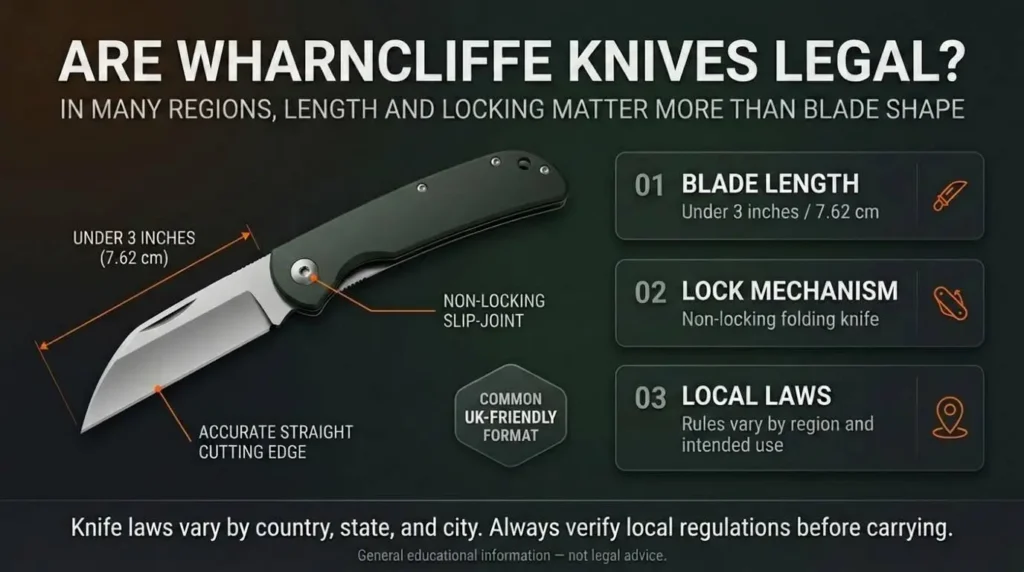
Blade ShapeBest ForMain Weakness
Clip PointEDC, piercing, detail, BowieThinner, more fragile tip
Drop PointHunting, EDC, skinningSlower piercing
TantoHard-target piercingLimited slicing belly
Spear PointThrusting, symmetric workOften double-edged, more legal restrictions

Clip Point vs Drop Point

A drop point lowers the tip and adds steel mass for strength. A clip point thins and raises the tip for piercing speed and detail work. Pick the clip point for piercing, fine work, and tactical or traditional carry. Pick the drop point for hunting, skinning, and general utility. See our drop point vs clip point comparison.

Clip Point vs Tanto

The tanto trades belly for an angular reinforced tip built for hard-target piercing. The clip point keeps a usable belly while still piercing faster than a drop point. See our tanto vs drop point comparison.

Clip Point vs Spear Point

A spear point is symmetric and often double-edged, which raises legal concerns. A clip point is asymmetric and single-edged, easier to classify as a working knife. See our spear point vs drop point vs dagger guide.

Is a Clip Point a Bowie Knife?

Bowie clip point knife next to a smaller EDC clip point folder showing the same blade geometry at different sizes.
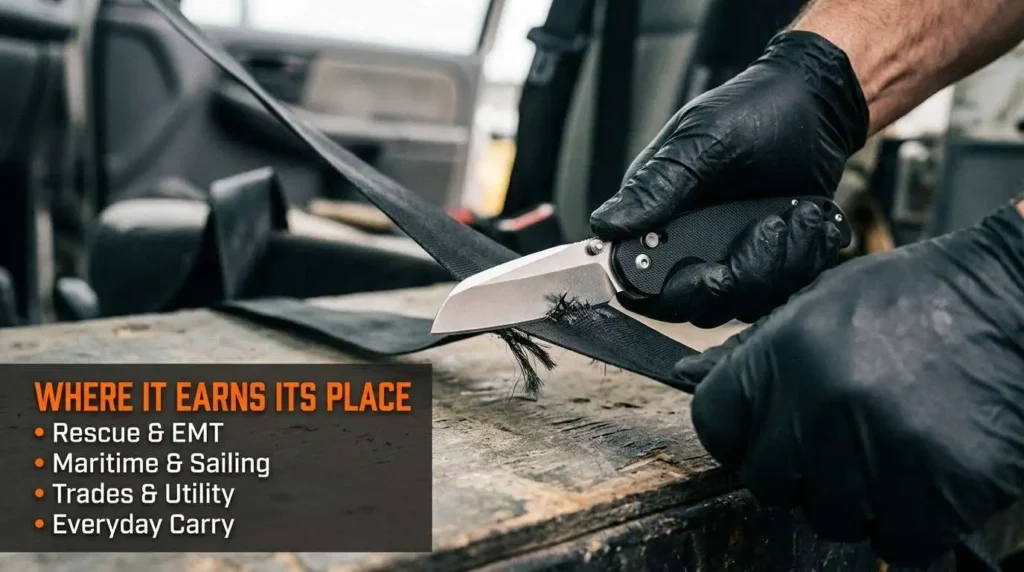
The clip point profile scales both ways: a 7.5-inch bowie for heavy field work and a 3-inch folder for everyday carry. The geometry doesn’t change, but the job does.
Most Bowies have clip point blades, but not every clip point is a Bowie. A Bowie is a specific large-format clip point — typically 6 inches or longer, with a long dramatic clip and often a sharpened false edge. A small EDC folder shares the geometry but not the heritage. See our Bowie knife guide.
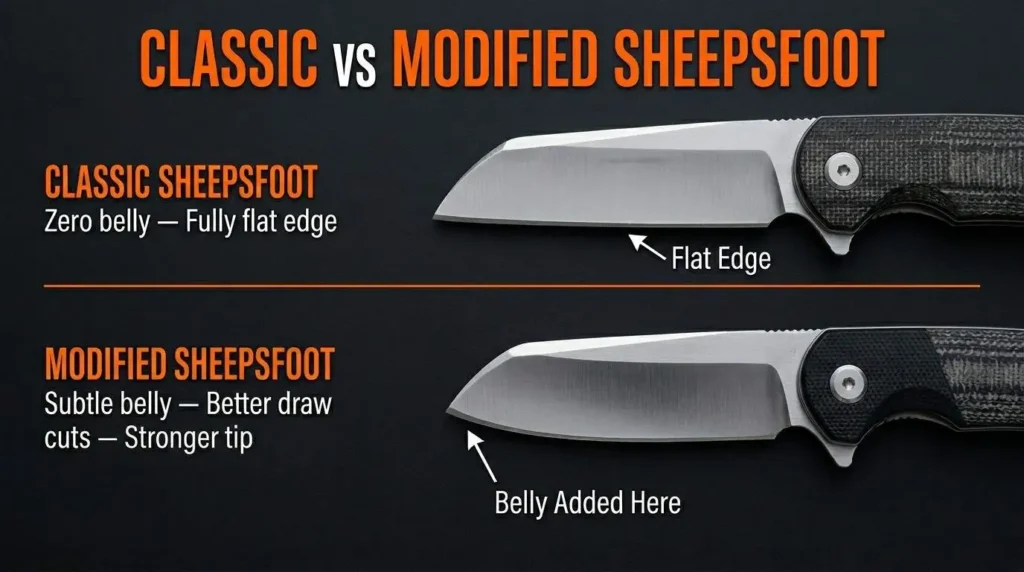
Pros and Cons

ProsCons
Sharp, fast-piercing tipTip is thinner and more fragile than drop point
Excellent control for detail workNot suited for prying or batoning
Retained belly for slicingRisk of puncturing hide when skinning
Iconic Bowie heritage and aestheticsCurved clip section is harder to sharpen
Strong fit for EDC, tactical, traditionalDrop point outperforms it for heavy utility

Anatomy of a Clip Point Blade

Anatomy diagram of a clip point knife labeling the tip, clip, false edge, spine, plunge line, belly, cutting edge, choil, and tang.

Nine working parts. Knowing them is the difference between buying a knife and buying the right knife.

  1. Spine. Unsharpened top edge. Runs straight from the handle, then transitions into the clip near the tip. EDC folders run 2.5–3.5mm thick; Bowie-style fixed blades 4–6mm.
  2. Clip. The section of spine removed near the tip. Short clip = high clip (more belly, stronger tip). Long clip = low clip (sharper tip, more piercing speed).
  3. False Edge / Swedge. The unsharpened bevel along the clip. Sometimes sharpened into a true secondary edge — common on Bowies. Otherwise it’s a swedge and is left alone.
  4. Belly. The curved cutting edge near the tip. Shorter than a drop point’s belly but still functional for slicing.
  5. Tip. Where spine and edge meet. Always thinner than a drop point tip — the trade-off for piercing speed.
  6. Plunge Line. The transition from unsharpened ricasso to sharpened edge. A clean vertical plunge line is a sign of quality grinding.
  7. Cutting Edge. Heel, flat working section, and the belly to the point.
  8. Choil. A small unsharpened notch between edge and handle. Lets you sharpen the full edge without rounding the heel.
  9. Tang. Steel extending into the handle. Full tang is non-negotiable on serious fixed-blade clip points.

A Brief History

Timeline display showing the evolution of the clip point knife from ancient stone blade to frontier bowie, classic folder, and modern damascus folder.

Knapped flint clip points have been unearthed at the estuary of the Drim river, dating back to Macedonian times of the Eneolithic period — one of the oldest functional blade designs in human history.

The modern American clip point was popularized by Rezin Bowie’s design for his brother Jim Bowie in the 1830s. The Sandbar Fight of 1827 made the geometry famous, and the “Bowie knife” became the defining profile of the American frontier.

In the 20th century, makers like Bo Randall and William Scagel refined the clip point using high-carbon tool steels. The American Bladesmith Society maintains a record of the makers who carried that tradition forward. The Buck 110 Folding Hunter (1964) brought the clip point into the modern folder market.

That hand-forging tradition survives today in custom shops producing true Damascus clip points and Bowies, where the clip line showcases the layered pattern more dramatically than any other blade geometry.

Clip Point Variations

“Clip point” isn’t one shape; it’s a family.

  • Standard Clip Point. Moderate concave clip with balanced belly. The default on EDC and traditional folders.
  • California Clip. Extended, gentle clip running nearly the full back of the blade. Long sweeping false edge.
  • Turkish Clip. Extreme recurve — almost trailing-point in feel. Aggressive, less common in production.
  • High Clip Point. Short clip with the tip closer to the spine line. Stronger tip, more belly, slightly slower piercing.
  • Low Clip Point (Bowie-Style). Long, dramatic concave clip with the tip well below the spine line. Maximum piercing speed and tip control.
  • Modified Clip. Production tweaks — recurved edge, sharpened swedge, or aggressive belly. Common on tactical folders.
Modified clip point folding knife with labels for sharpened swedge, recurved edge, and aggressive belly.
The modified clip point pushes the classic profile further: a sharpened swedge, a recurved cutting edge, and a deeper belly built for aggressive slicing.

Grind Variations

The grind matters as much as the profile, especially on a thin tip.

  • Scandi. Easy to sharpen, traditional, but thins the tip aggressively.
  • Hollow. Razor-thin edge, fragile under prying — risky on clip point tips.
  • Flat. Balanced — the most common on quality clip points.
  • Convex. Strongest geometry, hardest to sharpen freehand. Best for hard use.

What Is a Clip Point Used For?

A clip point handles EDC, fine detail cutting, piercing, caping, tactical work, traditional pocket-knife tasks, and Bowie-style heavy field use. The thin precise tip and retained belly make it the go-to profile when piercing speed and control matter more than tip strength.

  • EDC. Opens packages, slices food, cuts cordage, handles fine work — opening seams, picking out splinters, detail carving — better than drop points.
  • Hunting (Caping & Detail). The thin tip excels at caping and detail work around joints.
  • Tactical and Self-Defense. Faster piercing than drop point, controllable tip, traditional fighting-knife geometry.
  • Traditional & Collector. The dominant profile in slip-joints, stockmen, trappers, and Bowies.
  • Bowie / Heavy Field Use. Large-format clip points (6″+) handle camp tasks, brush clearing, and heavy field work.

Honest exception: for clean primary skinning, batoning, or prying, a drop point or tanto outperforms.

Clip Point Knife by Use Case

EDC

Look for a 2.8–3.5 inch blade, a strong lock (frame, liner, or AXIS), and steel that resharpens easily — D2, 154CM, 14C28N, or S30V. The clip point dominates modern pocket knives because the thin tip handles tasks a drop point struggles with.

Hunting (Caping & Detail)

Look for a 3.5–4.5 inch blade on a full tang, with a tough steel — MagnaCut, S30V, CPM 3V, or hand-forged 1095 + 15N20 Damascus. Caveat: clip points aren’t optimal for primary skinning — a drop point is usually better.

Tactical

Look for a 4–5 inch blade (or longer for fixed-blade Bowies), a strong lock or full tang, and high-toughness steel — CPM 3V, S35VN, or MagnaCut. The clip point is the historically preferred tactical profile because it pierces faster than any other working blade. See our tactical fixed blade roundup.

Bowie & Heritage

True Bowies use clip points 6″+ with full tangs, thick spines, and often a sharpened false edge. 1095 high-carbon and hand-forged Damascus are the traditional picks. See our Bowie knife guide.

Self-Defense

The clip point is historically the preferred defensive geometry — faster piercing, traditional fighting-knife heritage. That said, blade shape matters far less than legal carry rules and training. A consistently carried legal knife beats a “better” knife left at home. See our best blade shape for hunting, EDC, and self-defense guide.

Best Steel for a Clip Point Knife

Steel matters more than profile — and even more on a clip point. The thin tip concentrates stress at the point: soft steel rounds off, brittle steel chips. Prioritize toughness first, edge retention second, corrosion third.

SteelEdge RetentionToughnessCorrosionSharpeningBest ForTier
1095 (carbon)GoodExcellentPoorEasyBowie, traditional$
D2Very goodModerateModerateModerateEDC$$
154CMGoodGoodGoodEasyEDC, all-around$$
S30VExcellentGoodExcellentHardPremium EDC$$$
CPM 3VVery goodOutstandingModerateModerateHard-use clip points$$$
MagnaCutExcellentExcellentExcellentModeratePremium tactical/EDC$$$$
Damascus (1095 + 15N20)Very goodExcellentModerateModerateHand-forged Bowies$$$
420HC / 3Cr13FairGoodExcellentVery easyBudget EDC$

1095 is the working standard for Bowies and traditional carry. Tough, sharpens to a razor, patinas naturally.

MagnaCut pairs high edge retention with the toughness a thin tip needs. For the metallurgy, see Larrin Thomas at Knife Steel Nerds — he designed the steel.

CPM 3V is the safest pick if you want a clip point that survives hard use without chipping. Outstanding toughness — exactly what a thin-tip geometry needs.

Damascus. True pattern-welded Damascus (1095 + 15N20) combines high-carbon performance with layered toughness — and the clip line is where the pattern shines. See our Damascus knife guide. Watch out for fakes:

  • Real Damascus shows pattern on both sides and into the bevel, has visible layers under magnification, and rusts without care.
  • Fake Damascus has pattern only on the flat surface and never rusts (chemically etched stainless).

Best Steel by User Type


User Type
Best Steel Choice
Beginner420HC / 3Cr13 — forgiving, low maintenance
EDC UserD2 / 154CM — balance of edge and ease
Hunter (caping/detail)S30V / MagnaCut — retention and toughness
Tactical / Hard UseCPM 3V / MagnaCut — outstanding toughness
Traditional / Bowie1095 — heritage steel, easy to sharpen
CollectorDamascus — pattern, character, tradition

Best Clip Point Knife by Use Case

Use CaseBest Blade LengthBest Steel
EDC2.8 – 3.5 inD2, 154CM, S30V
Hunting (caping/detail)3.5 – 4.5 inS30V, MagnaCut, Damascus
Tactical4 – 5 inCPM 3V, S35VN, MagnaCut
Bowie / Heritage6 – 10 in1095, Damascus
Traditional Folder2.5 – 3.5 in1095, 154CM, D2

How to Choose Your Clip Point Knife

Seven questions, in order:

  1. Primary use case? EDC, tactical, hunting (caping/detail), Bowie/heritage, or collector.
  2. Fixed or folding? Fixed for Bowies, tactical, and serious field work. Folding for EDC and traditional carry.
  3. Blade length? EDC: 2.8–3.5″. Hunting/tactical: 3.5–5″. Bowie: 6″+ (with the legal caveat below).
  4. What steel? Carbon (1095) if you’ll oil it. Stainless (S30V, MagnaCut) for low maintenance. Damascus for hand-forged character. Prioritize toughness — soft or brittle steels chip the thin tip.
  5. Budget tier? Under $50: budget production. $50–$150: mid-range or entry hand-forged. $150–$400: premium production. $400+: custom shop.
  6. Hand-forged or production? Production = consistency, warranty. Hand-forged = unique craftsmanship, more care required.
  7. Is it legal where you’ll carry? Bowie lengths and sharpened swedges are the two clip-point traps.

Common Buying Mistakes

  1. Choosing too long a blade. Bowie-style clip points feel like overkill in real carry. Many states cap legal length at 4–5″. Most users are better served by 3.5–4.5 inches.
  2. Buying a clip point for primary skinning. The thin tip risks puncturing hide. Get a drop point instead.
  3. Buying fake Damascus. Cheap “Damascus” on big marketplaces is usually chemically etched stainless. Look for layers in the bevel and confirm the steel makeup.
  4. Ignoring the false edge. A sharpened swedge changes how you sharpen and can reclassify the knife as a dagger in stricter jurisdictions.
  5. Ignoring local knife laws. Bowie length limits and dagger reclassification trip up clip point buyers more than buyers of any other blade type.

How to Sharpen a Clip Point Knife

The curved belly, thin tip, and (sometimes) sharpened false edge need a different approach than a straight-edged blade. Skip this and you’ll round the tip — the most-broken part of any clip point.

  1. Set your angle. 17–22 degrees per side. Tactical and EDC clips lean toward 20°. When unsure, 20° is safe.
  2. Sharpen the flat section first. Hold your angle and pull the edge from heel to where the belly begins to curve. Match strokes on each side.
  3. Roll into the belly. As you reach the curve, lift the handle slightly and rotate to keep the angle consistent. The belly is shorter than a drop point’s, so the roll is tighter.
  4. Sharpen the false edge — only if it was designed sharp. If your clip has a true sharpened false edge, treat it as a separate edge. Never sharpen an unsharpened swedge — you’ll change the geometry permanently.
  5. Finish the tip carefully. The thin tip rounds faster than any other geometry. Light pressure, fewer passes, more rotation as the belly tightens.
  6. Strop to finish. Leather strop with polishing compound, five to ten passes per side.

For carbon and Damascus blades: wipe dry, then apply a thin coat of food-safe mineral oil or camellia oil. See our knife care guide.

Knife law varies significantly by state, county, and city. The clip point shape itself is rarely the legal issue — blade length, lock type, opening mechanism, sharpened false edge, and how you carry are what matters.

The American Knife & Tool Institute (AKTI) maintains a state-by-state breakdown worth checking before you carry.

Three clip-point-specific legal traps:

  • Bowie length limits. Many states cap legal carry at 4–5″. Most full-size Bowies exceed this.
  • Sharpened false edge = dagger. A sharpened swedge can reclassify a single-edged clip point as a double-edged dagger in stricter jurisdictions.
  • Concealed carry. Bowie-style clip points are usually too large to legally conceal.

This is not legal advice. Check your local laws before carrying any knife.

Caring for Your Clip Point Knife

  • Clean after use. Wipe with a dry cloth. After cutting food, blood, or anything acidic, clean with warm water and dry immediately.
  • Oil carbon and Damascus blades. Thin film of food-safe mineral oil or camellia oil. Once a week for EDC; after every use for hunting.
  • Strop between sharpenings. A weekly strop extends time between full resharpenings significantly.
  • Store properly. Don’t leave a knife in a leather sheath long-term — leather retains moisture. Use kydex, a knife roll, or wall display.
  • Avoid lateral pressure on the tip. The single most-broken part of any clip point. Don’t pry, twist, or throw.

For a complete maintenance routine, see our knife care guide.

Frequently Asked Questions (FAQs)

What is a clip point knife used for?

EDC, fine detail cutting, piercing, caping, tactical work, traditional pocket-knife tasks, and Bowie-style heavy field use.

What is the benefit of a clip point blade?

Three main benefits: piercing speed, tip control for detail work, and aesthetic heritage. The thin clipped tip enters materials with less drag than any other working profile.

Are clip point knives good?

Yes, for EDC, piercing tasks, tactical use, and traditional carry. Not the best choice for primary skinning, prying, or batoning.

Is a clip point a Bowie knife?

Most Bowies have clip point blades, but not every clip point is a Bowie. A Bowie is a specific large-format clip point — typically 6 inches or longer with a long dramatic clip and often a sharpened false edge.

Why is the clip point weak?

The “weakness” is geometric. Removing material from the spine to thin the tip trades tip strength for piercing speed. Buy quality steel and avoid prying with the tip.

Which is better, clip point or drop point?

Neither universally. Clip points pierce faster and allow finer detail work. Drop points are stronger and slice better. See our drop point vs clip point comparison.

Is a clip point good for hunting?

For caping and detail work, yes. For primary skinning, the thin tip risks puncturing hide — a drop point is usually better.

Is a clip point good for self-defense?

Historically the preferred defensive geometry, but blade shape matters far less than legal carry rules and training.

Can you baton wood with a clip point?

Not recommended. The thin tip is the weakest part of the blade.

What’s the best steel for a clip point knife?

For most users: CPM 3V or MagnaCut (toughness handles the thin tip). For traditional carbon: 1095. For hand-forged: real pattern-welded 1095 + 15N20 Damascus.

Are Damascus clip point knives worth it?

Real pattern-welded Damascus (not etched stainless) is worth it for collectors and traditional carriers who’ll maintain their blades.

How long should a clip point hunting knife be?

3.5 to 4.5 inches covers most caping and detail work. Larger (5″+) moves into Bowie territory and runs into legal limits.

Is a clip point knife legal to carry?

In most U.S. jurisdictions, yes — but it depends on blade length, lock type, sharpened false edge, and carry method.

Conclusion

The clip point isn’t the strongest blade shape, and it isn’t the most utility-focused. It’s the most traditional, precise, and historically defining profile in American knife-making — which is why EDC carriers, tactical users, traditional pocket-knife fans, and Bowie collectors keep choosing it.

What Is a Drop Point Knife? Uses, Pros, Cons & Buying Guide

A drop point knife is a fixed or folding blade with a convex spine that curves gently downward from handle to tip, lowering the point below the spine line. The result is a strong tip and a wide cutting belly — well-suited for hunting, EDC, skinning, camping, and general utility.

This guide covers what a drop point is, what it’s used for, how it compares to other knife blade types and shapes, the best steels and sizes, common buying mistakes, and how to choose the right one.

Quick Answer: A drop point knife has a spine that slopes downward toward the tip, creating a strong point and curved belly. It is best for hunting, EDC, skinning, camping, and general utility because it balances slicing control, durability, and everyday versatility.

What Is a Drop Point Knife?

Labeled diagram of a drop point knife showing the convex spine, lowered tip, and wide cutting belly.

A drop point knife is defined by one feature: the spine drops in a smooth convex curve from the handle to the tip, placing the point lower than the top of the blade.

That single design choice creates three working advantages:

  • A strong tip with more steel mass behind it
  • A wide cutting belly for slicing and skinning
  • A controllable profile that’s easy to guide through detailed work

The lowered tip is more resistant to tip stress than a clip point, which is one reason hunters and EDC users have made it one of the most popular working profiles in the modern knife market.

Best For / Not Best For


Best For

Not Best For
HuntingHard-target piercing
SkinningDedicated defensive use
EDC tasksPrying
CampingUsers who want a fine piercing tip
BushcraftDetail tip work on tight cuts
Field food prepCutting through hard sheet materials

The drop point is a generalist. If your priority is fast piercing or fine tip work, a clip point, tanto, or
spear point will fit your needs better.

Drop Point vs Other Blade Shapes

Side-by-side comparison of drop point, clip point, tanto, and spear point blade shapes with their best-use labels.

Most readers come to a guide like this with one question: how does it compare to the alternatives? Here’s the short version, followed by the details.

Blade ShapeBest ForMain Weakness
Drop PointHunting, EDC, skinning, slicingSlower piercing
Clip PointPiercing, detail workThinner, more fragile tip
TantoHard-target piercingLimited slicing belly
Spear PointThrusting, symmetric workOften double-edged, more legal restrictions

Drop Point vs Clip Point

A clip point has a concave spine that “clips” away material toward the tip, raising the point and thinning it. It pierces faster and works better for fine tip detail.

A drop point has a convex spine that lowers the tip and adds steel behind it. It slices better, controls better, and resists tip stress better.

Pick the drop point for hunting, EDC, and general work. Pick the clip point when piercing speed or fine tip work is the priority. For a full breakdown, see our drop point vs clip point comparison.

Drop Point vs Tanto

The tanto has an angular tip with a strong reinforced point, built for piercing hard targets. It has little to no belly, so slicing performance is limited.

The drop point’s curved belly is the opposite design: optimized for long, controlled cuts.

Pick the drop point for utility, hunting, food prep, and EDC. Pick the tanto for tactical hard-target use.

For a side-by-side breakdown, see our tanto vs drop point comparison.

Drop Point vs Spear Point

A spear point is symmetric, with the tip on the centerline. It’s often double-edged, which raises legal concerns in many jurisdictions.

A drop point is single-edged and asymmetric — built for working tasks, not thrusting.For a deeper comparison including daggers, see our spear point vs drop point vs dagger guide.

Is a Drop Point a Dagger?

No. A dagger is symmetric and double-edged with the tip on centerline. A drop point is single-edged with an asymmetric working belly. They are different geometries and have different legal classifications in most regions. For more on dagger laws and definitions, see our dagger vs knife guide.

Pros and Cons

ProsCons
Strong tip, more resistant to stressSlower to pierce than clip point
Deep slicing bellyNot ideal for hard-target tactical work
Versatile across hunting, EDC, bushcraftLess piercing speed than spear point
Single-edged, simpler to classify legallyTip can round if sharpened incorrectly
Easy to control for field-dressingTanto outperforms it on hard surfaces

Anatomy of a Drop Point Blade

Anatomy diagram of a drop point blade labeling the spine, belly, tip, cutting edge, and choil.

There are eight working parts on a drop point. Knowing them is the difference between buying a knife and buying the right knife.

  • Spine. The unsharpened top edge. On a drop point, it curves convexly from handle to tip. Hunting drop points typically run 3–4mm thick.
  • Drop. The downward curve of the spine. Subtle drop = high drop point (better piercing). Pronounced drop = low drop point (better skinning control).
  • Belly. The curved section of the cutting edge near the tip. The drop point’s deep belly is what makes it perform well for slicing and skinning.
  • Tip. Where spine and edge meet. It sits below the spine line and is more resistant to stress than a clip-point tip.
  • Plunge Line. The transition from unsharpened ricasso to sharpened edge. A clean, vertical plunge line is a quiet sign of quality grinding.
  • Cutting Edge. The full length of sharpened steel: flat working section + the deep belly leading to the tip.
  • Choil. A small unsharpened notch between edge and handle. Lets you sharpen the full edge without rounding the heel.
  • Tang. The blade steel extending into the handle. A full tang (steel running the full length and width of the handle) is strongly recommended on any serious fixed-blade hunting knife.

A Brief History

Bob Loveless is widely credited with shaping the modern drop point hunter. In the late 1960s and 1970s, he redesigned the hunting knife around a working belly and lowered tip. Within a decade, his geometry became the template for nearly every serious American hunting blade. The American Bladesmith Society maintains a strong record of the makers who carried that tradition forward.

The underlying idea predates Loveless by centuries. Pattern-welded blades from Persia and the Indian subcontinent were forging drop-shaped working knives long before American custom makers picked up the profile. That hand-forging tradition survives today in custom shops producing true damascus drop points.

Drop Point Variations

Five drop point knife variations side by side: standard, high, low, modified, and deep-belly skinner profiles.

“Drop point” isn’t one shape; it’s a family.

  • Standard Drop Point. Moderate spine drop, balanced belly, tip roughly centered on the handle. The safe default.
  • High Drop Point. Subtle spine curve with the tip closer to the spine line. Better piercing, less belly. Common on EDC folders.
  • Low Drop Point. Pronounced drop, tip well below the spine. Excellent belly, safer for field-dressing. Less piercing speed.
  • Modified Drop Point. Production tweaks — recurved edge, spine swedge, or more aggressive belly.
  • Deep-Belly (Skinner-Style) Drop Point. The belly is the dominant feature, wide and sweeping, paired with a low drop. Built for skinning.

Grind Variations

The profile is only half the story. The grind matters just as much.

  • Scandi. Easy to sharpen, great for bushcraft.
  • Hollow. Razor-thin edge, fragile under prying.
  • Flat. Balanced — the most common on quality hunters.
  • Convex. Strongest geometry, hardest to sharpen freehand.

What Is a Drop Point Used For?

Gloved hand using a drop point folding knife to slice through rope outdoors.

A drop point handles hunting, field-dressing, skinning, EDC, bushcraft, food prep, and general utility cutting. The strong tip and wide belly make it one of the most versatile blade profiles for tasks that prioritize control and slicing over raw piercing speed.

  • Hunting. The lowered tip lets you open a hide without puncturing the gut cavity — the single biggest mistake new hunters make with a clip point.
  • EDC. Opens packages, slices food, cuts cordage. The strong tip handles daily contact with concrete, metal, and bone.
  • Skinning. The continuous belly curve stays in contact with the hide through the full draw, with no repositioning needed.
  • Bushcraft and Camping. Handles batoning, feathersticks, notching, and food prep in one tool.
  • Tactical. More resistant to tip stress than clip points, but still not designed for prying.

Honest exception: if your sole task is piercing hard targets like sheet metal or armor, a clip point or tanto will outperform the drop point.

Drop Point Knife by Use Case

Hunting

For most game, look for a 3.5 to 4.5 inch blade on a full tang, with a steel that holds an edge through a full field-dressing session. MagnaCut, S30V, 1095 high-carbon, and hand-forged 1095 + 15N20 damascus are all proven choices. For a deeper look at picking the right shape for the field, see our guide on the best blade shape for hunting, or browse our hunting knife collection for real-world examples.

Key requirements:

  • Enough belly to skin without repositioning
  • Enough tip control to open a hide cleanly
  • Spine thickness to handle bone contact
  • A handle that grips when wet

Skinning

Skinning is a belly-of-the-edge job, not a tip job. A deep-belly drop point keeps the cutting edge in continuous contact with the hide. Hand-forged options tend to carry a slightly more aggressive micro-edge from the forge finish.

EDC

For everyday carry, look for:

  • 2.8 to 3.5 inch blade (legal in most jurisdictions)
  • A strong lock (frame lock, liner lock, or AXIS)
  • Steel that resharpens easily — D2, 154CM, or S30V if budget allows

Self-Defense

The drop point is not the optimal blade shape for self-defense. Clip points, spear points, and daggers all pierce faster. A consistently carried sharp knife is more useful than a “better” knife left at home, but legal restrictions on carry usually matter more than blade geometry. For dedicated tactical fixed blades, see our tactical fixed blade roundup.

Best Steel for a Drop Point Knife

Steel matters more than profile. A perfect drop point in soft stainless will lose its edge fast; a capable profile in good steel will outlast the trip.

SteelEdge RetentionToughnessCorrosionSharpeningBest ForTier
1095 (carbon)GoodExcellentPoorEasyBushcraft, hunting$
D2Very goodGoodModerateModerateHunting, EDC$$
154CMGoodGoodGoodEasyEDC, all-around$$
S30VExcellentGoodExcellentHardPremium EDC$$$
MagnaCutExcellentExcellentExcellentModeratePremium hunting$$$$
Damascus (1095 + 15N20)Very goodExcellentModerateModerateHand-forged hunting$$$
420 / 3Cr13FairGoodExcellentVery easyBudget EDC$

1095 is the working standard for carbon steel. Tough, sharpens to a razor, and tells you when it needs maintenance (it patinas). Oiled regularly, it can last for years with care.

MagnaCut is one of the strongest premium options for hunters who want edge retention, toughness, and corrosion resistance without compromise. For an in-depth look at the metallurgy, see Larrin Thomas’s MagnaCut writeup at Knife Steel Nerds — he designed the steel.

Damascus: True pattern-welded damascus (1095 + 15N20) combines high-carbon performance with layered toughness. For a deeper look, see our damascus knife guide. Watch out for fakes:

Close-up of a true damascus drop point blade showing 1095 and 15N20 pattern-welded layers.
Real pattern-welded damascus shows its layers across the bevel and into the edge — the visible signature of forged 1095 and 15N20 steel.
  • Real damascus shows pattern on both sides and into the bevel, has visible layers under magnification, and will rust without care.
  • Fake damascus has pattern only on the flat surface and never rusts (it’s chemically etched stainless).

Best Steel by User Type

User TypeBest Steel Choice
Beginner420HC / 3Cr13 — forgiving and low maintenance
EDC UserD2 / 154CM — balance of edge and ease
HunterS30V / MagnaCut — retention and toughness
Bushcrafter1095 / 3V — tough and field-sharpenable
CollectorDamascus — character, uniqueness, tradition

Best Drop Point Knife by Use Case

Use CaseBest Blade LengthBest Steel

EDC
2.8 to 3.5 inD2, 154CM, S30V
Hunting3.5 to 4.5 in1095, S30V, MagnaCut, Damascus
Bushcraft4 to 5 in1095, 3V, MagnaCut
Skinning3.5 to 4.5 in1095, Damascus, S30V
Tactical3.5 to 5 inS35VN, MagnaCut

How to Choose Your Drop Point Knife

Seven questions get you to the right knife. Answer them in order.

  1. Primary use case? Hunting, EDC, skinning, bushcraft, or tactical. Be honest — most people overestimate how often they’ll do bushcraft.
  2. Fixed or folding? Fixed for hunting, serious work, and bushcraft. Folding for EDC and carry convenience.
  3. Blade length? EDC: 2.8–3.5″. Hunting: 3.5–4.5″. Bushcraft: 4–5″. Tactical: 5″+ (anything over 5″ moves into bowie knife territory).
  4. What steel suits your habits? Carbon (1095) if you’ll oil it. Stainless (S30V, MagnaCut) for lower maintenance. Damascus for hand-forged character with working performance.
  5. Budget tier? Under $50: budget production. $50–$150: mid-range or entry hand-forged. $150–$400: premium production. $400+: custom shop.
  6. Hand-forged or production? Production = consistency, warranty, easy replacement. Hand-forged = unique craftsmanship and character, more care required.
  7. Is it legal where you’ll carry? Check blade length, lock type, opening style, and carry method rules in every jurisdiction you’ll travel through.

Common Buying Mistakes

Avoiding these five mistakes will save more money than picking any one “best” knife.

  1. Choosing too large a blade. A 7-inch blade looks impressive online and feels like overkill the first time you actually field-dress an animal or open a package. Most users are better served by 3.5–4.5 inches.
  2. Ignoring steel maintenance. Buying a 1095 or damascus blade and never oiling it is a fast way to ruin it. If you won’t maintain a carbon blade, buy stainless. See our knife care guide for a simple maintenance routine.
  3. Buying fake damascus. Cheap “damascus” knives on big marketplaces are usually chemically etched stainless. The pattern washes off the bevel during sharpening. Look for visible layers in the bevel and the seller’s willingness to confirm the steel makeup.
  4. Choosing looks over handle grip. A beautiful handle that slips when wet is worse than a plain handle that doesn’t. Test grip with wet hands if you can, or read reviews specifically about wet-hand performance.
  5. Ignoring local knife laws. Blade length, lock type, opening mechanism, carry method, and even location (school zones, federal buildings, airports) all matter. The blade shape is rarely the legal issue.

How to Sharpen a Drop Point Knife

Drop point knife being sharpened on a wet whetstone with labels showing correct angle and light pressure.

The curved belly and lowered tip need a slightly different approach than a straight-edged blade. Skip this and you’ll round the tip.

  1. Set your angle. Most drop points run 17–22 degrees per side. Hunting and bushcraft: 17–20. EDC folders: ~20. When unsure, 20° is safe.
  2. Sharpen the flat section first. Hold your angle and pull the edge from heel to where the belly begins to curve. Match strokes on each side.
  3. Roll into the belly. As you reach the curve, lift the handle slightly and rotate so your angle stays consistent against the stone. Smooth roll, not a separate motion.
  4. Finish the tip carefully. As the belly tightens, keep rotating, lift slightly more, and reduce pressure. Heavy pressure here is what rounds the tip off.
  5. Strop to finish. A leather strop with polishing compound aligns the edge and removes the burr. Five to ten passes per side.

For carbon and damascus blades: wipe dry, then apply a thin coat of food-safe mineral oil or camellia oil. These steels rust without it. Our full knife care guide covers oiling schedules and storage.

Knife law in the United States varies significantly by state, county, and city, and the drop point shape itself is rarely the legal issue. Blade length, lock type, opening mechanism, and how you carry are usually what matters.

Many U.S. jurisdictions are more permissive with common utility knives, but rules vary by state, city, blade length, lock type, opening mechanism, concealment, and intent. The American Knife & Tool Institute (AKTI) maintains a state-by-state breakdown that’s worth checking before you carry. Cities like NYC and parts of California have stricter rules than surrounding state law.

Drop points are often easier to classify as a working knife, since they’re single-edged and clearly utility-shaped. But length, lock type, and carry method still apply.

This is not legal advice. Check your local laws before carrying any knife.

Caring for Your Drop Point Knife

  • Clean after use. Wipe with a dry cloth. After cutting food, blood, or anything acidic, clean with warm water and dry immediately. Never put a quality knife in the dishwasher.
  • Oil carbon and damascus blades. Thin film of food-safe mineral oil or camellia oil. Once a week for EDC; after every use for hunting.
  • Strop between sharpenings. A weekly strop can extend the time between full resharpenings significantly.
  • Store properly. Don’t leave a knife in a leather sheath long-term — leather retains moisture. Use a kydex sheath, knife roll, or wall display.

For a complete maintenance routine including oiling schedules, storage, and rust prevention, see our knife care guide.

Frequently Asked Questions (FAQs)

What is a drop point knife used for?

Hunting, field-dressing, skinning, EDC, bushcraft, food prep, and general utility cutting. Its strong tip and wide belly make it one of the most versatile working blade profiles available.

Is drop point better than clip point?

For most users, yes. Drop points are stronger, slice better, and resist tip damage more effectively. Clip points are better only when piercing speed or fine tip work is the priority. See our full drop point vs clip point comparison for the side-by-side breakdown.

Is a drop point knife good for beginners?

Yes. The strong tip is forgiving of beginner mistakes, the wide belly makes basic cutting tasks easier, and the shape is widely accepted legally. Pair it with an easy-to-sharpen steel like 420HC, D2, or 154CM.

What is the best drop point knife size?

EDC: 2.8–3.5 inches.
Hunting: 3.5–4.5 inches.
Bushcraft: 4–5 inches.
Four inches is a reliable sweet spot for North American hunters.

Is drop point good for camping?

Yes. The combination of a strong tip, deep belly, and full-tang construction handles food prep, batoning kindling, cutting cordage, and general camp tasks in one tool.

Is drop point good for self-defense?

It’s not the optimal shape for self-defense. Clip points, spear points, and daggers pierce faster. That said, blade shape matters far less than legal carry rules and personal training.

What’s the best steel for a drop point knife?

For most users: MagnaCut or S30V (stainless, low maintenance). For carbon: 1095 (tough, easy to sharpen, needs oiling). For hand-forged: real pattern-welded 1095 + 15N20 damascus.

Are damascus drop point knives worth it?

Real pattern-welded damascus (not etched stainless) is worth it for hunters and collectors who will maintain their blades. They require regular oiling.

Can you baton wood with a drop point knife?

Yes — if it’s a full-tang fixed blade with a spine of 4mm or more. Folders and thin-spine drop points are not suitable for batoning.

Is a drop point knife legal to carry?

In most jurisdictions, yes, but it depends on blade length, lock type, opening mechanism, and how you carry. Check local law before carrying any knife.

Conclusion

The drop point isn’t the flashiest blade shape, and it isn’t the fastest piercer. It’s the most useful one for the widest range of tasks, which is why hunters, EDC carriers, and bushcrafters keep choosing it.

If you’re buying your first one, focus on three things: a blade length that matches your real use (not your wishlist), a steel that fits how much maintenance you’ll actually do, and a handle that grips when wet. Get those right and the knife will serve you well for years.

Knife Blade Types: What Actually Works in the Field (and What’s Just Marketing)

A friend of mine spent $340 on a “premium skinning knife” with a deep trailing point because three buying guides told him it was the “best blade shape for big game.” Two seasons later, that knife has dressed exactly one mule deer and badly. He now does the same job with a $90 fixed-blade drop point and laughs about it.

That story isn’t unusual. It’s the rule.

Most of the internet’s writing on knife blade types is recycled brand copy, repeated by sites that have never field-dressed an animal, broken down 300 boxes a shift at a warehouse, or had to cut a jammed seatbelt in the dark. The result is predictable: people buy the wrong shape for the work they actually do, then blame the steel.

This guide isn’t a glossary. You can find a glossary anywhere. It’s what blade shapes actually do under load, where the standard advice falls apart, and one strong opinion that contradicts almost every other knife blog you’ve read. I’ll get to it about halfway down. If you only remember one thing from this article, it’ll be that section.

The fast answer (if you don’t have ten minutes)

Side-by-side comparison of drop point vs Americanized tanto knife blade shapes showing key features and best uses
Organic vs geometric — drop point handles field work, tanto dominates tactical tasks. Same knife category, completely different jobs.

If you want a knife and you don’t want to think about it, get a drop point for hunting and bushcraft, and ignore tantos unless you specifically like how they look. That covers most real-world use.

There is one blade shape most guides completely ignore that is actually better for modern everyday carry, but it contradicts almost everything you will read in standard knife advice. I will get to it about halfway down.

The rest of this article is for the 10% of people doing something specific enough that blade shape genuinely matters, or for anyone about to spend serious money and wants to spend it correctly.

Drop point: the default that earns its reputation (mostly)

Annotated diagram of a drop point knife blade shape showing strong tip, controlled belly for slicing, and balanced edge geometry

The drop point has a convex spine that curves down to meet a controlled belly. The tip sits below the spine, which makes it strong, and the belly is long enough to slice without being so deep that you lose tip control.In real use, field-dressing whitetail, breaking down camp food, cutting cordage, light carving, the drop point is genuinely hard to beat. The tip won’t snap when you hit a rib. The belly rolls through hide. You can choke up on it for detail work. This is one of the few cases where the marketing and the performance line up. Browse our hunting knives if this is the use case you’re shopping for.

When NOT to use it: opening 200 Amazon boxes a day in a warehouse. The tip is fine enough to puncture whatever’s inside the box, and the belly geometry isn’t doing anything for you on a straight pull cut. A drop point is overkill for cardboard, and the tip is the part that breaks first when you pry, which warehouse workers always end up doing, no matter how many times the safety video says not to.

The clip point, found on Bowie knives, traditional pocket knives, and classic hunters, has a “clipped” section taken out of the spine, leaving a fine, often upswept tip.

Here’s the problem: the clip point is marketed as a do everything traditional blade. In practice, that fine tip is the weakest part of the shape. Snapped clip point tips show up more often than any other blade type, usually after sideways pressure from everyday misuse such as prying staples, opening blister packs, or twisting the tip into something it was not designed to handle. Tasks a drop point would tolerate are exactly where clip points tend to fail.

Clip point knife blade shape with Damascus steel and green resin handle showing fine tip weaknesses and best use cases
The clip point looks great — but that fine tip has a price. Know exactly what it can and can’t handle before you buy.

A clip point excels at one specific thing: piercing soft material with precision. Field-dressing where you need to slip the tip under hide without nicking the gut sack. Detail work in leather. Fine slicing in food prep, if the steel is good. Our Shadow Vanguard fixed blade hunting knife is a clip point built for exactly this kind of disciplined, controlled work.

When NOT to use it: anywhere there’s a chance you’ll lever the knife sideways. Anywhere the tip might catch in something hard. If your “EDC” includes opening anything stapled, taped, or industrially packaged, a clip point will eventually disappoint you. Torn between this shape and the safer alternative? See the drop point vs clip point knife comparison.

Tanto: mostly theater

I’m going to be direct here, because the marketing on this one is genuinely misleading.

The Americanized tanto, the angular, two-bevel point you see on every “tactical” folder from the early 2000s onward, is sold on a story about armor piercing and tip strength. The story is partly true and largely irrelevant. Yes, the geometry concentrates force at the secondary point, and yes, the tip is stronger than a needle-fine clip point. But it’s not stronger than a properly ground drop point, and the chances that you, personally, need to pierce a car door or body armor are functionally zero.

Hand using a Damascus tanto EDC knife to cut a cardboard box, highlighting low-set tip and straight edge blade shape features

What the tanto gives up to get that strength is everything that makes a knife useful day-to-day. The angled secondary edge means there’s no continuous belly. Slicing anything, an apple, a length of rope, a piece of cardboard, becomes a two-stage motion where the blade catches at the angle. Sharpening it correctly requires maintaining two distinct edge geometries, which most people don’t do, so they end up with a tanto that’s dull on one section and sharp on the other.

When NOT to use it: anything that involves slicing. Which is most knife work. For the head-to-head, See tanto vs drop point knife comparison .

The original Japanese tanto, by the way, didn’t have this geometry. It’s a modern American interpretation, and “tactical” is doing a lot of marketing work in that sentence.

When it actually makes sense: if you specifically need to break or pierce a hard barrier, auto extrication, certain rescue scenarios, and you’ve trained on it. That’s a narrow use case. If that’s not you, the tanto is a knife shape you bought because it looked cool, and that’s a perfectly fine reason to own one. Just don’t pretend it’s a better tool than it is.

Sheepsfoot and wharncliffe: the contrarian section

Here’s the strong opinion. The one I said you’d remember.

For most people doing modern EDC, a sheepsfoot or wharncliffe is a meaningfully better tool than a drop point, and the entire knife industry is quietly steering you away from them because they don’t sell the “do anything, go anywhere” fantasy that drives margins.

A sheepsfoot has a straight edge that runs horizontal, with a curved spine that drops to meet it. No real point, just a rounded nose. A wharncliffe is similar but with a straight edge and a straight spine that angles down sharply to a fine, low-set tip. Both share the same useful property: a long, perfectly straight cutting edge with no belly to speak of.

Now think about what modern EDC actually looks like. You’re cutting:

  • Tape on packages
  • Cardboard boxes
  • Zip ties
  • Plastic clamshell packaging
  • Loose threads on clothing
  • Maybe an apple at lunch
Side-by-side comparison of Wharncliffe vs Sheepsfoot knife blade shapes showing tip profile, spine shape, and best use cases

Every single one of those is a push cut or a draw cut along a straight line. A straight edge transmits force cleanly and predictably. A bellied drop point, on the same task, rolls through the cut at a varying angle, which is fine but never optimal. And on the ones where the cut is right against your hand or against something you don’t want to puncture (the contents of the box, the table, the steering wheel), the lack of a forward-projecting tip is a feature, not a bug.

I’ve watched warehouse pickers, electricians, and ER nurses converge independently on Wharncliffe-style blades for exactly this reason. They figured it out by doing the work, not by reading buying guides. Browse our folding knives if you’re shopping for an EDC folder.

When NOT to use a sheepsfoot or wharncliffe: anything involving a stab, pierce, or fine tip work. You can’t field-dress a deer with one, you can’t drill a starting hole in wood, and you can’t slip the tip into a clamshell seam from above. They are not hunting knives. Outside the EDC use case, they fall off hard.

But for the use case the average modern adult knife-buyer actually has? They quietly outperform drop points. The reason you don’t read this in most blade guides is that “the drop point is best” is a safer recommendation that doesn’t risk a return. Choosing between the two? See sheepsfoot vs wharncliffe blade comparison.

Trailing point: oversold for big game

The trailing point, where the tip rises above the spine in a long, deep belly, is the blade shape every buying guide calls “the best skinner.”

For deer, elk, and most big game, drop points outperform trailing points in actual field use, and if you want a specialized tool, a knife with a small gut hook handles the job more cleanly.

The trailing point’s deep belly is genuinely useful for one thing: working a large amount of hide off smaller animals, fish, rabbits, squirrels, or detailed caping work.

Damascus steel trailing point skinning knife with stag handle showing upswept tip and extended belly blade shape features

For breaking down a 200-pound deer in the field, that extra belly becomes unnecessary, and the raised tip is easier to drive into the body cavity compared to the controlled tip of a drop point.

The trailing point earned its reputation in the era of fur trapping, where you were processing a lot of small hides per day. Modern big-game hunting isn’t that work. The advice has lagged behind reality by about a hundred years. For big-game work, Browse hunting knives for big game.

When NOT to use it: big game field dressing if you don’t already know what you’re doing. Anything where tip control matters more than belly length. EDC of any kind.

Spear point: niche, but excellent at the niche

A spear point is symmetrical. The tip sits in line with the centerline of the blade, with belly on both sides (or a sharpened false edge). Daggers, throwing knives, some boot knives.

The advantage is straightforward: maximum piercing efficiency along the centerline. The disadvantage: you’ve built a knife optimized for stabbing, which is a use case civilians almost never encounter legally. A symmetrical grind also means there’s less efficient cutting geometry on either side compared to an asymmetric grind of the same width. Our Damascus Boot Dagger is a spear point in this geometry.

When NOT to use it: as a general utility knife. The shape is optimized for one motion, and that motion isn’t “open a package.” (For comparisons, see spear point vs drop point vs dagger.)

Hawkbill: the underrated utility shape

Gloved hand using a rainbow titanium hawkbill knife to cut rope, highlighting concave edge and constant engagement blade geometry
The hawkbill doesn’t push — it pulls. Concave edge traps material, zero-slip engagement does the rest. One blade shape, one job, zero compromise.

A hawkbill curves downward. The tip points toward the ground, and the entire edge is concave. This is the curved blade knife people are usually asking about when they search “what is a curved knife called.” (Karambits and kukris are also curved, but they’re curved in different directions and for different reasons; we’ll get there.)

Hawkbills are excellent, and I mean excellent, at one specific job: pulling a cut through material that wants to slip away. Roofing felt. Carpet. Linoleum. Insulation. Vines. Fishing line wrapped around a prop. Any time you’re hooking the blade into something and pulling, the hawkbill geometry concentrates force at the curve and stays engaged.

If you’re a tradesperson, a gardener, or someone who works around cordage and rope, a hawkbill in your kit is genuinely useful. The reason most people don’t have one is that the shape looks aggressive and intimidating, and the marketing has historically leaned into that, which is a shame, because it’s one of the most utilitarian shapes ever designed.

When NOT to use it: food prep, fine work, anything that benefits from a forward-projecting tip, anywhere it might be misread as a weapon (it photographs aggressive even when it isn’t).

Recurve: pretty, marginal, high-maintenance

A recurve has a wave in the edge. The belly sweeps forward, the section near the handle curves back inward. It looks aggressive, and it cuts aggressively.

The marketing claim is that recurves “increase cutting performance” by drawing material into the curve as you slice. This is technically true and practically marginal. You’ll cut maybe 10 to 15% more efficiently on certain draw cuts, and you’ll pay for it every time you sharpen the knife, because most standard sharpening systems don’t accommodate the inward curve. You either learn to sharpen freehand, buy specialized equipment, or send the knife out.

For a working knife you’ll actually use in the field, that maintenance burden is rarely worth the marginal cutting gain. For a collection piece or a knife you sharpen ritually, fine.

When NOT to use it: anywhere you’ll need to sharpen the knife with whatever’s available. Bushcraft. Long backcountry trips. Workplaces without a dedicated sharpening setup.

Reverse tanto: an actual improvement

The reverse tanto puts the angular break on the spine instead of the edge. The cutting edge stays continuous with a normal belly; the spine has a strong, beefy tip. You get tip strength without sacrificing slicing geometry.

This is one of the few “modern” blade shapes that’s genuinely better than the older shapes it competes with. The Benchmade 940 is the famous example, and the reason that knife sells decade after decade is that the geometry just works. If you find yourself drawn to the tanto aesthetic but you actually want a usable knife, the reverse tanto is what you’re looking for. (See how it stacks up: reverse tanto vs drop point vs wharncliffe.)

Karambit and kukri: curved blade knives that aren’t EDC

Side-by-side comparison of kukri and karambit curved knife blade shapes showing camp vs tactical specialization and best uses
Two curved blade shapes, two completely different worlds. The kukri owns the campsite. The karambit owns tactical work. Neither belongs in your daily pocket.

Both come up in searches for curved blade knives, both deserve a paragraph, and neither belongs in most readers’ pockets.

The karambit is a small, deeply curved knife with a finger ring. Originally an agricultural tool from Southeast Asia, now sold mostly as a tactical/martial arts piece. The curve and the ring make it excellent for the specific cutting motions it was designed for. Outside that context it’s an awkward EDC choice and tends to read as confrontational in any social situation.

The kukri is a heavy, forward-angled chopping blade from Nepal. Essentially a knife that wants to be a small machete. For chopping firewood, clearing brush, or processing game in camp, a kukri is genuinely useful. For everything else it’s too much knife. Our Damascus Kukri is the version we forge.

Both of these answer the “what is a curved knife called” question, but neither answers “what knife should I carry,” and they get conflated in articles that should know better.

How to actually choose: the decision framework

Three knife blade shapes matched to their best use — drop point for hunting, Wharncliffe for warehouse work, and hawkbill for tradesman pull-cuts
Wrong blade shape for the job costs you time and edge life. Drop point for the field, Wharncliffe for the warehouse, hawkbill for the trades — match the shape to the work.

Forget the shape names for a second. Ask:

What’s the most common cut you make? If it’s pull-and-slice on flat material, you want a straight edge (sheepsfoot, wharncliffe). If it’s roll-and-slice through irregular material, you want a belly (drop point).

Will the tip ever take side load? If yes, avoid clip points and trailing points. Drop points and reverse tantos handle accidental side load better than anything else.

Will you sharpen it yourself in non-ideal conditions? If yes, no recurves.

Is fine tip control a feature you’ll actually use, or are you imagining a use case? Be honest. Most people don’t need a fine tip. They’ve just been told they do. Answer those four questions and the shape picks itself, regardless of what any blog tells you. Once you’ve narrowed it down, browse our full knife catalog or see our guide to the best blade shape for hunting, EDC, and self-defense.

A note on knives in general (the one product bridge)

The blade shape matters, but it’s downstream of build quality. A poorly-heat-treated drop point will lose its edge faster than a well-made tanto, and an excellent steel ground into the wrong shape for your use case will still disappoint you. If you’re shopping with this guide in mind, prioritize shape-for-task first, then steel and heat treatment, then handle ergonomics, then everything else. Brand name comes last. The right blade shape from a small maker beats the wrong blade shape from a big-name brand every time. If you’re looking at custom or hand-forged options, our Damascus knives are forged with this principle in mind.

Resolving the open loop

Back to the friend with the $340 trailing point. He didn’t make a stupid choice. He made the choice the buying guides told him to make, based on a use case (high-volume small-game processing) that didn’t match what he actually does (one or two big-game animals a season). The shape was optimized for someone else’s work.

That’s the whole pattern. The standard blade shape advice was written for the work people used to do, then re-written by content sites that copied each other, and now most of it is calibrated for a knife user who doesn’t really exist anymore. Match the shape to the work you actually do, not the work you imagine doing, and you’ll spend less money on knives, and the knives you do buy will work better.

Frequently Asked Questions (FAQ):

What is a curved knife called?

“Curved knife” usually refers to one of three shapes: a hawkbill (concave edge curving toward the ground, used for utility cuts on cordage, carpet, and roofing material), a karambit (deeply curved blade with a finger ring, originally agricultural, now mostly tactical/martial), or a kukri (forward-angled chopping blade from Nepal). All three are “curved knives” but they’re optimized for completely different tasks. If someone says “curved blade knife” with no other context, they usually mean a hawkbill.

What are different knife shapes for?

At the highest level, blade shapes optimize for three trade-offs: how much belly the edge has (which controls slicing vs. straight cutting), where the tip sits relative to the spine (which controls piercing and tip strength), and whether the edge curves up, down, or stays flat (which controls what kind of pull cut works best). Drop points optimize for general utility. Wharncliffes and sheepsfoots optimize for straight-line cutting. Trailing points optimize for hide work. Tantos optimize for tip strength at the cost of slicing. Hawkbills optimize for pulling cuts on tough material. There’s no “best” shape, only best-for-the-job.

Is a drop point really the best EDC blade?

For traditional outdoor EDC, yes. For modern urban EDC, boxes, tape, packaging, light office tasks, a sheepsfoot or wharncliffe is arguably better, even though the buying guides rarely say so. The drop point is the safest recommendation, not always the best one.

Are tanto blades good for self-defense?

This is a question with a marketing answer and a real answer. The marketing answer is yes, because of tip strength and “armor piercing” geometry. The real answer is that self-defense with a knife is something you should be training for under qualified instruction, not selecting a blade shape for. The tanto’s strengths are real but narrow, and they come at the cost of general usability. (See the best blade shape for self-defense for context.)

What blade shape should I get for hunting?

Drop point for almost everyone. Trailing point if you specifically process a lot of small game or fish. Avoid clip points unless you specifically want a fine tip and you’re disciplined about side load.Browse drop point hunting knives.

© Axevar Knives — Texas, USA | Domestic Shipping Available

About Axevar

Customer Support

Get the latest news
and offers.

Customer service

  • +1 (347) 238-8968

We will respond as quickly as we can

Copyright © 2026 Axevar Knives. All Rights Reserved.

Add to cart