The Complete Guide to Damascus Steel Knives in 2026: Kitchen, Hunting, and EDC Explained

Walk into any knife shop in America right now and you will see hundreds of blades labeled “Damascus steel.” Some cost $20 on Amazon. Some cost $400 from boutique makers. Most of them look similar at first glance those flowing, hypnotic patterns swirling across the blade are hard to look away from.
But here is the part no one tells you upfront: a huge portion of those “Damascus steel knife” options on the market today are fakes. The pattern is acid-etched onto ordinary stainless steel and fades with use. You pay Damascus prices. You get a surface treatment.
This guide exists to fix that. We cover what real Damascus steel actually is, how to spot the difference, and which Damascus steel knife fits your actual needs, whether you cook every night, hunt deer in the fall, or carry a pocket knife every day.
Every knife in our Texas workshop is built from real 1095 high-carbon steel and 15N20 nickel steel billets. The pattern goes all the way through the blade. This is our honest guide to knives not a sales pitch.
Table of Contents
What Is a Damascus Steel Knife, Really?
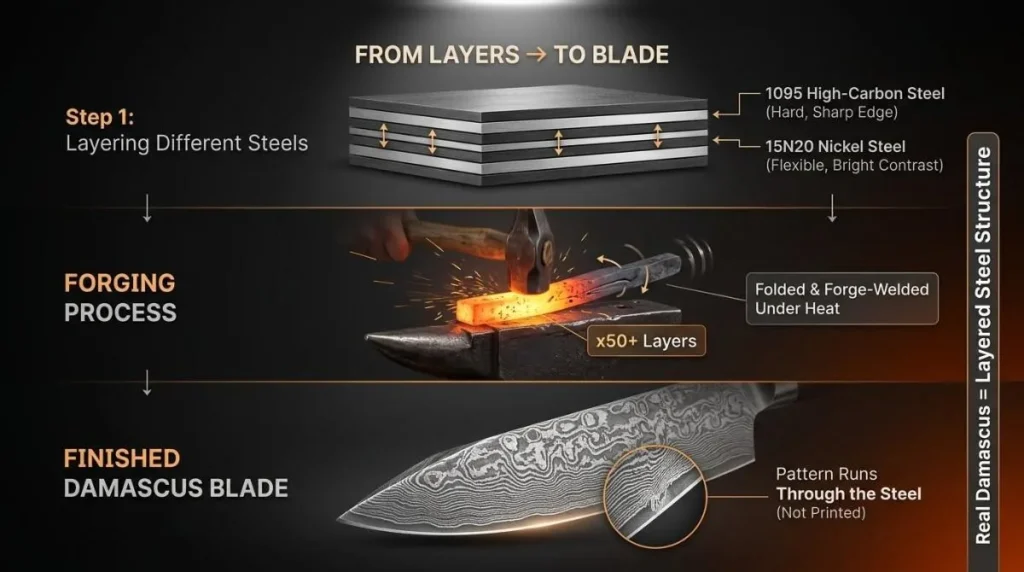
A Damascus steel knife is a blade made by forge-welding alternating layers of two different steel alloys typically a high-carbon steel and a nickel-alloy steel then folding, drawing, and grinding the billet to reveal a flowing pattern in the steel itself.
If you’re paying for real Damascus steel, you need to know exactly what you’re getting.
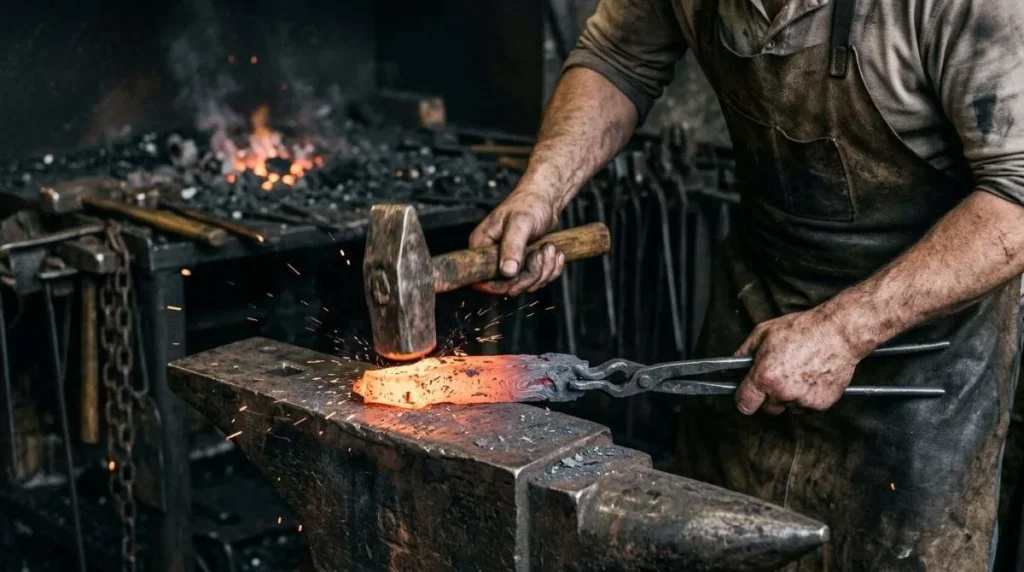
The original Damascus steel from the ancient world was a type of crucible steel called Wootz, made in India and the Middle East. That process is essentially a lost art. What we call Damascus steel today is pattern-welded steel: alternating layers of high-carbon and softer steel forge-welded under heat and hammer, folded to multiply the layers, then acid-etched so the different steels react and reveal the contrast pattern.
We use 1095 high-carbon steel paired with 15N20 nickel steel. The 1095 provides a razor-sharp cutting edge and exceptional toughness. The 15N20 creates the bright contrast that makes the pattern pop. Each billet is forged, drawn, and finished by hand in our Texas workshop no laser cutters, no assembly lines.
The result is not just a beautiful Damascus blade. The layered construction genuinely improves performance. The hard carbon layers give outstanding edge retention. The softer nickel layers provide flexibility that resists chipping. A well-made hand-forged Damascus knife performs better than single-alloy alternatives and lasts decades when cared for properly.
How to Tell Real Damascus from Fake — The Honest Test
This is the most important section in this guide. Every year, millions of Americans spend money on so-called “Damascus” blades that are nothing more than stainless steel with a decorative pattern printed on the surface.
Here is exactly how to tell the difference.
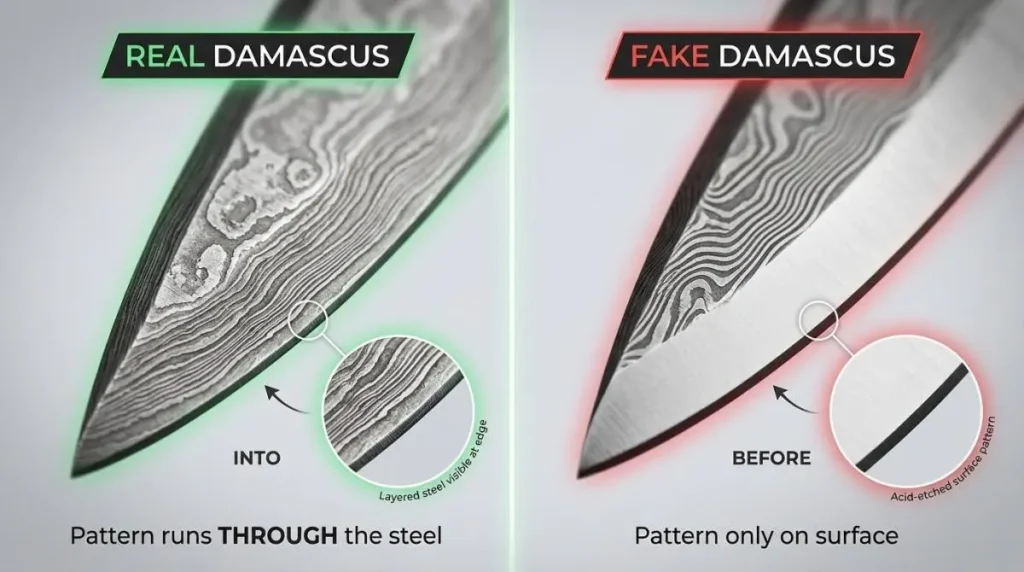
Look at the edge of the blade. On a genuine Damascus steel knife, the pattern continues right down to the cutting bevel , you can see the layers where the two sides of the edge meet. On a fake Damascus knife, the pattern stops or fades before it reaches the sharpened edge. The coating was only applied to the flat face.
Look at the spine. On real Damascus, the layers are visible on the spine too, not just the face. A fake Damascus blade shows a plain steel spine with no layering.
Run your fingertip across the flat of the blade. Real Damascus, after acid etching, has subtle 3D texture a faint but real ridged feel from one steel type reacting more to the acid than the other. A fake blade feels completely flat and smooth because the pattern is surface-only.
Check the price. A genuine hand-forged Damascus knife takes real time and skill to make. A Damascus kitchen knife selling for $15 is almost certainly a fake Damascus knife. Real Damascus steel commands higher prices because it requires real labor.
The sand test. This is the definitive test. Lightly sand a small area of the flat of the blade until the pattern disappears from that spot. Then apply a few drops of lemon juice or diluted acid to the sanded area. On real Damascus, the layers re-emerge because the pattern is structural it is in the steel, not on it. On a fake, the sanded area stays uniform with no pattern.
Damascus Knife Comparison: Kitchen vs. Hunting vs. EDC
Before diving into each use case, here is a side-by-side breakdown to help you find your match quickly.
| Feature | Damascus Kitchen Knife | Damascus Hunting Knife | EDC Folding Damascus Knife |
|---|---|---|---|
| Typical blade length | 8–10.5 inches | 7–12 inches | 2.5–3.5 inches |
| Blade style | Chef, bread, boning, paring | Drop point, clip point, gut hook | Drop point, tanto, clip point |
| Construction | Fixed blade, full-tang recommended | Full-tang fixed blade (non-negotiable) | Folding, liner lock or frame lock |
| Steel care needed | High — hand wash only, oil weekly | High — rinse and dry after field use | Moderate — wipe clean, occasional oil |
| Best for | Home cooks, professional kitchens | Field dressing, skinning, camp tasks | Daily carry, utility, emergencies |
| Handle materials | Micarta, pakkawood, stabilized wood | Stag antler, dyed wood, synthetic | G10, carbon fiber, titanium |
| Comes with sheath? | Leather chef’s roll (for sets) | Leather knife sheath (standard) | Pocket clip (sheath optional) |
| Price range | $50–$170 | $35–$90 | $17–$60 |
| Legal carry? | Kitchen use, no restrictions | Field/outdoor carry, check local laws | Most US states under 3 inches |
Choosing the Right Damascus Steel Knife for Your Needs
Here is the truth that most knife content skips: the best Damascus blade is not the one with the prettiest pattern. It is the one that fits how you actually use it. A beautiful chef’s knife in the wrong size makes dinner prep harder. A hunting knife with the wrong blade profile costs you precision in the field.
Damascus Kitchen Knives: What Home Cooks Actually Need
Most American home cooks own three or four knives they never fully use. They have a cheap chef’s knife that feels unbalanced, a bread knife that tears instead of slices, and a paring knife they use for everything else. The result is a kitchen experience that feels harder than it should.
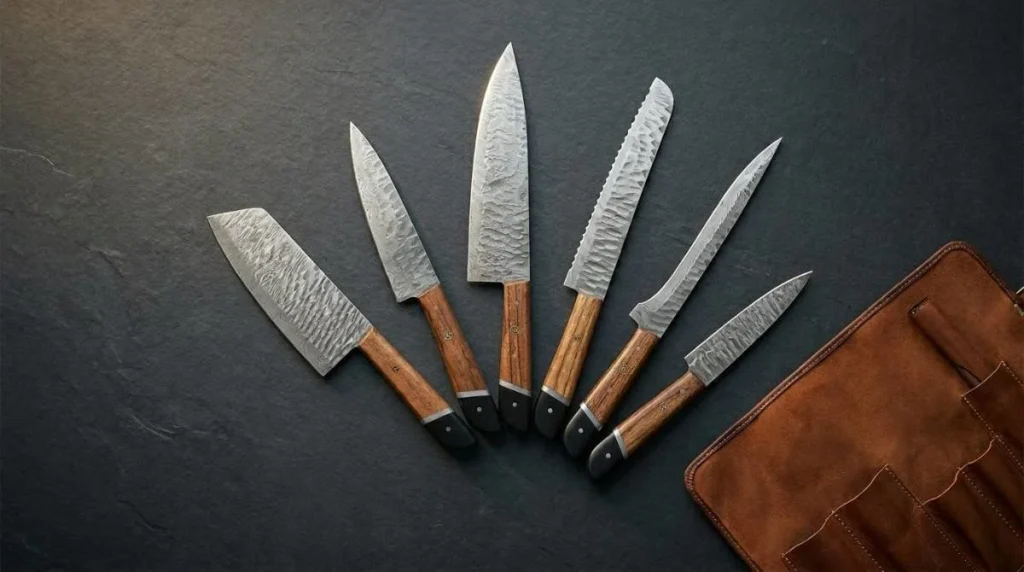
A hand-forged Damascus chef knife changes that entirely. Not as a luxury , as a functional upgrade.
The 1095 high-carbon core in a Damascus kitchen knife holds a sharper edge than mass-produced stainless steel knives. When you sharpen it on a whetstone at 15 to 17 degrees per side, you get a cutting edge that glides through onions, tomatoes, and herbs with zero resistance. And it stays sharp longer.
For most home cooks, a single 8 to 10.5-inch chef’s knife handles 80% of everything you do in the kitchen. Chopping vegetables, slicing proteins, mincing herbs, dicing onions one good blade does it all. Our 10.5-inch Hammered Damascus Chef Knife at $59.99 is the ideal first Damascus kitchen knife. It is hand-forged from real Damascus, includes a leather sheath, and outperforms mass-produced alternatives at two to three times the price.
For serious home cooks who want a complete kitchen knife set, our 5-Piece and 6-Piece Damascus sets include a chef’s knife, bread knife, boning knife, utility knife, and paring knife all in a leather chef’s roll. The 5-piece set starts at $152.99. The 6-piece set with Saddlewood Micarta handles runs $169.99.
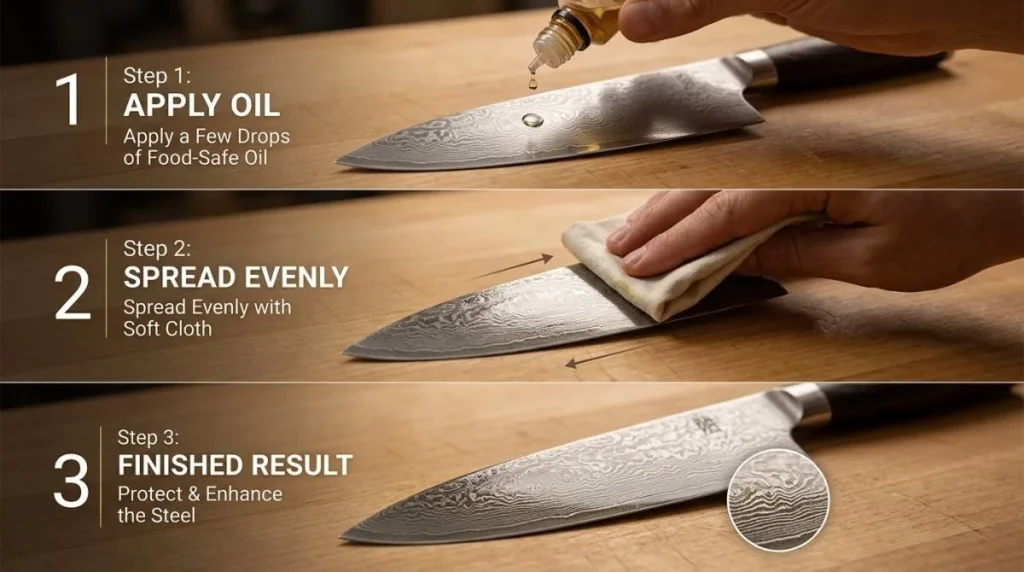
What most knife sellers don’t mention: Damascus kitchen knives need specific care. Never put them in the dishwasher. The heat and detergent attack both the high-carbon layers and the handle material. Hand wash and dry immediately after use. Apply a thin coat of food-safe mineral oil to the blade weekly if you use it regularly. A light patina forming on the dark layers is normal and protective do not sand it off.
Damascus Hunting Knives: What Actually Matters in the Field
Fall hunting season puts real demands on a blade that no kitchen will ever match. You are field dressing a deer in cold weather with wet hands, potentially hours from your truck. The hunting knife needs to hold an edge through a full field dressing job, survive rough handling, and clean up without rust destroying the blade overnight.
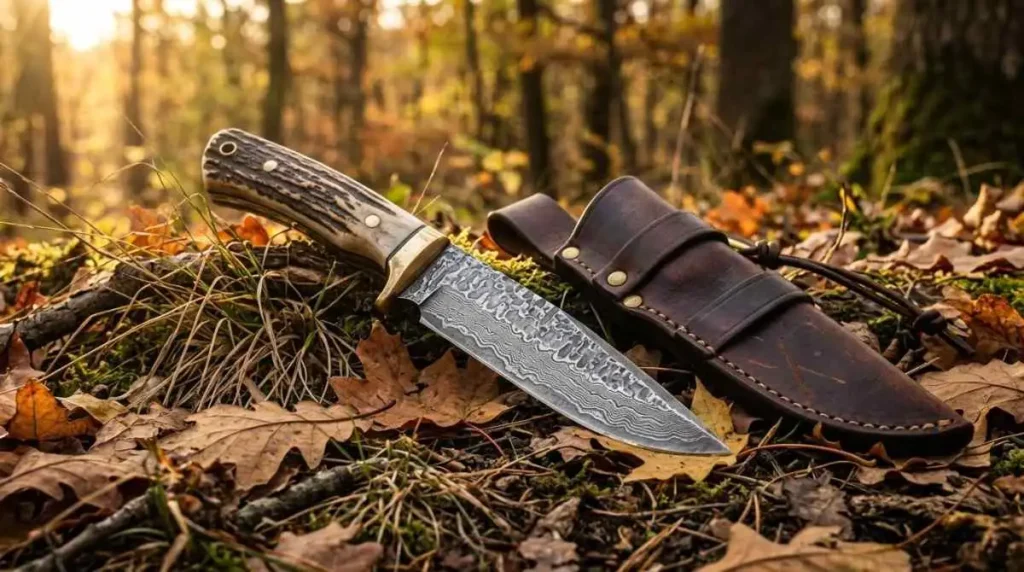
Here is what matters and what does not.
Full-tang construction is non-negotiable. A full-tang fixed blade knife has the steel running the full length of the handle. When you apply lateral force during skinning, or use the knife for camp tasks, there is no weak joint to fail. If a hunting knife does not explicitly say full tang, assume it is not.
Blade profile matters more than most buyers realize. The drop point profile where the spine curves gently down to a controlled tip is the best all-around hunting blade shape. It gives you controlled entry for gutting without puncturing organs, and a strong belly for skinning.
If you prefer to open the abdominal cavity with a gut hook skinner, a 9-inch Damascus gut hook skinner adds a sharpened hook on the spine specifically for that task. You zip open the hide and abdominal cavity cleanly without using the tip of the blade reducing the risk of puncturing the gut. Experienced hunters who field dress multiple animals per season find this feature genuinely useful.
Every serious hunting knife should ship with a fitted leather knife sheath. It protects the blade edge, protects you from accidental cuts, and makes safe belt carry possible in the field. That is not a minor detail it is a basic requirement.
Our Damascus knife for deer hunting lineup includes options at multiple price points. The Blue Rhino Hunter at $47.99 is our go-to recommendation for a reliable field blade. For a premium upgrade with a genuine stag antler handle, the Whitetail Stag Skinner at $85.99 is the most-purchased hunting knife among experienced buyers. Our Damascus Gut Hook Skinner at $87.99 covers both functions — drop-point main blade plus a gut hook on the spine.
Damascus EDC Folding Knives: Why What You Carry Every Day Should Mean Something
Most people carry a folding knife they never think about. A stamped factory blade in a plastic handle, bought at a gas station or grabbed off an Amazon listing. It opens packages. It gets the job done. And it means absolutely nothing.
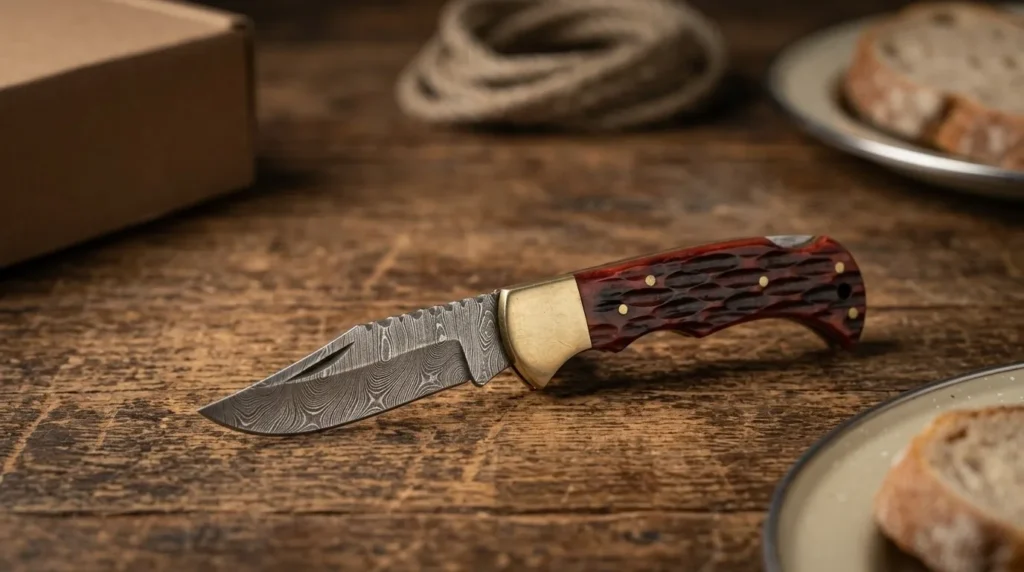
A hand-forged Damascus folding knife changes that relationship entirely.
When you pull a Damascus folder out of your pocket, you are carrying something made with real craft. Layers of high-carbon steel folded and forged by hand, acid-etched to reveal a pattern that no two blades share. It cuts better than the gas station knife. It holds that edge longer. And it starts more conversations than you expect.
For everyday carry, blade length is worth knowing. Most US states allow a blade under 3 inches without restriction. Our Damascus EDC line is built around that reality.
If you want Damascus steel that disappears on your keychain, the Damascus Toothpick Knife at $20.99 is the answer. A 4.25-inch overall Texas Toothpick pattern with a genuine stag handle and brass bolsters slim, sharp, and always there.
For a more capable pocket carry, the Ram Horn Damascus Folder at $53.99 steps up with a 3-inch Damascus blade, authentic ram horn scales, hand-filed spine work, and a lockback mechanism built for daily use. It comes with a leather belt sheath. This is the one you reach for at the end of every day and think about keeping forever.
For something with a little more character, the Emberlock Red Bone Damascus Folder at $35.99 pairs a Damascus blade with jigged red bone handle scales and brass bolsters traditional American pocket knife DNA with hand-forged steel.
The best EDC knife is the one you actually have with you. Make it one worth carrying.
The Steel Behind Every Damascus Blade: 1095 and 15N20
Steel specifications fill entire forums with debate. Most of it is theoretical. Here is what actually matters in practice.
Every Damascus blade we forge is built from 1095 high-carbon steel and 15N20 nickel steel. The 1095 is a classic American knife steel tough, easy to sharpen in the field with a simple whetstone, and capable of holding a genuinely sharp edge. The 15N20 adds nickel, which creates the bright contrast layer in the Damascus pattern and contributes flexibility.
The combined billet, heat-treated to 57–59 HRC, gives outstanding edge retention without the brittleness that comes with harder steels. You can field-sharpen a 1095-core blade with a basic whetstone. You cannot say that about all premium steels.
One note that often gets skipped: 1095 high-carbon steel is not stainless. It requires care. Rinse and dry after use. Apply a thin oil coat if you will not use the blade for a week or more. This is a worthwhile trade-off the edge performance and sharpening response of high-carbon Damascus steel is genuinely superior to comparable stainless options.
Caring for Your Damascus Steel Knife: The Simple Routine
Most Damascus knives are under-cared for simply because no one explains the routine in plain terms.
After every use: Rinse the blade under water. Dry it completely with a cloth before putting it away. Never let water sit on a Damascus blade , the 1095 layers will begin to rust within hours in humid conditions.
Weekly (if you use it regularly): Apply a thin coat of food-safe mineral oil or camellia oil to the blade with a cloth. This takes 30 seconds and prevents oxidation.
Every few months: Sharpen on a whetstone. For Damascus kitchen knives, use a 1000-grit stone to set the edge bevel at 15–17 degrees per side, then finish on a 6000-grit stone to refine and polish. This sharpening angle produces a very keen edge that the high-carbon core holds well.
Never: Put a Damascus knife in the dishwasher. The heat, detergent, and steam damage both the carbon layers and handle materials. Never use a pull-through sharpener the aggressive carbide teeth remove too much material and destroy the thin Damascus layers over time.
A dark patina forming on the blade face is not rust. It is a protective iron oxide layer that actually helps the blade resist further oxidation. Leave it alone. It is a sign the knife is aging correctly.
Knife Laws in the USA: What You Need to Know Before You Carry
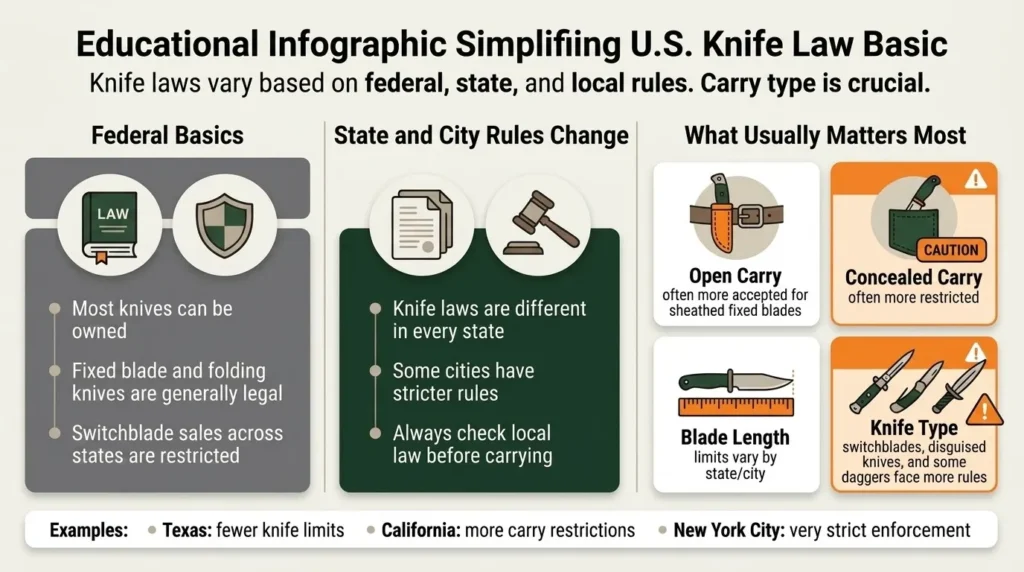
The United States has no single federal knife law. Regulations are set at the state, county, and city level and they vary significantly. Here is the practical overview.
Blades under 3 inches are legal to carry in most US states without restriction. This is why a good EDC folding knife line is designed around this length. Once you exceed 3 inches, check your specific state.
Texas has some of the most permissive knife laws in the country. Arizona is similarly permissive. Florida allows concealed carry of most folding knives statewide.
California bans automatic-opening knives and restricts concealed carry of most fixed blades. New York is significantly more restrictive, especially in New York City. Colorado limits concealed carry to blades under 3.5 inches.
For hunting knives and fixed blades: in most US states, carrying a fixed blade in a leather knife sheath on a belt is fully legal in outdoor and field settings. Always check your specific city ordinances separately from state laws urban restrictions are often much stricter.
For the most current state-by-state information, the American Knife and Tool Institute at akti.org maintains updated legal resources.
Laws change frequently — always verify with your state legislature’s official website before carrying.
FAQ: Frequently Asked Questions
What is a Damascus steel knife?
A Damascus steel knife is a blade made by forge-welding alternating layers of two different steel alloys typically high-carbon steel and nickel steel then folding and grinding the billet to reveal the flowing layered pattern that runs all the way through the blade.
How do I know if my Damascus knife is real?
Check whether the pattern continues down to the cutting edge bevel. On real Damascus, the layers are visible at the edge itself. On a fake Damascus knife, the pattern stops before the bevel. You can also run your fingernail lightly across the flat of the blade , real Damascus has a subtle textured feel from the acid etch; a fake blade is perfectly smooth.
What is the best knife for deer hunting?
For most deer hunters, a full-tang drop-point Damascus skinner in the 8-inch range is the ideal choice. Drop-point blades give you control during gutting without risking organ puncture, and a good belly for skinning. If you prefer a gut hook for opening the abdominal cavity, look for a gut hook skinner specifically designed for that task.
What is an EDC knife?
An EDC knife — everyday carry knife — is a folding blade carried in the pocket daily for common cutting tasks. The best everyday carry knives have a blade under 3 inches, a pocket clip for tip-up carry, a reliable lock mechanism, and weigh under 3 ounces.
How do I sharpen a Damascus kitchen knife?
Use a whetstone, not a pull-through sharpener. Start with a 1000-grit stone to establish the bevel at 15–17 degrees per side, then move to 6000-grit to polish. Work in sets of 10–15 strokes per side at a consistent angle. Finish on a leather strop. Most Damascus kitchen knives go from dull to shaving sharp in under 15 minutes with practice.
Do Damascus knives come with a sheath?
Quality Damascus hunting knives and fixed blades should always include a fitted leather knife sheath. Sets should include a leather chef’s roll. Never buy a hunting blade that does not include blade protection it is a basic sign of a quality purchase.
Which Damascus Knife Is Right for You? Quick Decision Guide
You cook regularly and want one great kitchen knife: Start with an 8 to 10.5-inch hand-forged Damascus chef knife. It handles 80% of everything you do in the kitchen and outperforms mass-produced alternatives at twice the price.
You want a complete kitchen upgrade: A 5 or 6-piece Damascus kitchen knife set with a leather roll covers every kitchen task chef’s knife, bread knife, boning knife, utility knife, and paring knife, ready to use from day one.
You are hunting deer this fall and want a reliable Damascus field knife: A full-tang drop-point Damascus blade with a dyed wood handle and leather sheath is the go-to recommendation. For a premium upgrade, step up to a genuine stag antler handle version.
You want a gut hook for field dressing: A dedicated Damascus gut hook skinner combines a drop-point main blade with a hook on the spine two functions in one knife.
You need a dependable daily carry knife: The most capable EDC option in most lineups is a G10 carbon fiber folding knife with a half-serrated blade. For lightweight keychain carry, a small carabiner folder clips directly to your gear.
You need a hard-use camp and trail knife: A Damascus kukri in the 13–14 inch range is built for batoning wood, clearing brush, and heavy outdoor chopping. A stacked leather handle and recurved blade multiply forward chopping force significantly.
Why Hand-Forged Matters — and Why It Does Not Always Cost More
The price-to-performance relationship in the knife market is not linear. A $60 hand-forged Damascus knife from a dedicated craft forge , where the money goes into steel and labor outperforms a $60 mass-produced branded knife where most of the price goes into marketing, packaging, and retail margin.
Our pricing is transparent. A 10.5-inch hand-forged Damascus chef knife at $59.99 covers steel, time, heat treatment, hand finishing, and a leather sheath. No factory shortcuts.
Every order includes free domestic USA shipping and delivery insurance. Returns are accepted on eligible items.
The knife you carry, cook with, or hunt with every day should be worthy of that use. That is why we forge every blade by hand and stand behind every piece we make.
Shop the full collection at axevarknives.com/knives/
Fast USA domestic shipping on every order. Delivery insurance included. Leather sheath or chef’s roll with every knife.
Written by the Axevar Knives Team , knife enthusiasts and researchers helping buyers find the right blade. Every guide is fact-checked against steel data, manufacturer specs, and trusted industry sources.