Wharncliffe Knife: What the Straight Edge Is Actually For (and Who Should Carry One)

Table of Contents
Most people meet the wharncliffe blade and quietly write it off. They see a knife with no belly, a spine that ramps straight down to the point, and they assume something is missing. Then they spend an afternoon trimming leather, scoring drywall on a flat bench, or making a long, dead-straight cut that any curved blade would have wandered off, and the wharncliffe suddenly makes complete sense.
That misread happens because most guides describe the shape in a sentence and move on. The wharncliffe is not a knife with the curve sanded off. It is a deliberate piece of geometry built around one idea: a perfectly straight edge that puts every millimeter of steel in contact with your work, with a fine point for detail and almost no risk of the edge rolling away mid-cut. Once you see what that trade buys, the shape stops looking incomplete and starts looking purpose-built.
This guide covers the geometry, the genuine history (including the naming argument nobody settles), who actually carries one, the steel that matters, how to sharpen the one tricky part, and where the wharncliffe earns its keep versus where it does not. For the full map of every common shape, our knife blade types pillar guide shows where the wharncliffe sits in the larger family. This is the deep dive.
What Is a Wharncliffe Knife?
A wharncliffe knife is a blade with a completely straight cutting edge and a spine that slopes gradually downward from the handle to meet that edge at a fine, acute point. There is no belly and no upward curve. The result is a blade engineered for controlled, precise cutting rather than sweeping or rocking cuts.
That single description explains everything the shape does well and everything it cannot do. Flat edge for control, descending spine for a keen tip, no belly for slicing efficiency. Every strength and every limitation of the wharncliffe blade flows from that one geometric decision.
You will see the term written a few ways across catalogs: wharncliffe blade, wharncliffe knife, and the plurals wharncliffe blades and wharncliffe knives. They all describe the same profile. It is closely related to the sheepsfoot blade but with one important difference we will get to in a moment.
Wharncliffe Blade Anatomy: Understanding the Geometry
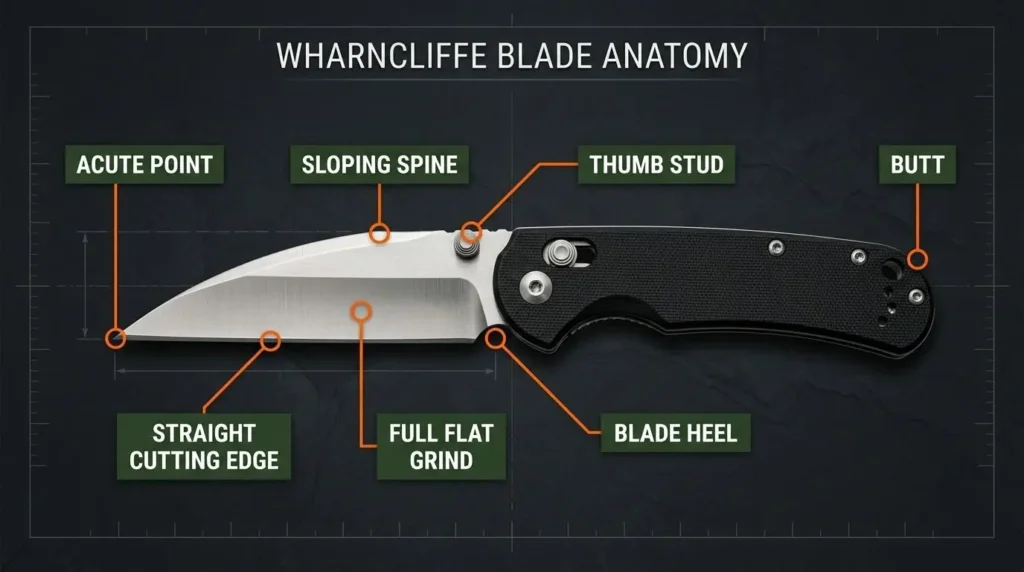
The wharncliffe blade shape comes down to four features that separate it from every other profile.
The straight cutting edge. The edge runs flat from heel to tip with no curve at all. On a flat surface, the entire edge touches the material at once, which is what gives the wharncliffe its signature control on push cuts and long straight slices. There is no belly to roll through a cut, which is a deliberate trade, not an oversight.
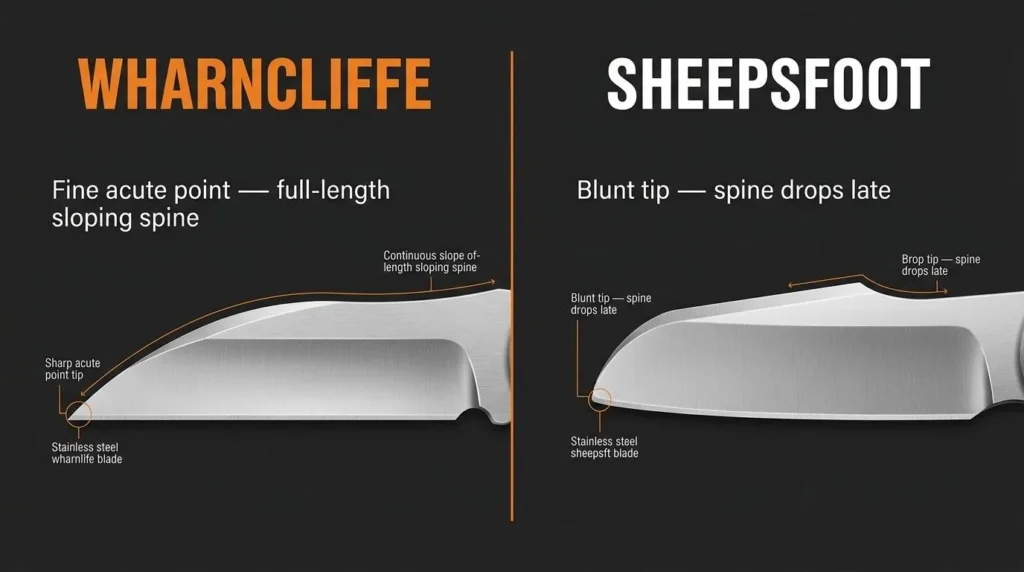
The sloping spine. This is the defining feature and the thing that separates a wharncliffe from a sheepsfoot. The spine starts straight along the top of the blade and descends in a long, gentle taper toward the tip. On a sheepsfoot, that drop happens late and steeply, leaving a blunt nose. On a wharncliffe, it begins early and runs the length of the blade, driving the spine all the way down to a true point.
The acute point. Where the sloping spine meets the straight edge, the wharncliffe forms a fine, low-set point. Unlike the sheepsfoot’s blunt false tip, this point pierces and handles detail work. It also sits low, near the centerline of the blade, which keeps it controllable. The catch is that this fine tip is the thinnest, most fragile part of the knife, and it has direct consequences for how you sharpen it.
The grind. The classic wharncliffe wears a full flat grind, which suits its role as a controlled slicer and adds strength behind the edge. But the shape works with several grinds, and the choice changes how the blade behaves.
Wharncliffe Grind Types
The grind sitting on a wharncliffe edge matters more than people expect. A full flat grind is the traditional choice and the best all-rounder, balancing slicing ability with a durable edge. A hollow grind thins the edge dramatically for cleaner, more aggressive slicing, which is why several modern tactical wharncliffes use it, at the cost of a slightly more delicate edge. A scandi grind is popular on bushcraft-leaning fixed blades and is exceptionally easy to maintain on a flat stone. A chisel grind, ground on one side only, appears on some utility and Japanese-influenced patterns and gives the thinnest, sharpest edge of all, though it cuts with a slight bias.
Whichever grind you choose, the straight edge makes a wharncliffe genuinely simple to sharpen, with one exception at the tip that we will cover in detail below.
Wharncliffe Blade History (and the Naming Question)
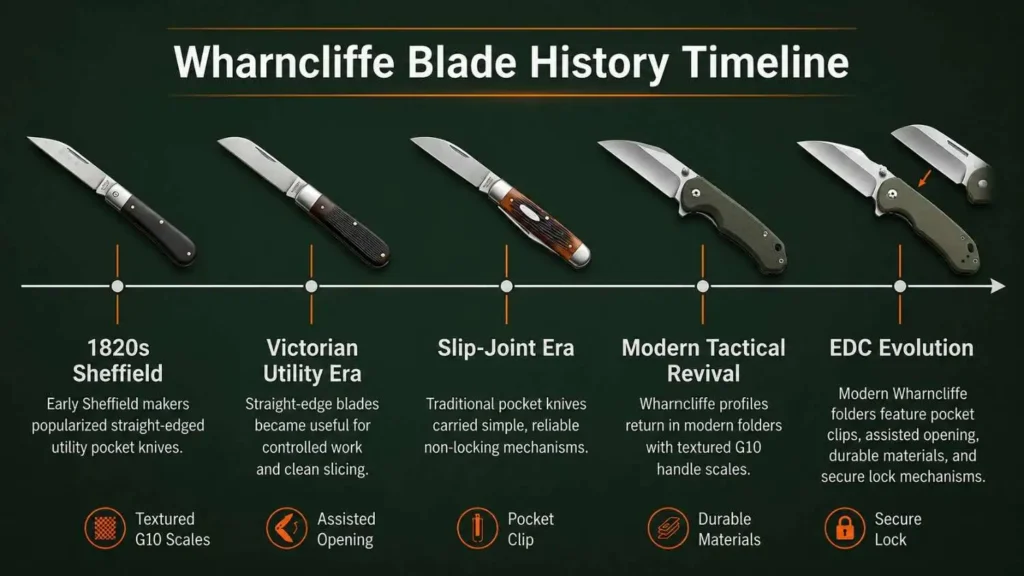
The wharncliffe is one of the few blade shapes named after a person rather than a function, and the story sits squarely in the golden age of Sheffield cutlery. Around the 1820s, James Archibald Stuart-Wortley-Mackenzie, the 1st Baron Wharncliffe, is credited with discussing a new blade design that would give the folding knives of the day, then a recent innovation, a strong, controllable straight edge. He took the idea to the renowned Sheffield firm Joseph Rodgers & Sons, who brought it to life, and the pattern carried his title forward as the wharncliffe.
That is the popular account, and it is worth knowing there is a competing one. Some sources argue the name traces instead to Wharncliffe Wood in southern Yorkshire, near the lord’s estate, rather than the man directly. Both explanations point to the same family and the same region, so the truth may simply be that the place named the title and the title named the blade. Either way, the wharncliffe pattern was a Sheffield creation, and traditional wharncliffe knives still carry that slip-joint, gentleman’s-knife heritage.
The shape rose and faded in popularity for over a century, surviving as a staple in traditional multi-blade folders. Its modern revival came from an unexpected direction. In the 1990s, self-defense instructor Michael Janich, founder of Martial Blade Concepts, argued that the straight edge and forward-driving point made the wharncliffe unusually effective and controllable, and partnered with Spyderco to produce the Ronin and then its folding successor, the Yojimbo. That collaboration dragged a nearly two-century-old gentleman’s pattern into the modern EDC and tactical world, where it has stayed ever since.
What Is a Wharncliffe Blade Used For?
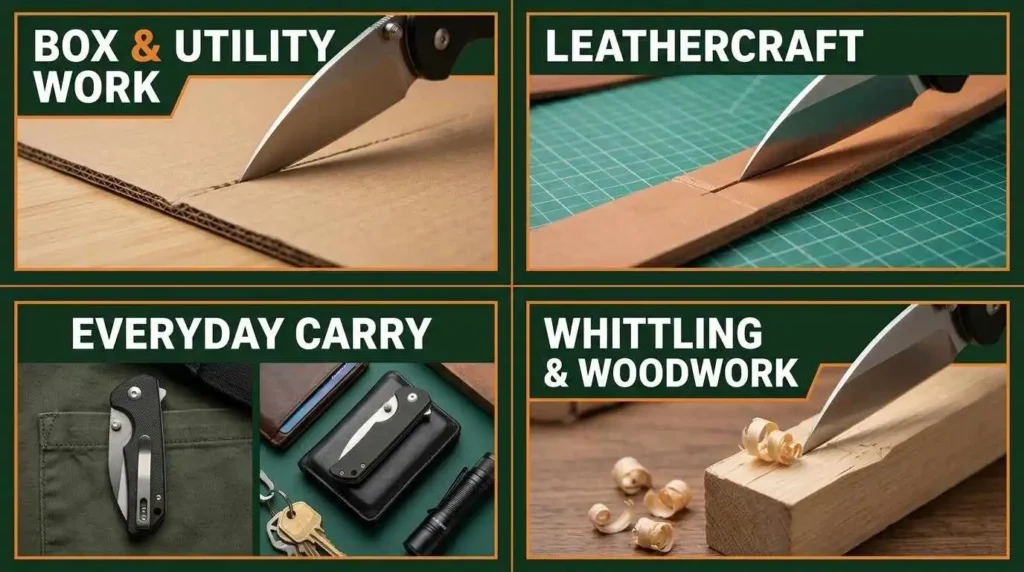
The wharncliffe is a precision specialist. Here is where the straight edge genuinely outperforms.
Wharncliffe for EDC
A wharncliffe EDC knife is an excellent everyday choice for anyone whose daily cutting leans toward utility and detail rather than the outdoors. Opening mail and packages, breaking down boxes, cutting tape and zip ties, trimming loose threads, the wharncliffe handles all of it with more control than a drop point and a less aggressive look than a tanto. The low, fine point excels at the small, fiddly punctures EDC throws at you, like starting a cut in shrink wrap or popping a staple. Most wharncliffe pocket knives and wharncliffe folding knives land in the practical 3-inch range, and compact mini wharncliffe folders make a tidy, low-profile carry.
Wharncliffe Utility and Box Work
This is the shape’s home turf. A wharncliffe utility knife slices clean on a flat surface because the whole edge contacts at once, scoring cardboard, drywall, gasket material, and packaging far more cleanly than a curved blade that only touches in a small arc. Warehouse and trade workers who open and break down material all day get real mileage out of the straight edge.
Wharncliffe for Leathercraft
Leatherworkers prize the wharncliffe for the same reason a straightedge and a sharp blade beat scissors: dead-straight, repeatable cuts. Trimming straps, skiving edges, cutting welts, and following a ruler all reward an edge with no belly to drift off the line. The fine point gets into corners and tight curves that a rounded tip cannot reach, which makes it a quiet favorite for wallet and sheath makers.
Wharncliffe for Whittling and Woodworking
It is fitting that one of the wharncliffe’s best modern jobs is close to its original one. The early pattern was conceived partly for woodwork, and the straight edge still shines at whittling, fine carving, and detail work where you push the edge in controlled passes and steer with the low tip. It is not a chopper or a roughing tool, but for clean, deliberate cuts in wood it is hard to beat.
Rescue and First-Responder Use
Like the sheepsfoot, the wharncliffe is valued as a rescue knife because the low, controllable point cuts seatbelts, clothing, and webbing with reduced risk of jabbing the person being freed. First responders who want a bit more piercing ability than a fully blunt sheepsfoot, while keeping the straight slicing edge, often reach for a wharncliffe or modified wharncliffe.
Where It Falls Short
An honest guide says where a shape struggles. The wharncliffe has no belly, so it is poor at the rolling, sweeping cuts that skinning and food prep depend on, and it does not bore or drill as comfortably as a curved tip. For hunting, field dressing, and general bushcraft, a drop point knife is simply the better tool. The fine tip is also vulnerable to lateral stress, so prying is a quick way to snap a point. Match the wharncliffe to controlled cutting, and pair it with a sturdier blade if your day includes rough outdoor work.
The Modified Wharncliffe and Other Variants
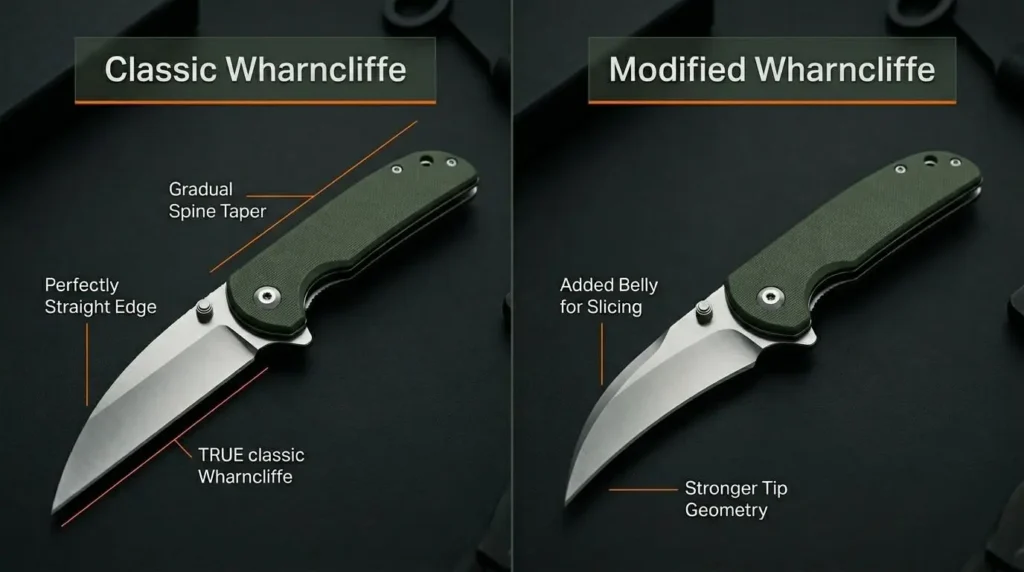
The classic wharncliffe is flat from heel to tip, which is perfect for push cuts but gives up some efficiency on draw cuts. The modified wharncliffe is the refinement. It adds a subtle, sloping belly near the tip to improve slicing while preserving the straight working edge and the forward point. Many modern designs, including reinterpretations on platforms like the Rick Hinderer XM-18, also leave more steel behind the point to address the fragility of the traditional fine tip.
It is also worth clearing up the reverse wharncliffe, a term people confuse with the reverse tanto. A reverse wharncliffe flips the geometry so the spine drops near the handle and the point rides high, the inverse of the standard layout. If you are sorting out the broader point-up family, our tanto knife guide breaks down the reverse tanto, which is a different shape entirely despite the similar name.
Notable Wharncliffe Knives
A few designs anchor the wharncliffe’s modern reputation and are worth knowing as reference points. The Spyderco Yojimbo 2 is the most influential, the folding result of Michael Janich’s collaboration with Spyderco, and the knife most responsible for the shape’s tactical revival. Spyderco’s Lil’ Native Wharncliffe brought the profile to a popular compact EDC platform with a full-flat-ground blade. On the custom and hard-use side, the Hinderer XM-18 wharncliffe is a benchmark for a reinforced, modern interpretation. And for traditionalists, classic Sheffield slip-joint patterns and the close-cousin sheepsfoot carry the original gentleman’s-knife lineage. None of these are required to appreciate the shape, but together they map how a 19th-century idea became a 21st-century staple.
How to Sharpen a Wharncliffe Blade
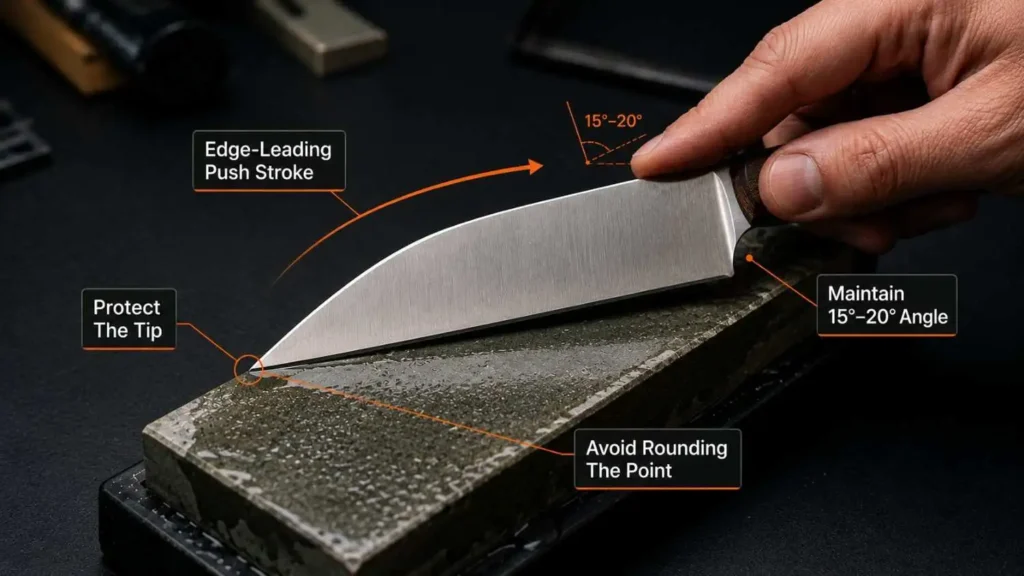
Here is the section every other guide skips. They all tell you a wharncliffe is “easy to sharpen because the edge is straight,” and they are half right. The straight edge is genuinely simple. The problem is the tip, and if you sharpen a wharncliffe the way you sharpen a normal blade, you will round off the point and ruin the profile over time. This is the single most common wharncliffe sharpening mistake, and the fix is straightforward once you understand the cause.
Why the tip rounds off. When you sharpen by pulling the blade toward you and letting the tip run off the end of the stone, you apply extra pressure right at the point and remove more steel there than anywhere else. Do that repeatedly and the once-sharp wharncliffe point slowly turns into a curve. It is the same way an old, over-sharpened sheepsfoot ends up looking like a spey blade.
The fix: sharpen tip-first with push strokes. Set the tip end of the edge on the stone and push away from yourself, working from the tip back toward the heel, rather than dragging the blade toward you and running off the point. Keeping the tip planted and pushing into the stone protects the point instead of grinding it away. Many experienced sharpeners do the last half-inch at the tip first, then blend the rest of the straight edge into it, stopping short of the point so they never drag across it.
A simple step-by-step:
- Mark the entire edge with a permanent marker. This shows you exactly where you are removing steel and confirms you are hitting the whole bevel.
- Set your angle. A wharncliffe sharpens well at roughly 18 to 20 degrees per side, which is about 36 to 40 degrees inclusive. A guided system or the slots on a fixed-angle sharpener make this consistent.
- Start at the tip and push the edge away from you along the stone, keeping steady, even pressure and a locked wrist so the angle never changes.
- Work back toward the heel in overlapping passes, checking that the marker is disappearing evenly.
- Flip and repeat on the other side, matching your stroke count.
- Move to finer grits, then finish on a strop to refine the edge.
Because the edge is dead straight, a simple flat bench stone is all you need, no following a curve. Just keep the angle locked and never let the tip run off the end of your sharpener. Get that one habit right and a wharncliffe is one of the easiest blades you will ever maintain.
Steel Selection for Wharncliffe Knives
The right steel depends on whether you value corrosion resistance, edge retention, or easy maintenance, and the wharncliffe’s fine tip adds one extra consideration.
Carbon steels like 1095, 1084, and 5160 are traditional choices, offering excellent toughness and an easy-to-sharpen edge, at the cost of needing care to prevent rust. Stainless steels like AUS-8, 154CM, VG-10, D2, Sandvik 12C27, and premium CPM S30V give strong corrosion resistance and good edge retention, which suits a knife that lives in a pocket. Most quality wharncliffe knives land around 56 to 62 HRC. There is a real trade-off at the tip: harder steel (60-plus HRC) holds an edge longer but is more brittle, and on a thin wharncliffe point, brittleness shows up as chipping. If you use the tip hard, slightly tougher steel at a moderate hardness will serve you better.
For those drawn to pattern-welded blades, a damascus wharncliffe knife pairs the shape’s clean lines with striking layered steel, and the same metallurgy rules still apply. Our Damascus steel knife guide explains what the layering does and does not do for performance, which is worth reading before you judge a blade by its pattern.
Are Wharncliffe Knives Legal?
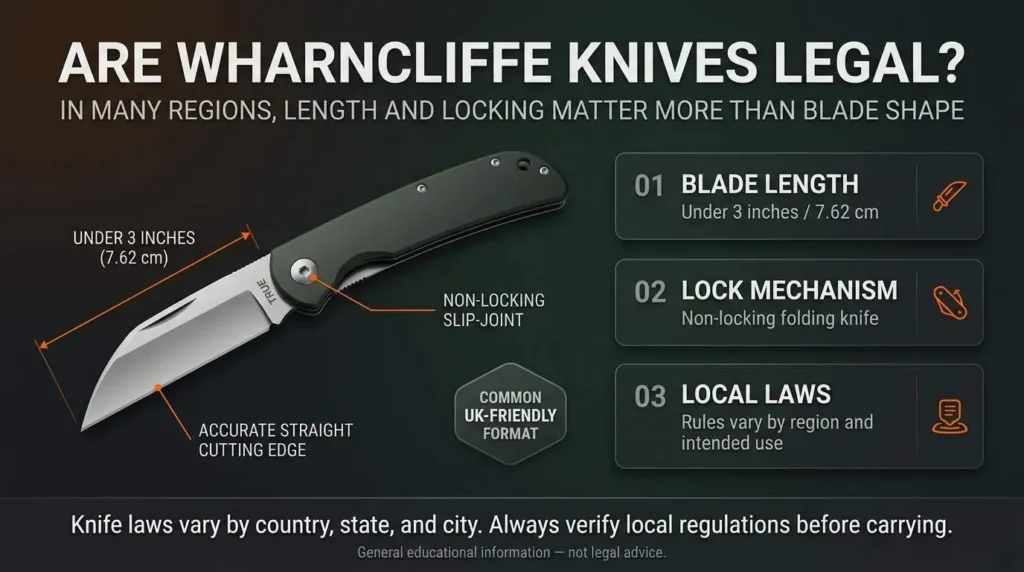
This is another area competitors ignore, and it is one where the wharncliffe genuinely stands out. In most places, a knife’s legality depends on its mechanism and blade length rather than the blade shape itself, but the wharncliffe pairs unusually well with the strictest carry rules.
In the United Kingdom, for example, you can generally carry a folding knife without needing a specific reason only if it is non-locking and has a cutting edge under 3 inches (7.62 cm). That is exactly the territory where the wharncliffe shines: it adapts perfectly to a non-locking slip-joint mechanism, and its controlled, low point makes a compact “UK-friendly” carry that is practical without being aggressive. A wharncliffe slip joint is one of the most popular UK-legal EDC formats for that reason, and several makers build sub-3-inch wharncliffe slip joints specifically for that market.
That said, knife laws vary widely by country, state, and even city, and lock type, opening mechanism, and intent can all matter. This is general information, not legal advice, so always confirm the current rules where you live and travel before you carry. For UK readers, the official guidance on buying and carrying knives is the authoritative starting point.
Wharncliffe vs Other Blade Shapes
Quick orientation against the shapes people most often compare it to. We are building dedicated head-to-head guides for these, but here is the short version.
Wharncliffe vs sheepsfoot: nearly the same idea, but the wharncliffe’s spine slopes the full length of the blade to a true, usable point, while the sheepsfoot drops late to a blunt, safety-first tip. Choose wharncliffe when you need the point; choose sheepsfoot when you want zero piercing risk.
Wharncliffe vs drop point: opposite philosophies. The wharncliffe is flat and precise; the drop point has a belly built for slicing, skinning, and general outdoor work. Detail versus versatility.
Wharncliffe vs tanto: both are strong-point shapes, but the tanto concentrates strength in a high, angular tip for piercing hard material, while the wharncliffe keeps a low, fine point and a continuous straight edge for control.
Wharncliffe vs clip point: the clip point gives you a fine tip plus a belly, making it more of a generalist, where the wharncliffe is the dedicated straight-cut specialist.
Wharncliffe vs lambsfoot: very close cousins from the same British tradition; the lambsfoot’s spine curves more gently and the point sits a touch higher, but in daily use they are near-interchangeable.
Wharncliffe Blade Pros and Cons
No shape wins every job, and the wharncliffe trades honestly.
On the positive side: outstanding control on straight and push cuts, full-edge contact on flat surfaces, a fine forward point that handles detail work and small punctures, an exceptionally easy edge to sharpen once you protect the tip, a clean non-threatening look, and a profile that adapts beautifully to UK-legal slip-joint carry.
On the negative side: no belly, so it is weak at sweeping, rolling, and skinning cuts; a fine tip that chips or rounds if you pry with it or sharpen it carelessly; limited bushcraft and food-prep utility; and a look some traditional buyers find unusual at first glance.
Frequently Asked Questions
Are wharncliffe knives good?
Yes, for the right user. If your cutting is mostly utility, detail, and straight-line work, a wharncliffe gives you more control than almost any other shape. It is the wrong pick only if you mainly skin, field-dress, or need a do-everything outdoor blade.
What is the benefit of a wharncliffe blade?
Control. The straight edge contacts your work along its full length, so cuts go exactly where you aim them, and the low point handles fine detail. That makes it ideal for leatherwork, whittling, box work, and precise EDC tasks.
Why is it called a wharncliffe?
It takes its name from the 1st Baron Wharncliffe, who is credited with the design’s creation in 1820s Sheffield, though some sources tie the name to Wharncliffe Wood in Yorkshire near his estate. Both point to the same family and region.
Is a wharncliffe good for self-defense?
Some instructors, notably Michael Janich, have built defensive systems around the shape because of its control and forward point. That said, this is a sensitive and heavily regulated area, carry laws differ everywhere, and capability is no substitute for training and legality. Treat any defensive use as a serious decision and check your local law first.
Can you sharpen a wharncliffe on a regular stone?
Yes. Because the edge is straight, a flat bench stone is ideal. The only rule is to push from the tip back rather than dragging the blade and running off the point, which is what rounds the tip over time.
What is a reverse wharncliffe?
It inverts the standard layout so the spine drops near the handle and the point sits high. It is a distinct shape from the reverse tanto, despite the similar naming.
Final Take
The wharncliffe is not a knife with something missing. It is a knife with something specific to offer: a straight edge that gives you control most blades cannot, and a fine point that handles detail most straight edges lack. That combination is wasted on a hunter and perfect for a leatherworker, an electrician, a whittler, or anyone who values clean, deliberate cuts over rough versatility.
Carry one if your work lives on flat surfaces and straight lines, sharpen it tip-first to keep that point sharp, and match the steel to whether you fear rust or chasing the stone. Used for what it was built to do, the wharncliffe is one of the most quietly capable shapes you can put in your pocket. For the full lineup of profiles and where each one fits, head back to our knife blade types guide.