Sheepsfoot Knife: What It’s Actually Made For (and Who Should Carry One)

Table of Contents
The sheepsfoot knife gets dismissed a lot. People see the blunt tip, decide it looks incomplete, and reach for something pointier. Then they end up cutting a seatbelt, opening fifty boxes a day, or working with rope on a moving deck, and suddenly the pointier knife is the wrong tool.
Most blade guides describe a sheepsfoot in two sentences and move on. That is exactly why people misjudge it. The shape is not a watered-down knife with the tip cut off. It is a deliberate piece of geometry built around one principle: maximum cutting control with zero piercing risk. Once you understand what that trade-off actually buys you, the sheepsfoot stops looking strange and starts looking obvious, for the right user.
This guide covers the geometry, the real history, who actually uses these knives, the steel choices that matter, and an honest look at where the sheepsfoot earns its keep versus where it does not. For the bigger picture across every common shape, our knife blade types pillar guide maps where the sheepsfoot sits in the larger family. This is the deep dive.
What Is a Sheepsfoot Knife?
A sheepsfoot knife is a blade profile with a perfectly straight cutting edge and a dull, gently curving spine that drops down to meet the edge at a blunt, rounded tip. The result is a false point: the tip exists geometrically but has no piercing capability.
That is the whole sheepsfoot blade shape right there. Flat edge for slicing, dropped spine for safety, no functional point. Everything the sheepsfoot does well, and everything it cannot do, comes from that one decision.
You will see the same word spelled three ways: sheepsfoot, sheep foot, and sheepfoot. They are identical. The one-word spelling is the most common and the one most catalogs use.
Sheepsfoot Blade Anatomy: Understanding the Geometry
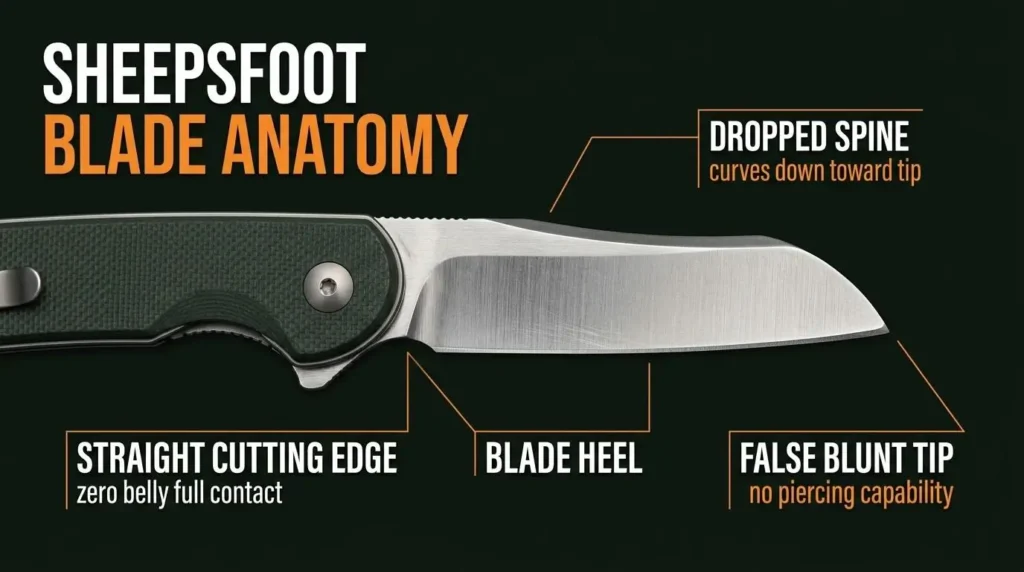
The sheepsfoot blade shape is defined by four features that set it apart from every other profile.
The straight edge. Unlike a drop point or clip point, the cutting edge does not curve. It runs flat from heel to tip. This eliminates the belly most knives have and changes how the blade behaves on a cutting surface: every part of the edge touches at the same time, which is exactly what you want for push cuts and controlled slicing.
The dropped spine. The spine starts straight along the top of the blade and curves downward to meet the edge. A steeper drop gives you the squared-off classic sheepsfoot. A gentler drop gives you something closer to a wharncliffe.
The false point. Where the spine meets the edge, you get a tip, but it is blunt. Depending on the maker, this can be a 90-degree corner (useful for striking a ferro rod) or a softly rounded curve (preferred for rescue work where any sharp corner is a liability).
The grind. Sheepsfoot blades work with almost every grind type. A flat grind gives balanced cutting performance. A chisel grind, common on Japanese and traditional patterns, gives a thinner, more aggressive edge for slicing. The straight edge makes all of these easier to sharpen than curved profiles.
This blade is engineered to slice with maximum control while making it physically difficult to puncture anything you did not mean to.
Sheepsfoot Blade History
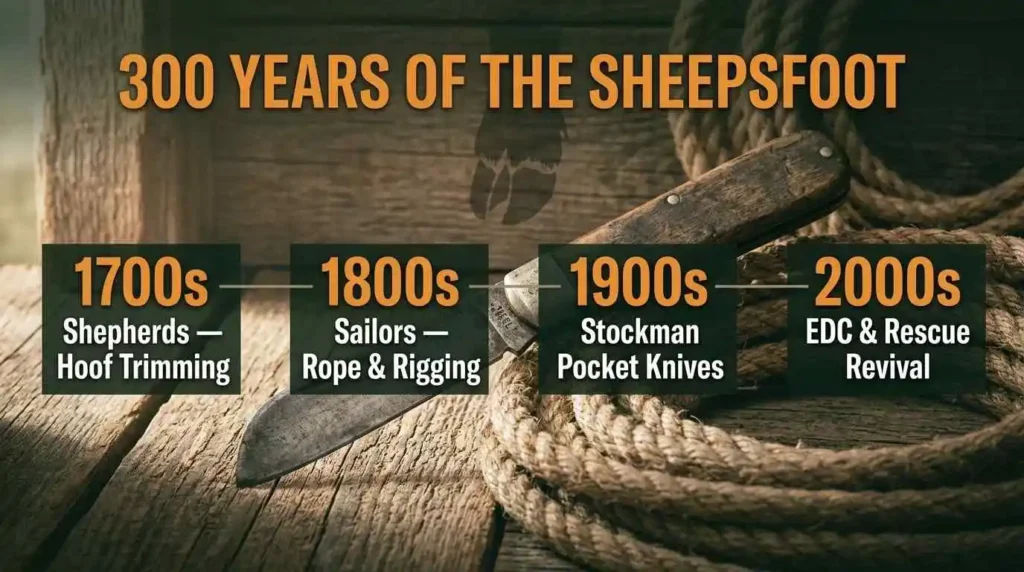
The name is literal. In the 1700s, shepherds needed a knife that could trim overgrown hoof material from sheep without slipping and injuring the animal. A straight edge gave them controlled cutting power against tough hoof. The dropped, rounded tip meant a startled animal could not get jabbed by a slipped knife. The shape worked, the name stuck, and the design spread well beyond livestock.
Sailors picked it up for the same reason: a pointy knife on a rocking deck is a problem. Cutting frozen rope, working around fragile sails, breaking up jams in pulleys, every one of those tasks rewards a flat slicing edge and punishes a pointed tip. The sheepsfoot became the standard maritime blade for several centuries, and there is a popular story that ship captains broke the points off their crewmen’s knives to prevent fights and accidents on board.
By the early 20th century, the shape was a fixture in folding pocket knives across Europe and America. The traditional American stockman pattern usually carries three blades, and one is almost always a sheepsfoot, designed specifically for the precision work a cattle rancher needs.
The modern revival came from two directions: rescue services adopting the shape for first-responder knives in the 1980s and 1990s, and custom makers like Rick Hinderer reinterpreting it for everyday carry in the 2000s. The sheepsfoot did not get popular again because it was new. It got popular because the original problem it solved has never gone away.
What Is a Sheepsfoot Blade Used For?
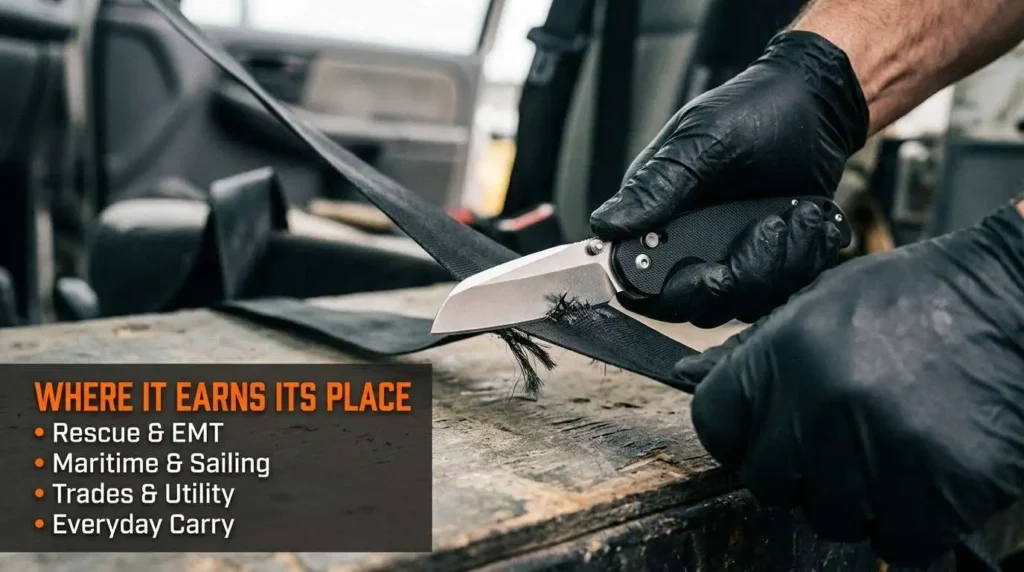
The sheepsfoot is a specialist, not a generalist. Here is where it actually earns its place.
Sheepsfoot Rescue Knives and Emergency Services
EMTs, paramedics, firefighters, and search-and-rescue teams rely on sheepsfoot rescue knives for one specific reason: they cut seatbelts, clothing, and webbing without risking deeper injury to the person trapped inside. When you are slicing fabric across someone’s chest, a pointed tip is the last thing you want near skin. The flat edge does the cutting work; the blunt tip stays out of trouble. This is the single strongest case for the sheepsfoot, and it is why most purpose-built rescue knives use either this shape or its close cousin, the modified sheepsfoot.
Maritime and Sailing Use
Cutting rope, line, and rigging on a boat, especially under load or in bad weather, rewards a blade you can drag across material without the tip catching or piercing what is underneath: your other hand, a sail, or an inflatable. The straight edge gives even pressure across the cut. The blunt tip will not punch through fabric or hull material. This is the use case that defined the sheepsfoot knife for sailors across centuries.
Electricians, Tradespeople, and Box Work
Stripping wire jackets, scoring drywall, cutting cardboard, opening packaging, slicing tape and foam, these are all sheepsfoot utility knife tasks. The flat edge slices clean on a flat surface like a workbench or floor, much cleaner than a curved blade that only contacts material in a small arc. Tradespeople have carried sheepsfoot patterns for over a century for exactly this kind of work.
Sheepsfoot EDC Knives
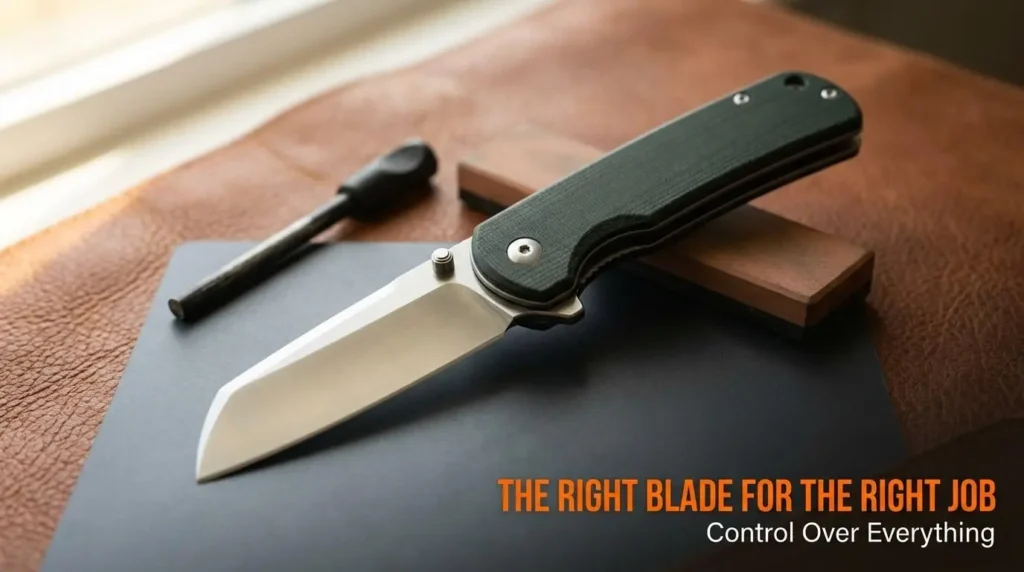
A sheepsfoot EDC knife is a quietly excellent choice if your daily cutting tasks lean toward utility rather than outdoor or defensive use. Mail, packages, food prep, loose threads, broken zip ties, the sheepsfoot handles all of it with more control than a drop point and considerably less anxiety than a tanto. Pocket-friendly profiles in the 3-inch range are the most common form factor for sheepsfoot folding knives and sheepsfoot pocket knives.
It is also worth noting that a sheepsfoot does not look threatening. In professional settings or restrictive environments, that matters. A knife with a flat edge and a rounded tip draws far less reaction than something with a tactical clip point.
Sheepsfoot Kitchen Knives and the Santoku Connection
The Japanese santoku knife is, geometrically, a sheepsfoot. Straight edge, dropped spine, blunt tip, same DNA. Santoku translates roughly to “three virtues,” referring to its use on meat, fish, and vegetables. The reason it works so well in the kitchen is identical to why a sheepsfoot works at sea: a flat edge against a flat surface gives you clean, controlled, full-contact cuts every time. A sheepsfoot kitchen knife and a santoku are solving the same problem at different scales.
Sheepsfoot Fixed Blade and Folding Options
The shape works across formats. Sheepsfoot fixed blade knives are popular in maritime and rescue contexts where a locking mechanism is a liability. Sheepsfoot folding knives cover EDC, traditional patterns like the stockman and Barlow, and modern tactical folders. Sheepsfoot pocket knives in compact sizes are a strong option for anyone who wants a low-profile, non-threatening carry.
Bushcraft and Outdoors: Where It Falls Short
A sheepsfoot is not a good bushcraft blade. You cannot reliably bore a hole, field-dress an animal without awkward angles, or drill a fire-board notch the way you would with a drop point. If your primary use is hunting, skinning, or wilderness survival, a drop point knife handles those tasks far better.
A sheepsfoot can work as a secondary woods blade paired with a chopper or fixed-blade survival knife, but as a sole bushcraft tool, it is the wrong choice.
The Modified Sheepsfoot Blade
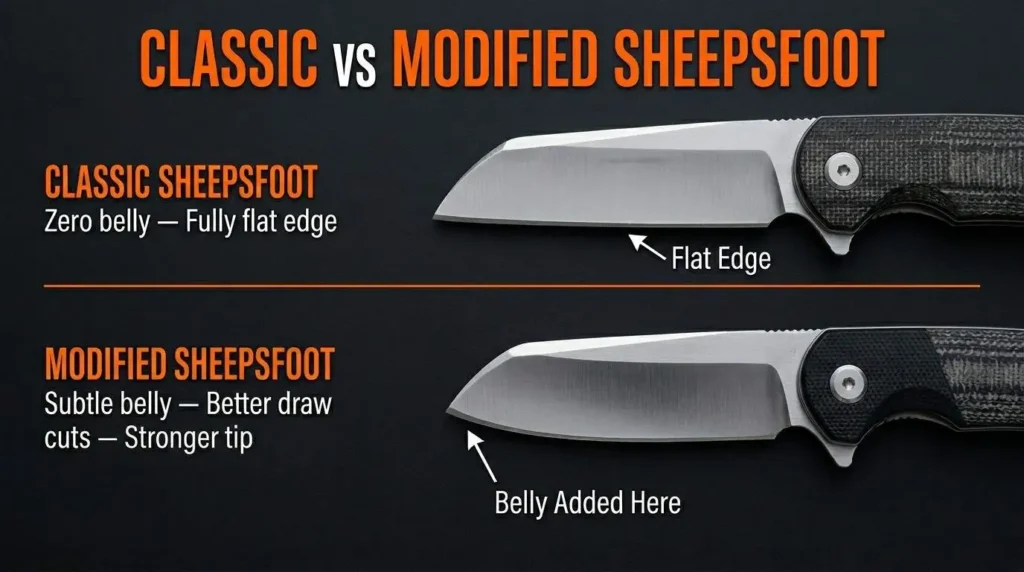
The classic sheepsfoot has a near-zero belly, completely flat from heel to tip. That works well for push cuts but loses some efficiency on draw cuts where a slight belly helps the blade roll through material.
The modified sheepsfoot blade is the refinement. Rick Hinderer popularized this evolution on his XM-18 platform, and it has since spread across the industry. The modification adds a subtle, sloping belly that improves slicing performance while preserving the dropped tip and the overall safety-first geometry. Hinderer also kept more steel behind the tip than traditional patterns, which were sometimes fragile at the point. The modern modified sheepsfoot is sturdier, slices better, and still will not accidentally puncture anything.
If you are shopping the modern market, you will see “modified sheepsfoot” listed on many EDC knives. It is not a different blade; it is a refined version of the same idea.
Sheepsfoot Blade Pros and Cons
No knife shape is perfect for every job, and the sheepsfoot trades capabilities honestly.
On the positive side: exceptional control on push cuts and draw cuts, no accidental punctures by design, easy to sharpen because the edge is straight, strong and durable tip from the thick steel behind the false point, excellent performance on flat cutting surfaces, and a non-threatening appearance that suits professional or restrictive environments.
On the negative side: no piercing ability at all, limited bushcraft utility, not a self-defense blade, and some users find the shape visually unfamiliar or unfinished-looking.
The trade-offs are clean. If your cutting tasks reward control and punish punctures, the sheepsfoot works. If you need to pierce, drill, or skin, it does not.
Damascus Sheepsfoot Knives
The sheepsfoot’s straight edge and broad blade face make it a natural canvas for Damascus steel. The flat geometry lets the pattern run uninterrupted across the entire blade, which means a damascus sheepsfoot knife tends to show off the steel pattern more dramatically than busier profiles like clip points or bowies, where curves break up the visual flow.
Practically, a damascus sheepsfoot combines the cutting characteristics of the shape with the toughness and edge retention of modern pattern-welded steel. Custom and hand forged sheepsfoot knives in Damascus have become a small but growing segment of the EDC and collector market. Because the shape is mechanically simple, no complex curves to forge around, it is also one of the more accessible profiles for makers working in Damascus.
You will find damascus sheepsfoot blades on slipjoint stockman knives, Barlows, and modern EDC folders. For fixed blades, the format works well as a utility or kitchen knife where visual appeal pairs with practical cutting performance.
Steel Selection for Sheepsfoot Knives
The right steel depends on what you are cutting and where.
For rescue and maritime use, prioritize corrosion resistance: saltwater, blood, and chemical exposure will damage carbon steel quickly. Look for 154CM, S35VN, CPM MagnaCut, or VG-10. MagnaCut has become a favorite for rescue and EDC sheepsfoot blades because it handles corrosion well without sacrificing toughness.
For everyday carry and utility work, you have more flexibility. S30V, S35VN, D2, and 154CM are solid mid-tier choices. Higher-end EDC sheepsfoots in M390 or 20CV push edge retention further but cost more and can be harder to sharpen in the field.
For traditional patterns and Damascus, carbon steel is often the right call. Options like 1095, 1084, or O1 sharpen to a keen edge and patina over time. They need more maintenance, but for collectors and traditional users, that is part of the appeal.
For sheepsfoot kitchen knives including santoku-style blades, high-carbon stainless options like AEB-L, 14C28N, or VG-10 give you slicing performance without rust concerns.
How to Sharpen a Sheepsfoot Blade
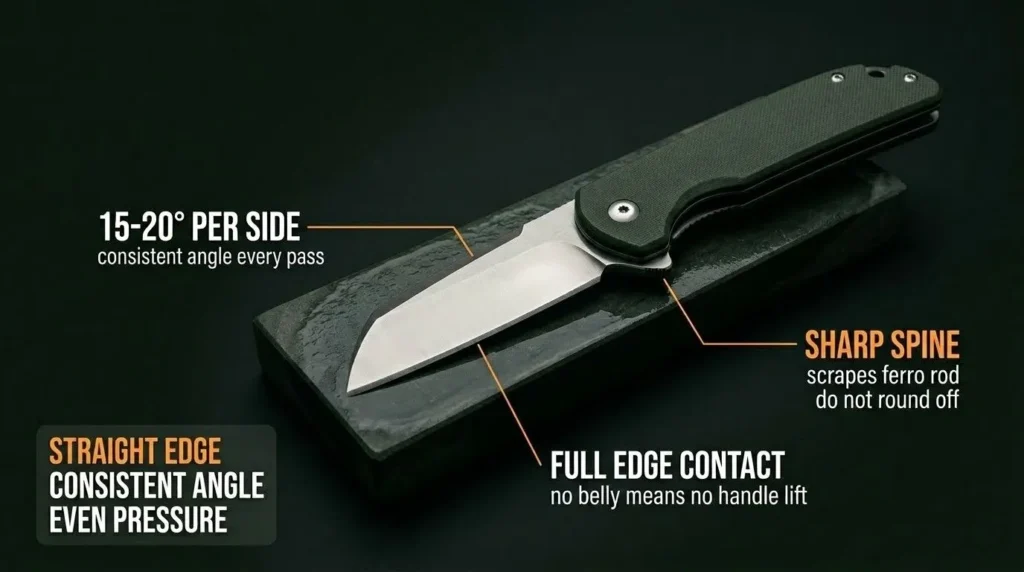
The sheepsfoot is one of the easiest blade shapes to sharpen. The straight edge means every part of the edge meets the stone at the same angle, every pass, with no belly to navigate.
Pick your bevel angle (15 to 20 degrees per side for most utility sheepsfoots), maintain it consistently, and work from heel to tip in even strokes. Because there is no belly, you will not need to lift the handle as you move along the edge. Chisel-ground sheepsfoot blades only need sharpening on one side, with a light deburring pass on the back.
The 90-degree spine on many modern sheepsfoot fixed blades is intentional. It is left sharp for scraping a ferro rod or processing tinder. Do not round it off when maintaining the blade.
A dedicated sharpening walkthrough is coming soon. The principle for now: straight edge, consistent angle, even pressure.
Sheepsfoot vs Other Blade Shapes
Each of these gets a dedicated comparison post. Here is the short version so you can place the sheepsfoot in the wider family.
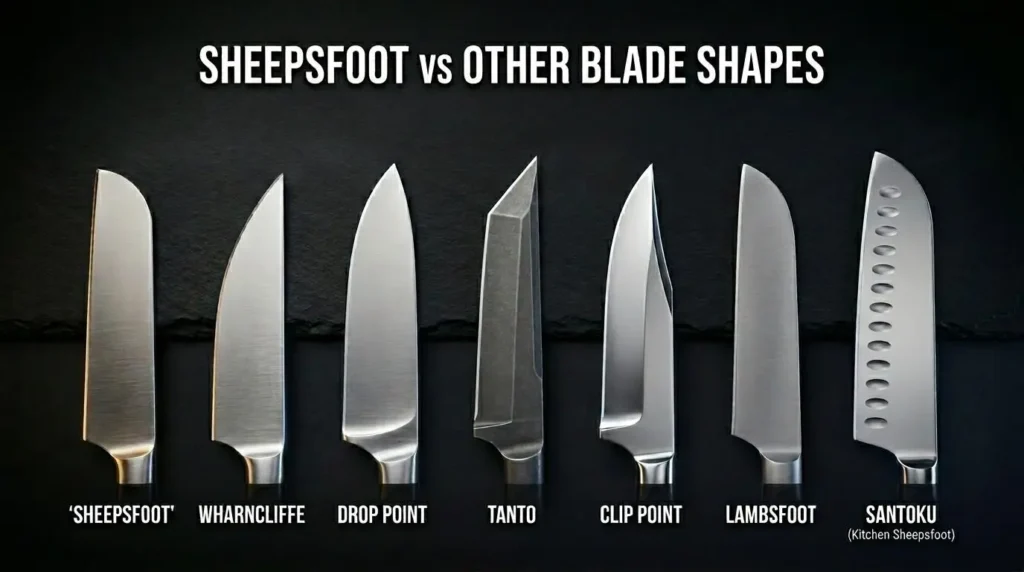
Sheepsfoot vs Wharncliffe: Both have straight edges, but the wharncliffe’s spine slopes gradually to a sharper, more usable point, giving you some piercing ability the sheepsfoot lacks. A dedicated sheepsfoot vs wharncliffe comparison is coming soon.
Sheepsfoot vs Drop Point: The drop point trades the sheepsfoot’s no-puncture design for a usable, controllable point. Outdoor work, drop point wins. Utility cutting, sheepsfoot wins.
Sheepsfoot vs Tanto: Opposite philosophies. The tanto maximizes piercing strength with its reinforced angular tip. The sheepsfoot eliminates piercing entirely. They serve completely different users.
Sheepsfoot vs Clip Point: The clip point gives you a fine, precise tip for detail work. The sheepsfoot gives you control across the whole edge.
Sheepsfoot vs Lambsfoot: The closest cousin. The lambsfoot has a slightly curved edge versus the sheepsfoot’s fully straight edge, and a more rounded transition at the tip. It is a more traditional British pattern. Visually similar, subtly different in use.
Sheepsfoot vs Santoku: A santoku is a sheepsfoot. Same geometry, scaled up for kitchen use.
FREQUENTLY ASKED QUESTIONS
Why is it called a sheepsfoot blade?
The name comes from its original use trimming the hooves of sheep in the 1700s. The straight edge and blunt tip let shepherds work safely around the animals. Some sources also note that the blade’s side profile resembles a sheep’s hoof, which may have reinforced the name over time.
Are sheepsfoot knives good?
For utility cutting, rescue work, maritime use, EDC, and kitchen tasks, yes, they are excellent. For hunting, bushcraft, piercing, or self-defense, they are the wrong tool. The shape rewards the right user and frustrates the wrong one.
Is a sheepsfoot good for self-defense?
No. A sheepsfoot has no piercing ability and a controlled edge optimized for slicing flat material. It is not built for defensive use, and there are better blade shapes for that purpose if it is your priority.
Is a santoku a sheepsfoot?
Yes, geometrically. The santoku is a Japanese kitchen knife built on sheepsfoot principles, flat edge, dropped spine, blunt tip, scaled and refined for food prep. The two share the same design DNA.
Are sheepsfoot blades legal to carry?
Sheepsfoot blades are among the least legally restricted knife shapes because the geometry eliminates piercing capability, helping them avoid definitions that flag stabbing knives in many jurisdictions. Blade length and locking mechanisms still matter, so check your local laws.
What is the difference between a sheepsfoot and a modified sheepsfoot?
A traditional sheepsfoot has a fully flat edge. A modified sheepsfoot adds a subtle belly toward the tip for better slicing performance on draw cuts while keeping the dropped, blunt tip. The modified version is what most modern EDC knives ship with.
Can a sheepsfoot blade be used for whittling?
Yes, and it is one of the better profiles for it. The straight edge gives controlled, predictable cuts on softwood, and the blunt tip means a slipped knife will not stab your palm. It is the same control logic that makes it good for rescue work.
Final Take
The sheepsfoot knife is not trying to be a do-everything blade. It is a specialist that solves a specific cutting problem with deliberate geometry, and for the right user, it does that job better than anything else in the drawer. EMTs, sailors, electricians, EDC carriers, and anyone whose daily cutting tasks involve flat surfaces and zero tolerance for accidental punctures end up reaching for this shape and not looking back.
If your needs run toward outdoor work, hunting, or defensive use, you are better served by other profiles in our knife blade types pillar. But if controlled slicing is what your day actually demands, the sheepsfoot has been quietly earning its keep for three hundred years, and the modern versions are the best they have ever been.