What Is a Trailing Point Knife? Uses, Pros, Cons & Buying Guide

Table of Contents
A trailing point knife is a blade whose spine sweeps upward from the handle so the tip “trails” higher than the spine where it leaves the handle. That upsweep stretches the cutting edge into a long, deep belly — which is why this profile is the default on skinning and fillet knives. You’ll also hear it called an upswept or Persian blade.
This guide covers what a trailing point is, what it’s actually good at, how its geometry creates both its strengths and its one real weakness, the best steels and sizes, common mistakes, and how to sharpen and use it properly. It’s part of our larger guide to knife blade types and shapes.
Quick Answer: A trailing point knife has an upswept spine that raises the tip and lengthens the belly. Best for slicing, skinning, caping, and filleting. The trade-off is a thin, unsupported tip that isn’t built for prying or hard work.
What Is a Trailing Point Knife?
A trailing point is defined by one feature: the spine rises as it travels toward the tip, finishing above the line it started on at the handle. Everything else follows from that single choice.
Raising the spine does one thing mechanically — it lengthens the curve of the edge. That creates three working advantages:
- A long, deep belly that puts more continuous cutting edge into every stroke
- A raised tip that stays up and out of the way during long belly cuts
- A lightweight blade, because the upsweep removes steel rather than adding it
That long belly is the whole point. When you draw a trailing point through a hide or a fish fillet, more edge passes through the cut per stroke than on almost any other shape — which is why hunters, anglers, and butchers reach for it. The cost of that geometry shows up at the tip, and we’ll be honest about it below.
Best For / Not Best For
| Best For | Not Best For |
| Skinning and caping game | Prying, twisting, or batoning |
| Filleting and processing fish | Piercing tough or hard materials |
| Long, sweeping slicing cuts | Heavy bushcraft and wood work |
| Butchering and breaking down meat | EDC where you need a durable tip |
| Collectors who value the upswept lines | Self-defense or hard-use carry |
If you want a strong tip and do-everything versatility, a drop point or clip point suits you better. The trailing point is a specialist, and it’s at its best when you let it specialize.
How the Trailing Point Compares (Quick Routers)
We keep head-to-head breakdowns in their own dedicated guides so each gets the room it deserves. The one-line version:
- Trailing point vs drop point: the drop point lowers and strengthens the tip; the trailing point raises it for more belly. Full comparison coming soon.
- Trailing point vs clip point: the clip point thins the tip for piercing; the trailing point sweeps the edge up for slicing. Full comparison coming soon.
- Trailing point vs spear point: the spear point is symmetric and tip-centered; the trailing point is all belly. Full comparison coming soon.
For the whole family — including the tip-strong tanto, the straight-edged sheepsfoot and wharncliffe, and the hooked hawkbill — see the pillar guide.
Pros and Cons
| Pros | Cons |
| Long, deep belly — excellent for slicing | Thin, unsupported tip that bends or breaks easily |
| Raised tip stays clear during belly cuts | Poor at piercing, prying, and hard-target work |
| Maximum continuous edge per stroke | Awkward to sheath — the upswept tip catches |
| Lightweight and fast in the hand | Harder to sharpen than a straight-edged blade |
| Distinctive, elegant blade profile | A specialist, not a do-everything tool |
Anatomy of a Trailing Point Blade
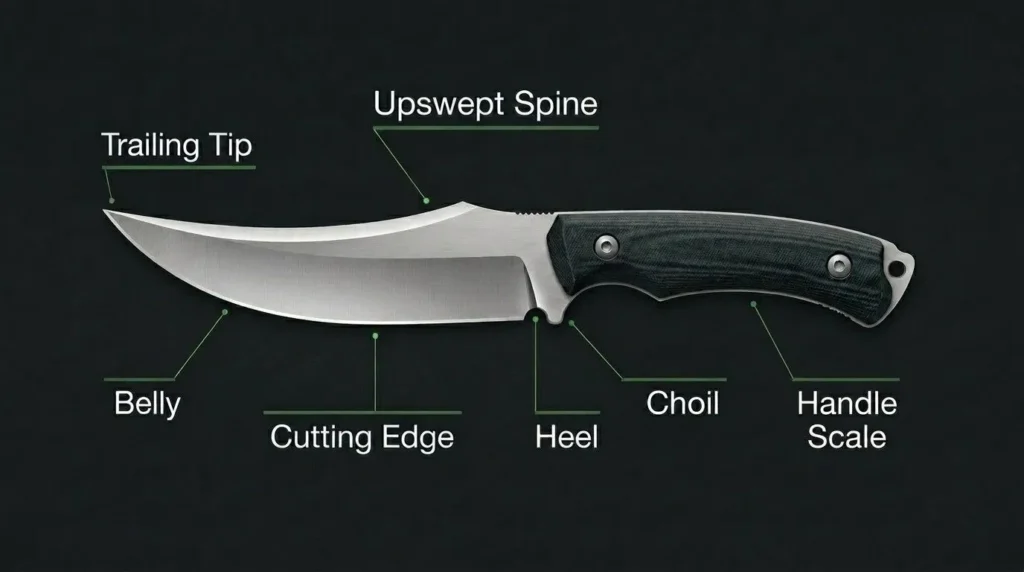
Seven working parts. Knowing them is the difference between buying a knife and buying the right knife.
- Upswept Spine. The unsharpened top edge that rises from the handle toward the tip. How aggressively it climbs controls how deep the belly and how raised the point.
- Trailing Tip. Where spine and edge meet, sitting higher than the spine’s origin at the handle. The thinnest, least-supported part of the blade and the first thing to break if you misuse the knife.
- Belly. The long curved cutting edge, deeper than on almost any other shape. This is the defining feature.
- Heel. The edge nearest the handle. On a skinner, this is the part you should work with most more on that below.
- Cutting Edge. Runs from the heel through the flat working section and sweeps up into the belly toward the point.
- Choil. A small unsharpened notch between edge and handle that lets you sharpen the full edge without rounding the heel.
- Tang. The steel running into the handle. On a serious fixed-blade skinner, full tang is non-negotiable lateral force during skinning needs a joint that won’t fail.
Why the Tip Is the Weak Point
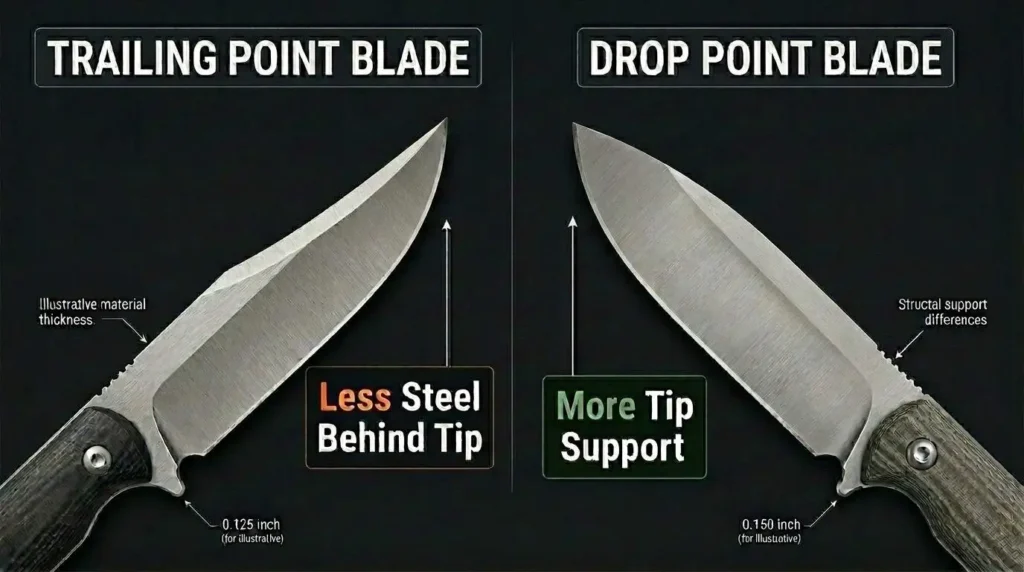
Every source that mentions a trailing point repeats the same warning “the tip is fragile” and stops. Here’s the part they leave out: why.
The upsweep that creates the long belly does it by removing steel from behind the point. On a drop point, the spine slopes down and adds mass behind the tip, propping it up. On a trailing point, the spine climbs away from the tip, so the point is left thin, high, and unsupported — a fine, exposed peak with very little steel backing it.
That’s not a flaw. It’s the unavoidable cost of the geometry that makes the blade slice so well. A trailing point tip will bend or snap if you pry, twist, drill, or stab into anything hard — and it’s also why these blades are awkward to sheath, since the raised tip has to be guided in rather than dropped. The fix isn’t to avoid the shape; it’s to buy the right steel and keep the tip out of jobs it was never built for.
A Brief History
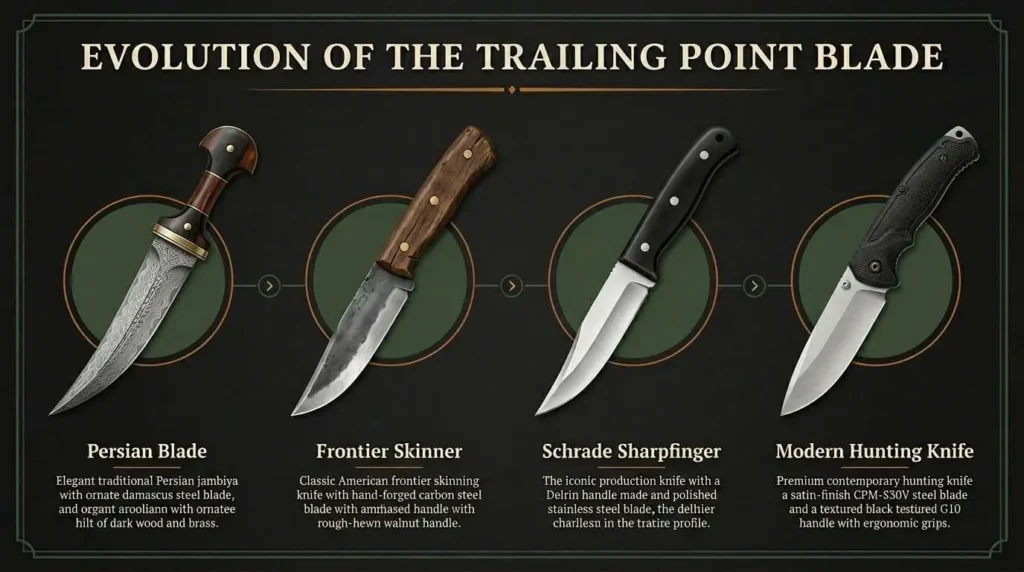
The trailing point’s upswept curve is one of the oldest functional blade ideas in cutlery. It descends from the scimitar family — the curved, belly-forward blades of the Persian and broader Middle Eastern tradition — which is why the profile is still called a Persian blade today. The curve was prized for the same reason it is now: a longer arc of edge sweeping through a draw cut.
As the shape moved into working knives, it found two homes. Butchers adopted the large upswept cimeter for breaking down carcasses, where the long belly slices and the raised tip stays clear of bone. Outdoorsmen adopted it for skinning — the frontier skinning knife leaned on the upswept belly to separate hide cleanly without puncturing it.
In the modern era, the Schrade Old Timer 152OT Sharpfinger became the production knife most people picture when they hear “trailing point” — a compact, hump-spined skinner that sold by the millions. The Buck 113 Ranger Skinner carried the same tradition, and the upswept skinning pattern lives on in the Nessmuk-style blades favored by bushcrafters. That hand-forging heritage continues today in custom shops producing layered Damascus skinners and fillet knives, where the long sweeping belly shows off the pattern like no other geometry.
Trailing Point Variations
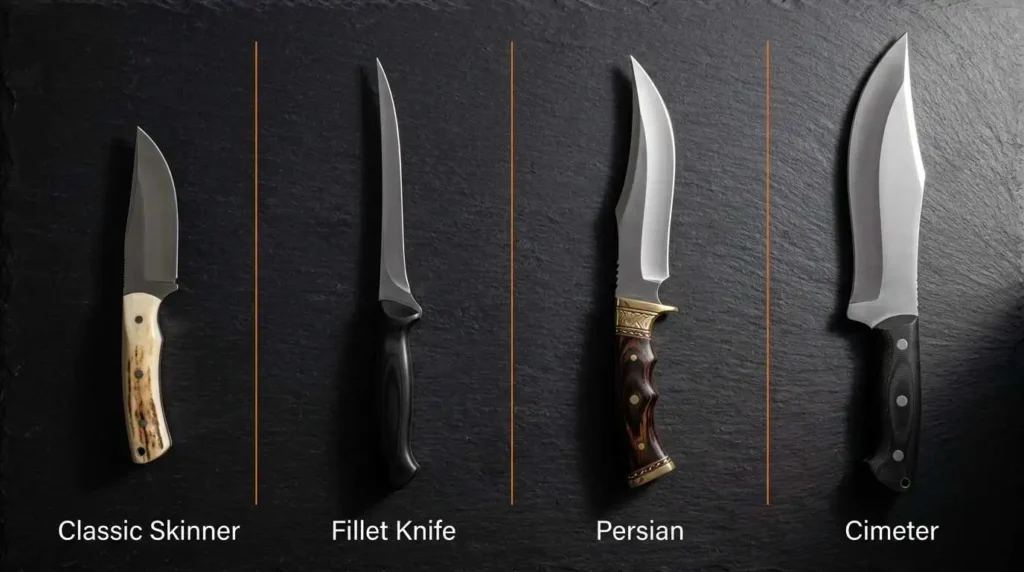
“Trailing point” isn’t one shape; it’s a family defined by how aggressively the spine climbs.
- Classic Skinner. Moderate upsweep, deep belly, compact blade. The default hunting form.
- Fillet. Long, thin, and flexible — the flex rides bone and lifts skin, which is why most fillet knives are trailing points.
- Persian. A dramatic, decorative upsweep. Common on collector pieces and some EDC folders.
- Butcher’s Cimeter. A large, long-bellied trailing point for breaking down meat in long slicing pulls.
- Modified. A gentle rise that adds belly without leaving the tip as exposed — a nod toward everyday durability.
Grind Variations
On a thin-tipped blade, the grind matters as much as the profile.
- Hollow. Razor-thin, superb at fine slicing and skinning — the traditional skinner grind, and the most fragile.
- Flat. The balanced middle ground and a safe default.
- Scandi. Easy to maintain and tough at the edge, but less common here.
- Convex. The strongest geometry and kindest to a delicate tip, at the cost of harder freehand sharpening.
What Is a Trailing Point Blade Used For?
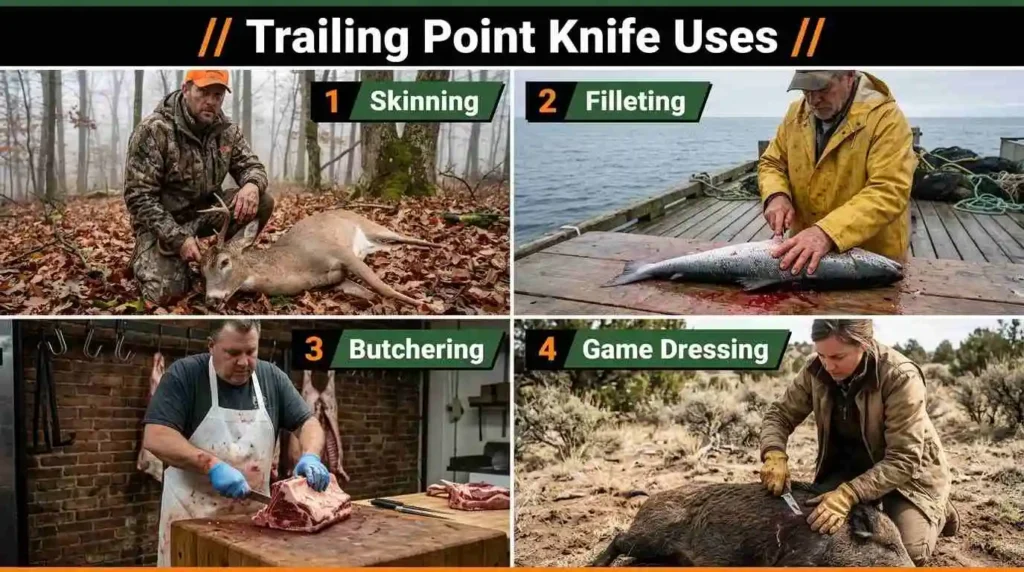
A trailing point handles skinning, caping, filleting, butchering, and any task built around long, sweeping slicing cuts — anywhere edge length and slicing control matter more than tip strength.
- Skinning. The deep belly separates hide in long clean pulls, and the raised tip stays clear of the meat.
- Filleting. A thin, flexible blade rides the backbone and lifts skin off a fillet better than any straight edge.
- Caping. The fine raised tip handles delicate detail work around the head and cape of game.
- Butchering. The long cimeter belly breaks down large cuts in efficient slicing strokes.
- General slicing. Anywhere a long draw cut beats a short chopping one.
For piercing, prying, or batoning, reach for a drop point or clip point instead — loading the tip is how a trailing point breaks.
Trailing Point Knife by Use Case
Hunting (Skinning & Caping)
The trailing point’s home turf. Look for a 3.5 – 4.5 inch blade on a full tang, with a deep belly and a tough steel CPM 3V, S35VN, MagnaCut, or hand-forged 1095 + 15N20 Damascus. Keep it stiff; skinning is about control, not flex.
Fishing (Filleting)
Look for a longer 6 – 9 inch blade with noticeable flex and a corrosion-resistant steel fillet knives stay wet, so stainless matters, and a medium hardness in the mid-to-upper 50s HRC keeps the flex. The belly is what lets you lift a clean fillet off the bone.
Butchering
Look for a long-bellied cimeter, 8 inches or more, in a tough stainless that shrugs off acidic contact and frequent washing. Length and belly are the priorities; tip strength is irrelevant for slicing meat off bone.
EDC, Pocket & Folding Knives
Honest answer: a trailing point is a poor everyday-carry choice. Trailing point pocket and folding knives exist the Kershaw Outright is a well-known example but the fragile tip struggles with the prying and scraping real carry demands. If you love the look, treat it as a dedicated slicer and keep a sturdier blade for hard tasks.
Self-Defense
The trailing point was not designed as a defensive blade, and its thin tip and slicing bias make it a poor fit. Far more important than shape is whether your knife is legal where you live and whether you’re trained. This isn’t legal or tactical advice see our guide to choosing a blade shape.
How to Actually Use a Trailing Point Knife
This is where most owners go wrong, because the marketing works against them. Listings sell the “sharp upswept tip” as the headline feature but on a skinner, the tip should rarely touch the hide at all.
The professional technique is the opposite of what the tip-forward marketing implies:
- Work off the belly and heel, not the point. The curved belly does the cutting on a long draw stroke, and skinning technique leans on the heel of the blade letting the tip lead is how beginners puncture hide and ruin a pelt.
- Draw the blade toward you in a sweeping motion. A trailing point is a pull-cut tool. Set the belly against the material and draw back, letting the long edge slice through in one continuous arc.
- Use the raised tip as a guide, not a digger. The whole reason the tip is lifted up and out of the way is so it doesn’t snag the meat while the belly works. Don’t force the point into anything.
- For filleting, let the flex do the steering. Lay the blade flat against the backbone and let the flexible spine follow the bone while the edge lifts the fillet.
Master the draw cut and the trailing point feels effortless. Fight its geometry by leading with the tip, and you’ll snap the point and blame the knife.
Best Steel for a Trailing Point Knife
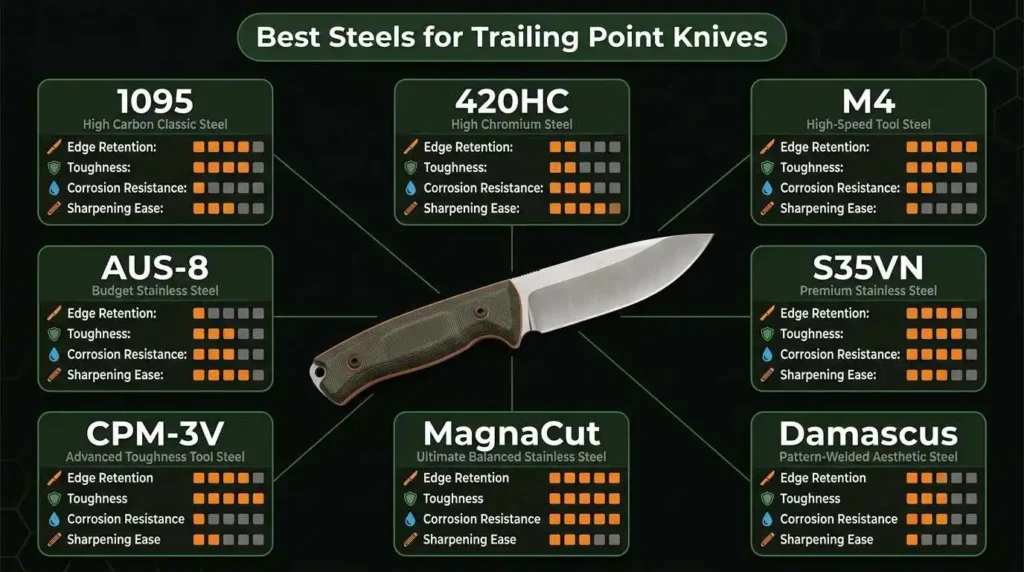
Steel matters more on a trailing point than on most shapes, because the unsupported tip has little margin for error. Soft steel rounds the point off; brittle steel snaps it. The right priority order is toughness first, then edge retention, then corrosion except on fillet knives, where corrosion resistance jumps to the top because the blade lives in water.
| Steel | Edge Retention | Toughness | Corrosion | Sharpening | Best For | Tier |
| 1095 (carbon) | Good | Excellent | Poor | Easy | Skinners, traditional | $ |
| 420HC | Fair | Good | Excellent | Very easy | Budget fillet/skinner | $ |
| AUS-8 | Good | Good | Very good | Easy | Fillet knives | $$ |
| D2 | Very good | Moderate | Moderate | Moderate | All-around skinner | $$ |
| S35VN | Excellent | Good | Excellent | Hard | Premium skinner | $$$ |
| CPM 3V | Very good | Outstanding | Moderate | Moderate | Hard-use trailing point | $$$ |
| MagnaCut | Excellent | Excellent | Excellent | Moderate | Premium all-purpose | $$$$ |
| Damascus (1095 + 15N20) | Very good | Excellent | Moderate | Moderate | Hand-forged skinners | $$$ |
1095 is the classic skinner steel tough, takes a screaming edge, patinas with use. Oil it. For fillet knives, prioritize corrosion resistance and flex: 420HC or AUS-8 in the mid-50s HRC.
CPM 3V is the safest pick if you want a trailing point that survives the occasional misuse without losing its tip. MagnaCut is the modern do-everything answer — high edge retention plus toughness and corrosion resistance; for the metallurgy, see Larrin Thomas at Knife Steel Nerds, who designed it.
Damascus. True pattern-welded Damascus (1095 + 15N20) gives high-carbon performance with layered toughness, and the long belly is where the pattern shines. See our Damascus knife guide to tell real from fake: real Damascus shows pattern into the bevel and rusts without care; fakes show pattern only on the flat (etched stainless) and never rust.
Best Steel by User Type
| User Type | Best Steel Choice |
| Beginner | 420HC — forgiving, low maintenance |
| Angler (filleting) | AUS-8 / 420HC — corrosion + flex |
| Hunter (skinning) | S35VN / MagnaCut / Damascus — retention + toughness |
| Hard-use outdoors | CPM 3V — outstanding toughness |
| Traditional / heritage | 1095 — classic skinner steel |
| Collector | Damascus — pattern shines on the long belly |
How to Choose Your Trailing Point Knife
Six questions, in order:
- Primary use case? Skinning, filleting, butchering, or collecting. The trailing point is a specialist match it to one job.
- Fixed or folding? Fixed for skinning, filleting, and butchering. Folding only if you want the look and accept the tip’s limits.
- Blade length? Skinner: 3.5–4.5″. Fillet: 6–9″. Cimeter: 8″+.
- How much flex? Stiff for skinning and butchering; flexible for filleting fish.
- What steel? Carbon (1095) if you’ll oil it; stainless (AUS-8, S35VN, MagnaCut) for low maintenance and wet work; Damascus for character. Prioritize toughness so the tip survives.
- Hand-forged or production? Production gives consistency and warranty; hand-forged gives unique craftsmanship and a belly that shows the steel, with more care required.
Common Buying Mistakes
- Buying a trailing point as a do-everything knife. It isn’t one. It’s a slicer. Pair it with a drop point for general tasks.
- Expecting the tip to handle hard work. The unsupported point is the first thing to break. If you need to pry or pierce, this is the wrong blade.
- Ignoring flex when buying a fillet knife. A stiff blade can’t ride the backbone. Match flex to the fish you process.
- Choosing carbon steel for a fillet knife. Carbon rusts fast in wet, salty conditions. Use a corrosion-resistant stainless for fish.
- Buying fake Damascus. Etched stainless looks the part but isn’t pattern-welded. Check for layers in the bevel.
How to Sharpen a Trailing Point Knife
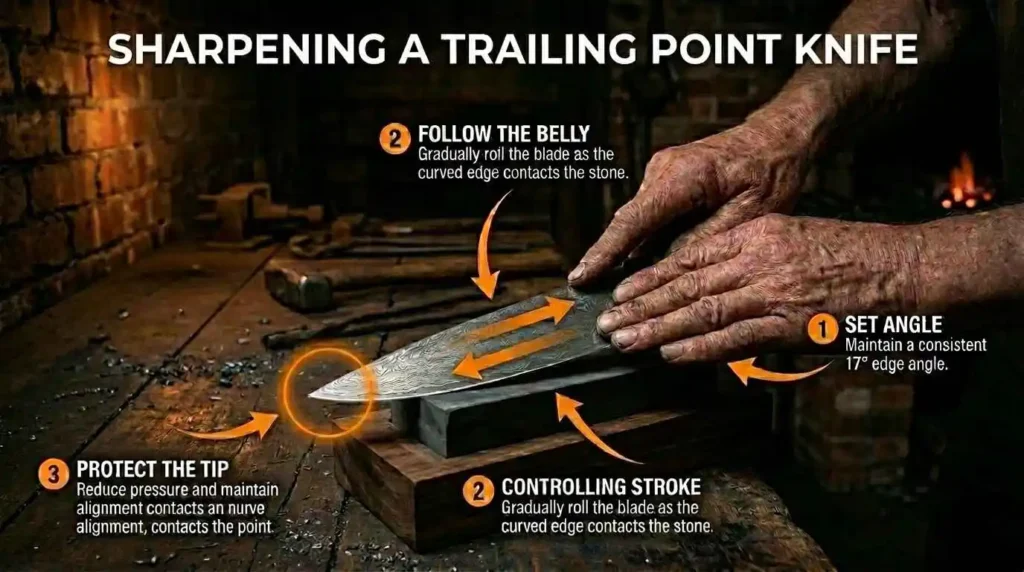
The continuous belly sweeping up into a raised tip is genuinely harder to sharpen than a straight edge — which is why so many trailing points end up with a rounded, dull point. The fix is controlling your angle through the whole curve.
- Set your angle. 15–20 degrees per side. Skinners and fillet blades lean toward the lower, finer end for slicing; 17° is a safe middle.
- Start at the heel. Hold your angle and pull the edge from the heel through the straight working section, matching strokes on each side.
- Roll through the belly the key step. As the edge begins to curve upward, slowly lift the handle and rotate the blade so the contact point keeps moving along the belly at the same angle. The longer belly means a longer, smoother roll than any other shape.
- Finish the tip with light pressure. The raised tip rounds off faster than anything else on the blade. Fewer passes, lighter touch, more rotation as the belly tightens.
- Support flexible fillet blades. A flexible blade flexes away from the stone and ruins your angle. Back it with a finger or use a guided system so the edge meets the abrasive cleanly.
- Strop to finish. Five to ten light passes per side on a leather strop with compound.
For carbon and Damascus blades, wipe dry and apply a thin coat of food-safe mineral or camellia oil when you’re done.
Legal and Carry Considerations (U.S.)
Knife law varies by state, county, and city, but the trailing point shape itself is almost never the legal issue blade length, fixed vs. folding, and how you carry are what matter. Most trailing points are fixed-blade skinning and fillet knives carried openly in a hunting or fishing context, which is the least restricted scenario in most places.
The American Knife & Tool Institute (AKTI) maintains a state-by-state breakdown worth checking before you carry. This is not legal advice — check your local laws before carrying any knife.
Caring for Your Trailing Point Knife
- Clean after every use. Hide, blood, and especially fish and saltwater are corrosive. Wash with warm water and dry immediately.
- Oil carbon and Damascus blades. A thin film of food-safe mineral or camellia oil after each use, especially for wet work.
- Guide the tip into the sheath. The raised point catches easily roll it in rather than forcing it, and consider a kydex sheath molded to the blade.
- Never pry or twist with the tip. It’s the single most-broken part of any trailing point. Keep it out of hard tasks entirely.
- Store outside the sheath long-term. Leather holds moisture against the steel. Use a knife roll or display for storage.
Frequently Asked Questions (FAQs)
What is a trailing point knife used for?
Skinning, caping, filleting, butchering, and any task built around long slicing cuts. The deep belly and raised tip make it a specialist slicer rather than a general-purpose blade.
What is the benefit of a trailing point blade?
A long, deep belly that puts more cutting edge into every stroke, plus a raised tip that stays clear of the material during long slicing pulls. That’s why it dominates skinning and fillet knives.
Are trailing point knives good?
Yes — for slicing, skinning, and filleting. No, if you want one knife for prying, piercing, or hard outdoor work. It’s a specialist, and excellent at its specialty.
Why is it called a trailing point?
Because the tip “trails” higher than the spine where it leaves the handle. The upswept spine carries the point up and back, so it sits above the blade’s starting line.
Why do trailing point tips break?
The upsweep that creates the long belly does it by removing steel from behind the point, leaving the tip thin and unsupported. Pry, twist, or stab with it and it bends or snaps. Buy tough steel and keep the tip out of hard jobs.
How do you sharpen a trailing point knife?
Set 15–20° per side, sharpen the heel and flat first, then roll the blade through the belly while keeping the angle constant, and finish the raised tip with light pressure. Support flexible fillet blades so they don’t flex away from the stone.
Is a trailing point good for hunting?
Yes — for skinning and caping it’s one of the best shapes there is. For field tasks that need a strong tip, pair it with a drop point.
Is a trailing point good for EDC?
Not really. The fragile tip struggles with everyday prying and scraping. Carry it as a dedicated slicer if you love the profile, but keep a sturdier blade for hard tasks.
Is a trailing point good for self-defense?
It wasn’t designed for it. The thin tip and slicing bias make it a poor defensive choice, and blade shape matters far less than legal carry rules and training. This is not legal or tactical advice.
Is a fillet knife a trailing point?
Usually, yes. Most fillet knives use a trailing point because the long belly and raised tip are ideal for lifting skin and riding the backbone of a fish.
What knives use a trailing point blade?
Skinning knives, fillet knives, butcher’s cimeters, Nessmuk-style bushcraft skinners, and some Persian-style EDC folders. The Schrade Sharpfinger and Buck 113 Ranger are the classic production examples.
What’s the best steel for a trailing point knife?
For skinners: CPM 3V or MagnaCut for toughness, or 1095/Damascus for traditional carbon. For fillet knives: a corrosion-resistant stainless like AUS-8 or 420HC, since the blade stays wet.
What’s the difference between a trailing point and a drop point?
In one line: the drop point lowers and reinforces the tip for strength, while the trailing point raises it for a longer slicing belly.
Conclusion
The trailing point isn’t the strongest blade shape, and it isn’t the most versatile. It’s the most belly-forward, slicing-focused profile in knife-making which is why hunters skinning game, anglers filleting fish, and butchers breaking down meat keep reaching for it.
Buy it for what it does best, choose a steel that protects the tip, work off the belly instead of the point, and a trailing point will out-slice anything else in your kit. Ask it to pry and it’ll break but that was never its job.
To see where it fits among the other shapes, read the full knife blade types guide, or compare it with the drop point, clip point, and spear point.