Knife Blade Types: What Actually Works in the Field (and What’s Just Marketing)

Table of Contents
A friend of mine spent $340 on a “premium skinning knife” with a deep trailing point because three buying guides told him it was the “best blade shape for big game.” Two seasons later, that knife has dressed exactly one mule deer and badly. He now does the same job with a $90 fixed-blade drop point and laughs about it.
That story isn’t unusual. It’s the rule.
Most of the internet’s writing on knife blade types is recycled brand copy, repeated by sites that have never field-dressed an animal, broken down 300 boxes a shift at a warehouse, or had to cut a jammed seatbelt in the dark. The result is predictable: people buy the wrong shape for the work they actually do, then blame the steel.
This guide isn’t a glossary. You can find a glossary anywhere. It’s what blade shapes actually do under load, where the standard advice falls apart, and one strong opinion that contradicts almost every other knife blog you’ve read. I’ll get to it about halfway down. If you only remember one thing from this article, it’ll be that section.
The fast answer (if you don’t have ten minutes)
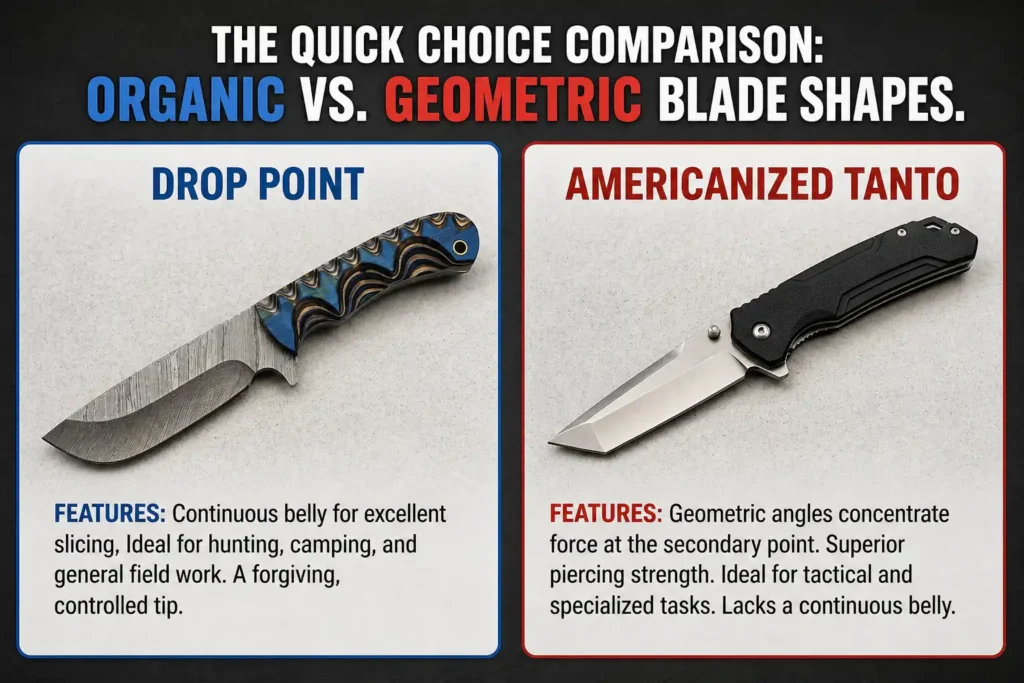
If you want a knife and you don’t want to think about it, get a drop point for hunting and bushcraft, and ignore tantos unless you specifically like how they look. That covers most real-world use.
There is one blade shape most guides completely ignore that is actually better for modern everyday carry, but it contradicts almost everything you will read in standard knife advice. I will get to it about halfway down.
The rest of this article is for the 10% of people doing something specific enough that blade shape genuinely matters, or for anyone about to spend serious money and wants to spend it correctly.
Drop point: the default that earns its reputation (mostly)
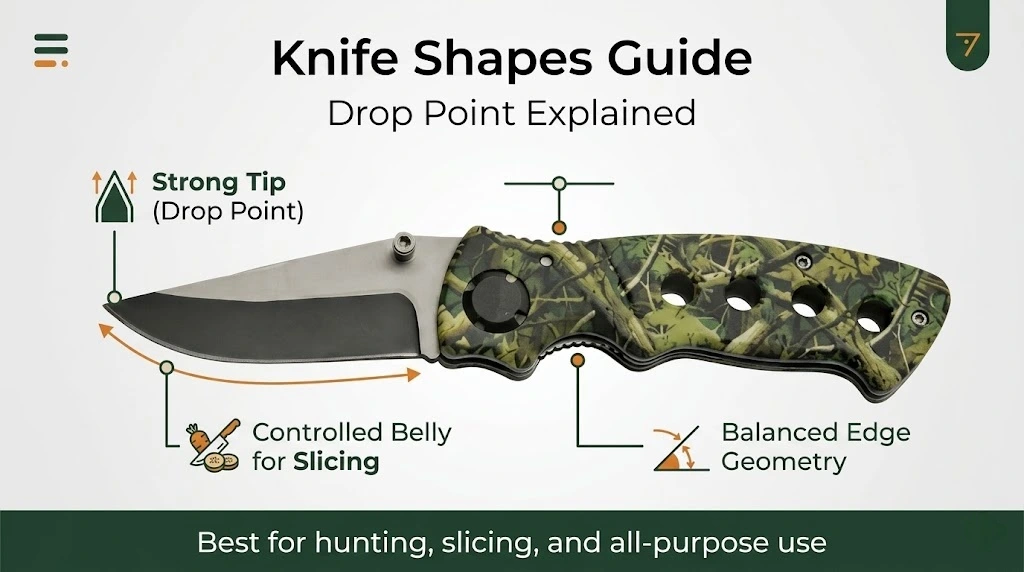
The drop point has a convex spine that curves down to meet a controlled belly. The tip sits below the spine, which makes it strong, and the belly is long enough to slice without being so deep that you lose tip control.In real use, field-dressing whitetail, breaking down camp food, cutting cordage, light carving, the drop point is genuinely hard to beat. The tip won’t snap when you hit a rib. The belly rolls through hide. You can choke up on it for detail work. This is one of the few cases where the marketing and the performance line up. Browse our hunting knives if this is the use case you’re shopping for.
When NOT to use it: opening 200 Amazon boxes a day in a warehouse. The tip is fine enough to puncture whatever’s inside the box, and the belly geometry isn’t doing anything for you on a straight pull cut. A drop point is overkill for cardboard, and the tip is the part that breaks first when you pry, which warehouse workers always end up doing, no matter how many times the safety video says not to.
Clip point: aesthetic, fragile, and over-recommended
The clip point, found on Bowie knives, traditional pocket knives, and classic hunters, has a “clipped” section taken out of the spine, leaving a fine, often upswept tip.
Here’s the problem: the clip point is marketed as a do everything traditional blade. In practice, that fine tip is the weakest part of the shape. Snapped clip point tips show up more often than any other blade type, usually after sideways pressure from everyday misuse such as prying staples, opening blister packs, or twisting the tip into something it was not designed to handle. Tasks a drop point would tolerate are exactly where clip points tend to fail.
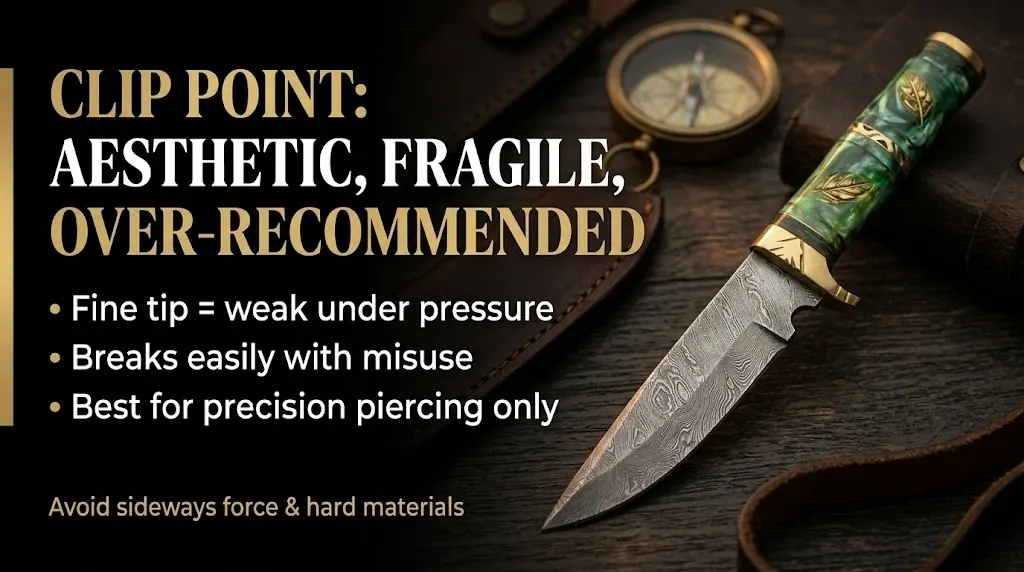
A clip point excels at one specific thing: piercing soft material with precision. Field-dressing where you need to slip the tip under hide without nicking the gut sack. Detail work in leather. Fine slicing in food prep, if the steel is good. Our Shadow Vanguard fixed blade hunting knife is a clip point built for exactly this kind of disciplined, controlled work.
When NOT to use it: anywhere there’s a chance you’ll lever the knife sideways. Anywhere the tip might catch in something hard. If your “EDC” includes opening anything stapled, taped, or industrially packaged, a clip point will eventually disappoint you. Torn between this shape and the safer alternative? See the drop point vs clip point knife comparison.
Tanto: mostly theater
I’m going to be direct here, because the marketing on this one is genuinely misleading.
The Americanized tanto, the angular, two-bevel point you see on every “tactical” folder from the early 2000s onward, is sold on a story about armor piercing and tip strength. The story is partly true and largely irrelevant. Yes, the geometry concentrates force at the secondary point, and yes, the tip is stronger than a needle-fine clip point. But it’s not stronger than a properly ground drop point, and the chances that you, personally, need to pierce a car door or body armor are functionally zero.
What the tanto gives up to get that strength is everything that makes a knife useful day-to-day. The angled secondary edge means there’s no continuous belly. Slicing anything, an apple, a length of rope, a piece of cardboard, becomes a two-stage motion where the blade catches at the angle. Sharpening it correctly requires maintaining two distinct edge geometries, which most people don’t do, so they end up with a tanto that’s dull on one section and sharp on the other.
When NOT to use it: anything that involves slicing. Which is most knife work. For the head-to-head, See tanto vs drop point knife comparison .
The original Japanese tanto, by the way, didn’t have this geometry. It’s a modern American interpretation, and “tactical” is doing a lot of marketing work in that sentence.
When it actually makes sense: if you specifically need to break or pierce a hard barrier, auto extrication, certain rescue scenarios, and you’ve trained on it. That’s a narrow use case. If that’s not you, the tanto is a knife shape you bought because it looked cool, and that’s a perfectly fine reason to own one. Just don’t pretend it’s a better tool than it is.
Sheepsfoot and wharncliffe: the contrarian section
Here’s the strong opinion. The one I said you’d remember.
For most people doing modern EDC, a sheepsfoot or wharncliffe is a meaningfully better tool than a drop point, and the entire knife industry is quietly steering you away from them because they don’t sell the “do anything, go anywhere” fantasy that drives margins.
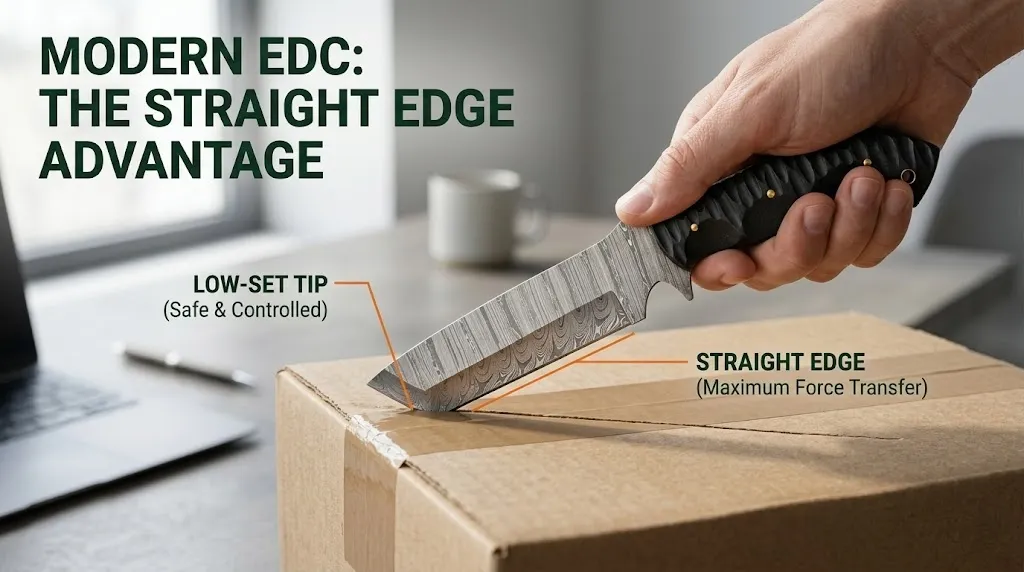
A sheepsfoot has a straight edge that runs horizontal, with a curved spine that drops to meet it. No real point, just a rounded nose. A wharncliffe is similar but with a straight edge and a straight spine that angles down sharply to a fine, low-set tip. Both share the same useful property: a long, perfectly straight cutting edge with no belly to speak of.
Now think about what modern EDC actually looks like. You’re cutting:
- Tape on packages
- Cardboard boxes
- Zip ties
- Plastic clamshell packaging
- Loose threads on clothing
- Maybe an apple at lunch
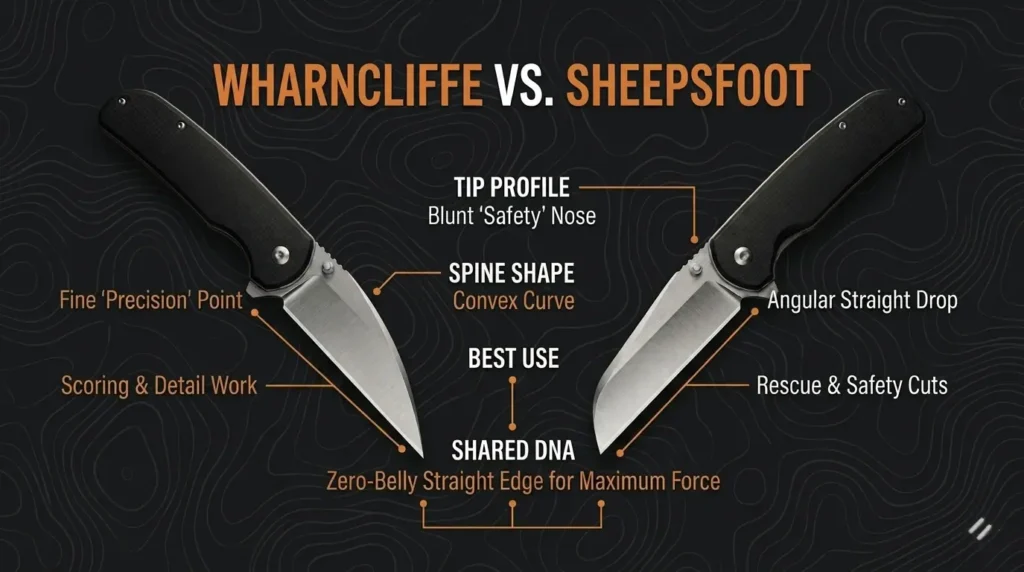
Every single one of those is a push cut or a draw cut along a straight line. A straight edge transmits force cleanly and predictably. A bellied drop point, on the same task, rolls through the cut at a varying angle, which is fine but never optimal. And on the ones where the cut is right against your hand or against something you don’t want to puncture (the contents of the box, the table, the steering wheel), the lack of a forward-projecting tip is a feature, not a bug.
I’ve watched warehouse pickers, electricians, and ER nurses converge independently on Wharncliffe-style blades for exactly this reason. They figured it out by doing the work, not by reading buying guides. Browse our folding knives if you’re shopping for an EDC folder.
When NOT to use a sheepsfoot or wharncliffe: anything involving a stab, pierce, or fine tip work. You can’t field-dress a deer with one, you can’t drill a starting hole in wood, and you can’t slip the tip into a clamshell seam from above. They are not hunting knives. Outside the EDC use case, they fall off hard.
But for the use case the average modern adult knife-buyer actually has? They quietly outperform drop points. The reason you don’t read this in most blade guides is that “the drop point is best” is a safer recommendation that doesn’t risk a return. Choosing between the two? See sheepsfoot vs wharncliffe blade comparison.
Trailing point: oversold for big game
The trailing point, where the tip rises above the spine in a long, deep belly, is the blade shape every buying guide calls “the best skinner.”
For deer, elk, and most big game, drop points outperform trailing points in actual field use, and if you want a specialized tool, a knife with a small gut hook handles the job more cleanly.
The trailing point’s deep belly is genuinely useful for one thing: working a large amount of hide off smaller animals, fish, rabbits, squirrels, or detailed caping work.
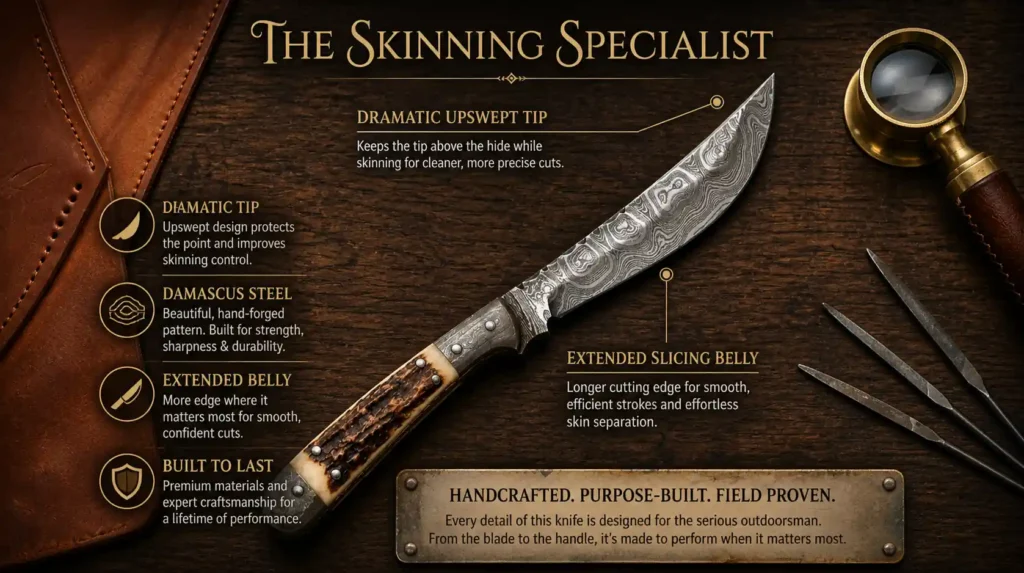
For breaking down a 200-pound deer in the field, that extra belly becomes unnecessary, and the raised tip is easier to drive into the body cavity compared to the controlled tip of a drop point.
The trailing point earned its reputation in the era of fur trapping, where you were processing a lot of small hides per day. Modern big-game hunting isn’t that work. The advice has lagged behind reality by about a hundred years. For big-game work, Browse hunting knives for big game.
When NOT to use it: big game field dressing if you don’t already know what you’re doing. Anything where tip control matters more than belly length. EDC of any kind.
Spear point: niche, but excellent at the niche
A spear point is symmetrical. The tip sits in line with the centerline of the blade, with belly on both sides (or a sharpened false edge). Daggers, throwing knives, some boot knives.
The advantage is straightforward: maximum piercing efficiency along the centerline. The disadvantage: you’ve built a knife optimized for stabbing, which is a use case civilians almost never encounter legally. A symmetrical grind also means there’s less efficient cutting geometry on either side compared to an asymmetric grind of the same width. Our Damascus Boot Dagger is a spear point in this geometry.
When NOT to use it: as a general utility knife. The shape is optimized for one motion, and that motion isn’t “open a package.” (For comparisons, see spear point vs drop point vs dagger.)
Hawkbill: the underrated utility shape
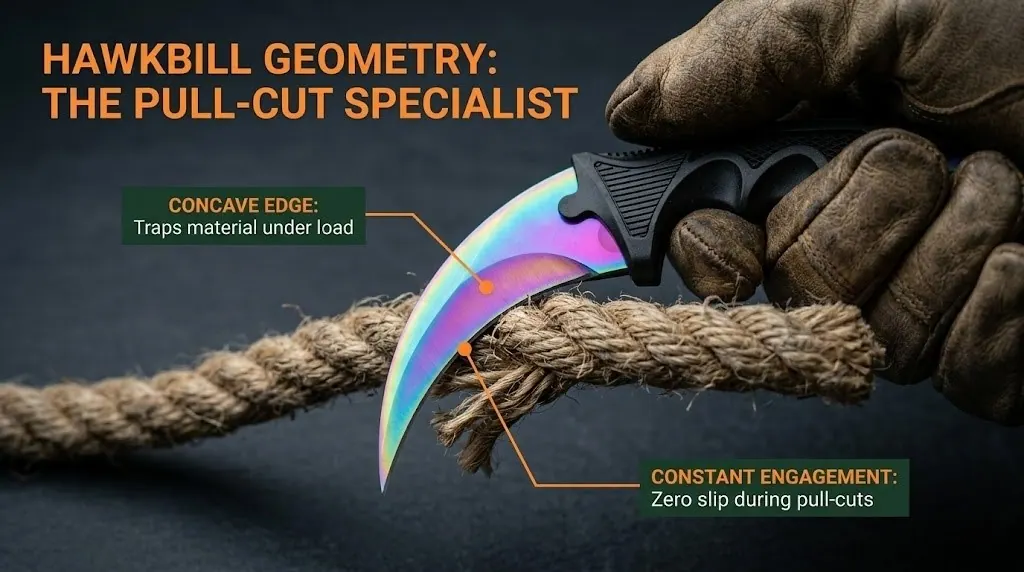
A hawkbill curves downward. The tip points toward the ground, and the entire edge is concave. This is the curved blade knife people are usually asking about when they search “what is a curved knife called.” (Karambits and kukris are also curved, but they’re curved in different directions and for different reasons; we’ll get there.)
Hawkbills are excellent, and I mean excellent, at one specific job: pulling a cut through material that wants to slip away. Roofing felt. Carpet. Linoleum. Insulation. Vines. Fishing line wrapped around a prop. Any time you’re hooking the blade into something and pulling, the hawkbill geometry concentrates force at the curve and stays engaged.
If you’re a tradesperson, a gardener, or someone who works around cordage and rope, a hawkbill in your kit is genuinely useful. The reason most people don’t have one is that the shape looks aggressive and intimidating, and the marketing has historically leaned into that, which is a shame, because it’s one of the most utilitarian shapes ever designed.
When NOT to use it: food prep, fine work, anything that benefits from a forward-projecting tip, anywhere it might be misread as a weapon (it photographs aggressive even when it isn’t).
Recurve: pretty, marginal, high-maintenance
A recurve has a wave in the edge. The belly sweeps forward, the section near the handle curves back inward. It looks aggressive, and it cuts aggressively.
The marketing claim is that recurves “increase cutting performance” by drawing material into the curve as you slice. This is technically true and practically marginal. You’ll cut maybe 10 to 15% more efficiently on certain draw cuts, and you’ll pay for it every time you sharpen the knife, because most standard sharpening systems don’t accommodate the inward curve. You either learn to sharpen freehand, buy specialized equipment, or send the knife out.
For a working knife you’ll actually use in the field, that maintenance burden is rarely worth the marginal cutting gain. For a collection piece or a knife you sharpen ritually, fine.
When NOT to use it: anywhere you’ll need to sharpen the knife with whatever’s available. Bushcraft. Long backcountry trips. Workplaces without a dedicated sharpening setup.
Reverse tanto: an actual improvement
The reverse tanto puts the angular break on the spine instead of the edge. The cutting edge stays continuous with a normal belly; the spine has a strong, beefy tip. You get tip strength without sacrificing slicing geometry.
This is one of the few “modern” blade shapes that’s genuinely better than the older shapes it competes with. The Benchmade 940 is the famous example, and the reason that knife sells decade after decade is that the geometry just works. If you find yourself drawn to the tanto aesthetic but you actually want a usable knife, the reverse tanto is what you’re looking for. (See how it stacks up: reverse tanto vs drop point vs wharncliffe.)
Karambit and kukri: curved blade knives that aren’t EDC
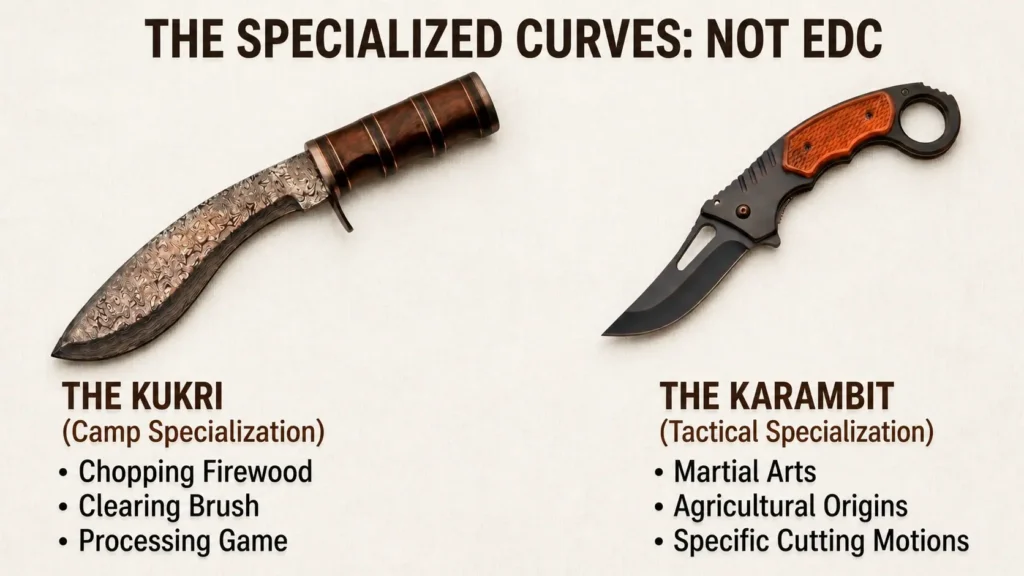
Both come up in searches for curved blade knives, both deserve a paragraph, and neither belongs in most readers’ pockets.
The karambit is a small, deeply curved knife with a finger ring. Originally an agricultural tool from Southeast Asia, now sold mostly as a tactical/martial arts piece. The curve and the ring make it excellent for the specific cutting motions it was designed for. Outside that context it’s an awkward EDC choice and tends to read as confrontational in any social situation.
The kukri is a heavy, forward-angled chopping blade from Nepal. Essentially a knife that wants to be a small machete. For chopping firewood, clearing brush, or processing game in camp, a kukri is genuinely useful. For everything else it’s too much knife. Our Damascus Kukri is the version we forge.
Both of these answer the “what is a curved knife called” question, but neither answers “what knife should I carry,” and they get conflated in articles that should know better.
How to actually choose: the decision framework
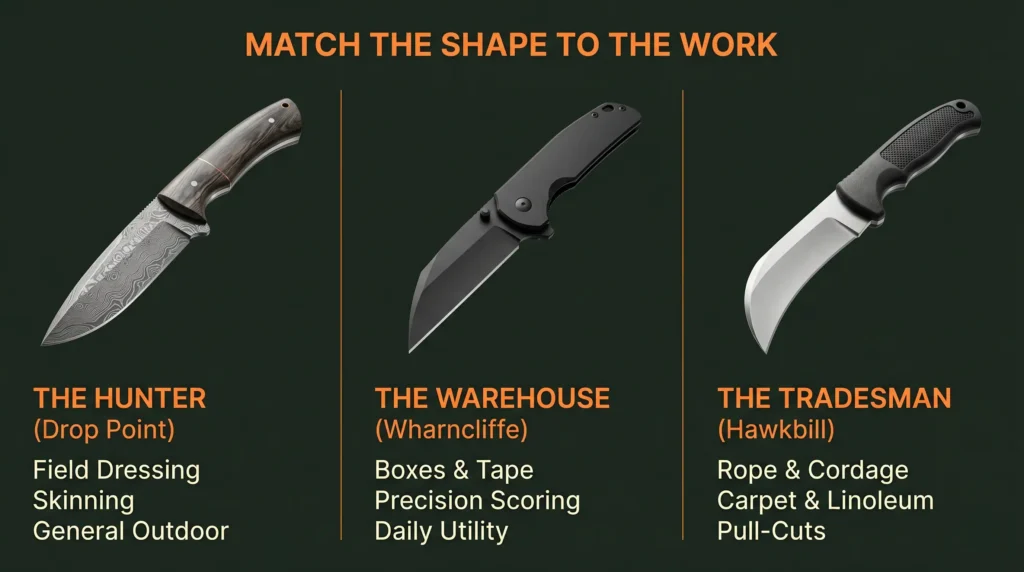
Forget the shape names for a second. Ask:
What’s the most common cut you make? If it’s pull-and-slice on flat material, you want a straight edge (sheepsfoot, wharncliffe). If it’s roll-and-slice through irregular material, you want a belly (drop point).
Will the tip ever take side load? If yes, avoid clip points and trailing points. Drop points and reverse tantos handle accidental side load better than anything else.
Will you sharpen it yourself in non-ideal conditions? If yes, no recurves.
Is fine tip control a feature you’ll actually use, or are you imagining a use case? Be honest. Most people don’t need a fine tip. They’ve just been told they do.Answer those four questions and the shape picks itself, regardless of what any blog tells you. Once you’ve narrowed it down, browse our full knife catalog or see our guide to the best blade shape for hunting, EDC, and self-defense.
A note on knives in general (the one product bridge)
The blade shape matters, but it’s downstream of build quality. A poorly-heat-treated drop point will lose its edge faster than a well-made tanto, and an excellent steel ground into the wrong shape for your use case will still disappoint you. If you’re shopping with this guide in mind, prioritize shape-for-task first, then steel and heat treatment, then handle ergonomics, then everything else. Brand name comes last. The right blade shape from a small maker beats the wrong blade shape from a big-name brand every time. If you’re looking at custom or hand-forged options, our Damascus knives are forged with this principle in mind.
Resolving the open loop
Back to the friend with the $340 trailing point. He didn’t make a stupid choice. He made the choice the buying guides told him to make, based on a use case (high-volume small-game processing) that didn’t match what he actually does (one or two big-game animals a season). The shape was optimized for someone else’s work.
That’s the whole pattern. The standard blade shape advice was written for the work people used to do, then re-written by content sites that copied each other, and now most of it is calibrated for a knife user who doesn’t really exist anymore. Match the shape to the work you actually do, not the work you imagine doing, and you’ll spend less money on knives, and the knives you do buy will work better.
Frequently Asked Questions (FAQ):
What is a curved knife called?
“Curved knife” usually refers to one of three shapes: a hawkbill (concave edge curving toward the ground, used for utility cuts on cordage, carpet, and roofing material), a karambit (deeply curved blade with a finger ring, originally agricultural, now mostly tactical/martial), or a kukri (forward-angled chopping blade from Nepal). All three are “curved knives” but they’re optimized for completely different tasks. If someone says “curved blade knife” with no other context, they usually mean a hawkbill.
What are different knife shapes for?
At the highest level, blade shapes optimize for three trade-offs: how much belly the edge has (which controls slicing vs. straight cutting), where the tip sits relative to the spine (which controls piercing and tip strength), and whether the edge curves up, down, or stays flat (which controls what kind of pull cut works best). Drop points optimize for general utility. Wharncliffes and sheepsfoots optimize for straight-line cutting. Trailing points optimize for hide work. Tantos optimize for tip strength at the cost of slicing. Hawkbills optimize for pulling cuts on tough material. There’s no “best” shape, only best-for-the-job.
Is a drop point really the best EDC blade?
For traditional outdoor EDC, yes. For modern urban EDC, boxes, tape, packaging, light office tasks, a sheepsfoot or wharncliffe is arguably better, even though the buying guides rarely say so. The drop point is the safest recommendation, not always the best one.
Are tanto blades good for self-defense?
This is a question with a marketing answer and a real answer. The marketing answer is yes, because of tip strength and “armor piercing” geometry. The real answer is that self-defense with a knife is something you should be training for under qualified instruction, not selecting a blade shape for. The tanto’s strengths are real but narrow, and they come at the cost of general usability. (See the best blade shape for self-defense for context.)
What blade shape should I get for hunting?
Drop point for almost everyone. Trailing point if you specifically process a lot of small game or fish. Avoid clip points unless you specifically want a fine tip and you’re disciplined about side load.Browse drop point hunting knives.