What Is a Drop Point Knife? Uses, Pros, Cons & Buying Guide

A drop point knife is a fixed or folding blade with a convex spine that curves gently downward from handle to tip, lowering the point below the spine line. The result is a strong tip and a wide cutting belly — well-suited for hunting, EDC, skinning, camping, and general utility.
This guide covers what a drop point is, what it’s used for, how it compares to other knife blade types and shapes, the best steels and sizes, common buying mistakes, and how to choose the right one.
Quick Answer: A drop point knife has a spine that slopes downward toward the tip, creating a strong point and curved belly. It is best for hunting, EDC, skinning, camping, and general utility because it balances slicing control, durability, and everyday versatility.
Table of Contents
What Is a Drop Point Knife?
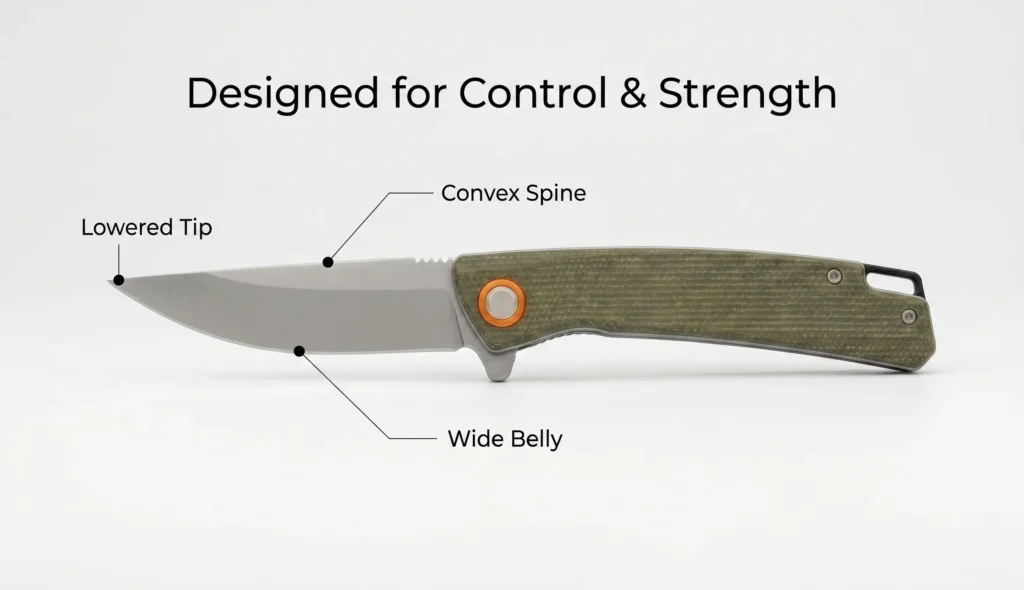
A drop point knife is defined by one feature: the spine drops in a smooth convex curve from the handle to the tip, placing the point lower than the top of the blade.
That single design choice creates three working advantages:
- A strong tip with more steel mass behind it
- A wide cutting belly for slicing and skinning
- A controllable profile that’s easy to guide through detailed work
The lowered tip is more resistant to tip stress than a clip point, which is one reason hunters and EDC users have made it one of the most popular working profiles in the modern knife market.
Best For / Not Best For
Best For | Not Best For |
|---|---|
| Hunting | Hard-target piercing |
| Skinning | Dedicated defensive use |
| EDC tasks | Prying |
| Camping | Users who want a fine piercing tip |
| Bushcraft | Detail tip work on tight cuts |
| Field food prep | Cutting through hard sheet materials |
The drop point is a generalist. If your priority is fast piercing or fine tip work, a clip point, tanto, or
spear point will fit your needs better.
Drop Point vs Other Blade Shapes
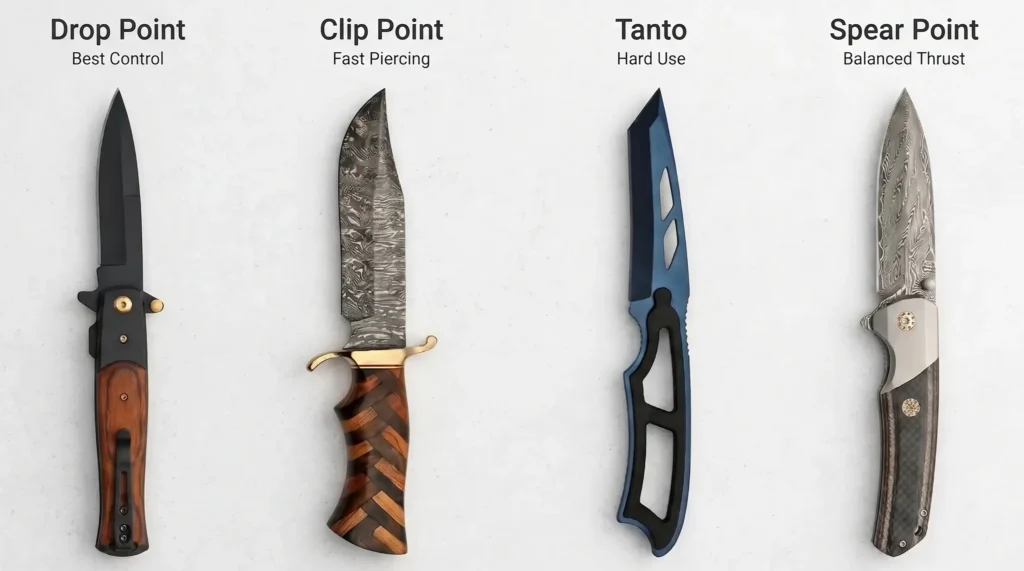
Most readers come to a guide like this with one question: how does it compare to the alternatives? Here’s the short version, followed by the details.
| Blade Shape | Best For | Main Weakness |
|---|---|---|
| Drop Point | Hunting, EDC, skinning, slicing | Slower piercing |
| Clip Point | Piercing, detail work | Thinner, more fragile tip |
| Tanto | Hard-target piercing | Limited slicing belly |
| Spear Point | Thrusting, symmetric work | Often double-edged, more legal restrictions |
Drop Point vs Clip Point
A clip point has a concave spine that “clips” away material toward the tip, raising the point and thinning it. It pierces faster and works better for fine tip detail.
A drop point has a convex spine that lowers the tip and adds steel behind it. It slices better, controls better, and resists tip stress better.
Pick the drop point for hunting, EDC, and general work. Pick the clip point when piercing speed or fine tip work is the priority. For a full breakdown, see our drop point vs clip point comparison.
Drop Point vs Tanto
The tanto has an angular tip with a strong reinforced point, built for piercing hard targets. It has little to no belly, so slicing performance is limited.
The drop point’s curved belly is the opposite design: optimized for long, controlled cuts.
Pick the drop point for utility, hunting, food prep, and EDC. Pick the tanto for tactical hard-target use.
For a side-by-side breakdown, see our tanto vs drop point comparison.
Drop Point vs Spear Point
A spear point is symmetric, with the tip on the centerline. It’s often double-edged, which raises legal concerns in many jurisdictions.
A drop point is single-edged and asymmetric — built for working tasks, not thrusting.For a deeper comparison including daggers, see our spear point vs drop point vs dagger guide.
Is a Drop Point a Dagger?
No. A dagger is symmetric and double-edged with the tip on centerline. A drop point is single-edged with an asymmetric working belly. They are different geometries and have different legal classifications in most regions. For more on dagger laws and definitions, see our dagger vs knife guide.
Pros and Cons
| Pros | Cons |
|---|---|
| Strong tip, more resistant to stress | Slower to pierce than clip point |
| Deep slicing belly | Not ideal for hard-target tactical work |
| Versatile across hunting, EDC, bushcraft | Less piercing speed than spear point |
| Single-edged, simpler to classify legally | Tip can round if sharpened incorrectly |
| Easy to control for field-dressing | Tanto outperforms it on hard surfaces |
Anatomy of a Drop Point Blade
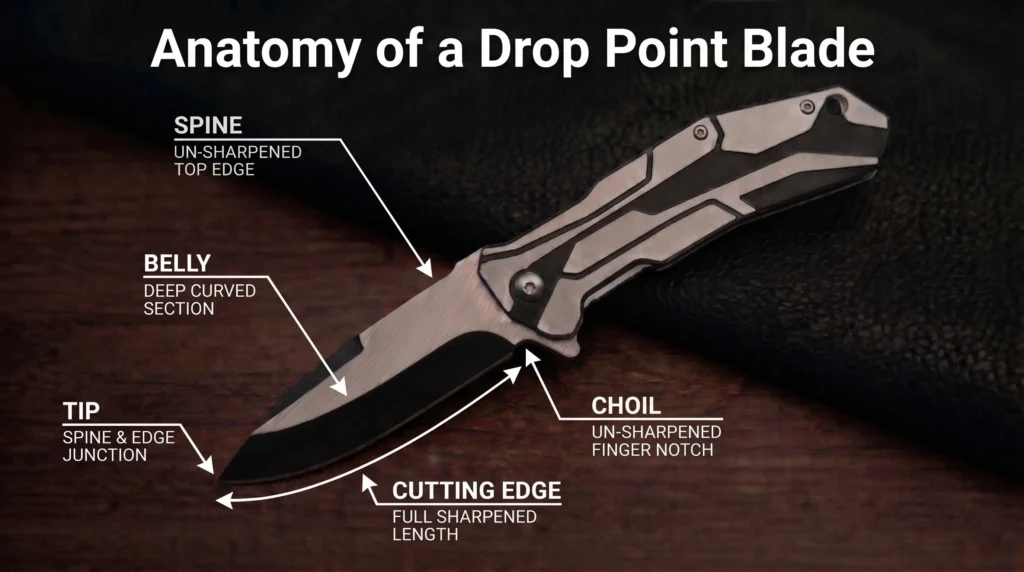
There are eight working parts on a drop point. Knowing them is the difference between buying a knife and buying the right knife.
- Spine. The unsharpened top edge. On a drop point, it curves convexly from handle to tip. Hunting drop points typically run 3–4mm thick.
- Drop. The downward curve of the spine. Subtle drop = high drop point (better piercing). Pronounced drop = low drop point (better skinning control).
- Belly. The curved section of the cutting edge near the tip. The drop point’s deep belly is what makes it perform well for slicing and skinning.
- Tip. Where spine and edge meet. It sits below the spine line and is more resistant to stress than a clip-point tip.
- Plunge Line. The transition from unsharpened ricasso to sharpened edge. A clean, vertical plunge line is a quiet sign of quality grinding.
- Cutting Edge. The full length of sharpened steel: flat working section + the deep belly leading to the tip.
- Choil. A small unsharpened notch between edge and handle. Lets you sharpen the full edge without rounding the heel.
- Tang. The blade steel extending into the handle. A full tang (steel running the full length and width of the handle) is strongly recommended on any serious fixed-blade hunting knife.
A Brief History
Bob Loveless is widely credited with shaping the modern drop point hunter. In the late 1960s and 1970s, he redesigned the hunting knife around a working belly and lowered tip. Within a decade, his geometry became the template for nearly every serious American hunting blade. The American Bladesmith Society maintains a strong record of the makers who carried that tradition forward.
The underlying idea predates Loveless by centuries. Pattern-welded blades from Persia and the Indian subcontinent were forging drop-shaped working knives long before American custom makers picked up the profile. That hand-forging tradition survives today in custom shops producing true damascus drop points.
Drop Point Variations
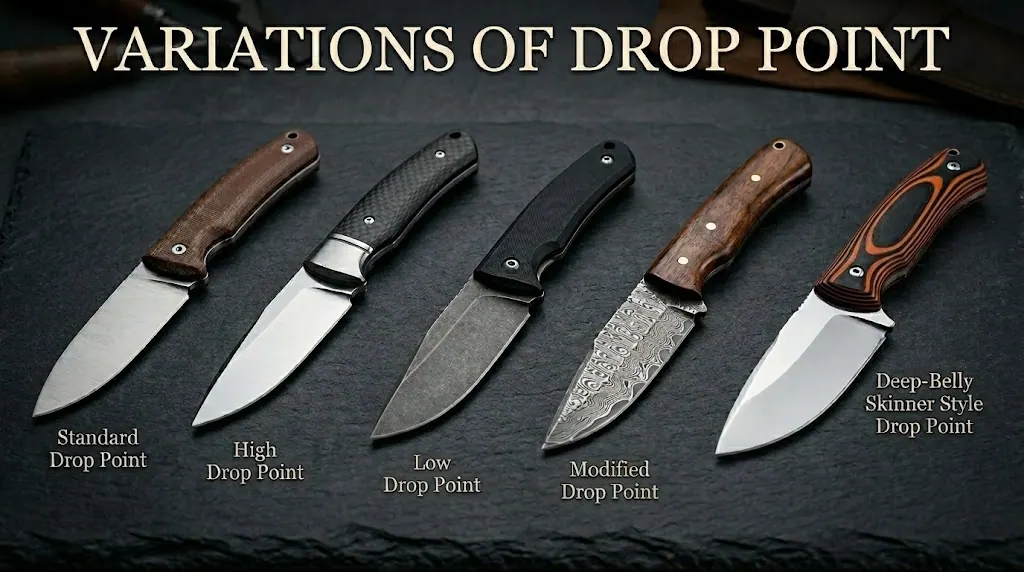
“Drop point” isn’t one shape; it’s a family.
- Standard Drop Point. Moderate spine drop, balanced belly, tip roughly centered on the handle. The safe default.
- High Drop Point. Subtle spine curve with the tip closer to the spine line. Better piercing, less belly. Common on EDC folders.
- Low Drop Point. Pronounced drop, tip well below the spine. Excellent belly, safer for field-dressing. Less piercing speed.
- Modified Drop Point. Production tweaks — recurved edge, spine swedge, or more aggressive belly.
- Deep-Belly (Skinner-Style) Drop Point. The belly is the dominant feature, wide and sweeping, paired with a low drop. Built for skinning.
Grind Variations
The profile is only half the story. The grind matters just as much.
- Scandi. Easy to sharpen, great for bushcraft.
- Hollow. Razor-thin edge, fragile under prying.
- Flat. Balanced — the most common on quality hunters.
- Convex. Strongest geometry, hardest to sharpen freehand.
What Is a Drop Point Used For?
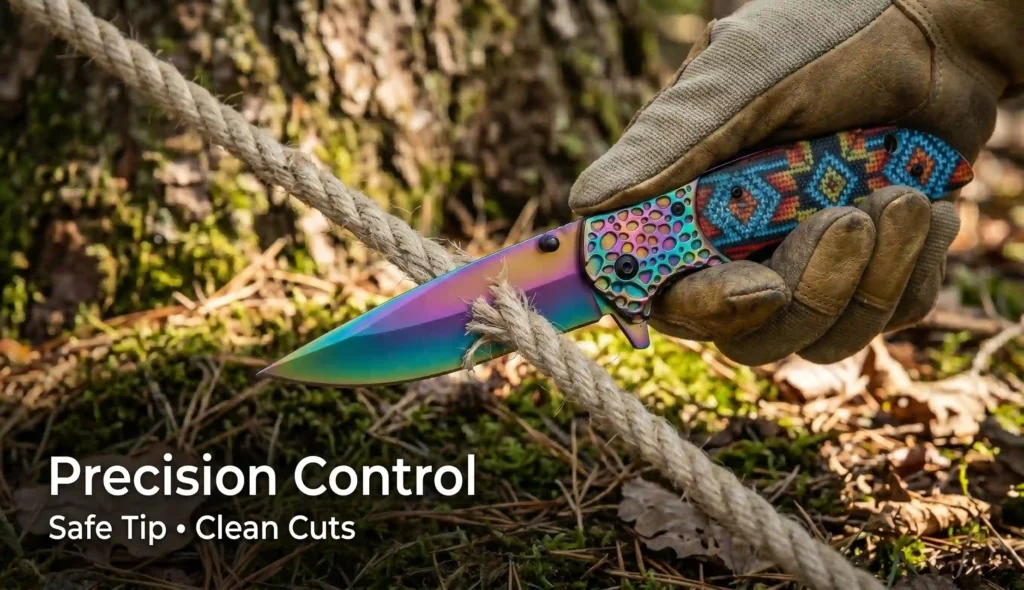
A drop point handles hunting, field-dressing, skinning, EDC, bushcraft, food prep, and general utility cutting. The strong tip and wide belly make it one of the most versatile blade profiles for tasks that prioritize control and slicing over raw piercing speed.
- Hunting. The lowered tip lets you open a hide without puncturing the gut cavity — the single biggest mistake new hunters make with a clip point.
- EDC. Opens packages, slices food, cuts cordage. The strong tip handles daily contact with concrete, metal, and bone.
- Skinning. The continuous belly curve stays in contact with the hide through the full draw, with no repositioning needed.
- Bushcraft and Camping. Handles batoning, feathersticks, notching, and food prep in one tool.
- Tactical. More resistant to tip stress than clip points, but still not designed for prying.
Honest exception: if your sole task is piercing hard targets like sheet metal or armor, a clip point or tanto will outperform the drop point.
Drop Point Knife by Use Case
Hunting
For most game, look for a 3.5 to 4.5 inch blade on a full tang, with a steel that holds an edge through a full field-dressing session. MagnaCut, S30V, 1095 high-carbon, and hand-forged 1095 + 15N20 damascus are all proven choices. For a deeper look at picking the right shape for the field, see our guide on the best blade shape for hunting, or browse our hunting knife collection for real-world examples.
Key requirements:
- Enough belly to skin without repositioning
- Enough tip control to open a hide cleanly
- Spine thickness to handle bone contact
- A handle that grips when wet
Skinning
Skinning is a belly-of-the-edge job, not a tip job. A deep-belly drop point keeps the cutting edge in continuous contact with the hide. Hand-forged options tend to carry a slightly more aggressive micro-edge from the forge finish.
EDC
For everyday carry, look for:
- 2.8 to 3.5 inch blade (legal in most jurisdictions)
- A strong lock (frame lock, liner lock, or AXIS)
- Steel that resharpens easily — D2, 154CM, or S30V if budget allows
Self-Defense
The drop point is not the optimal blade shape for self-defense. Clip points, spear points, and daggers all pierce faster. A consistently carried sharp knife is more useful than a “better” knife left at home, but legal restrictions on carry usually matter more than blade geometry. For dedicated tactical fixed blades, see our tactical fixed blade roundup.
Best Steel for a Drop Point Knife
Steel matters more than profile. A perfect drop point in soft stainless will lose its edge fast; a capable profile in good steel will outlast the trip.
| Steel | Edge Retention | Toughness | Corrosion | Sharpening | Best For | Tier |
|---|---|---|---|---|---|---|
| 1095 (carbon) | Good | Excellent | Poor | Easy | Bushcraft, hunting | $ |
| D2 | Very good | Good | Moderate | Moderate | Hunting, EDC | $$ |
| 154CM | Good | Good | Good | Easy | EDC, all-around | $$ |
| S30V | Excellent | Good | Excellent | Hard | Premium EDC | $$$ |
| MagnaCut | Excellent | Excellent | Excellent | Moderate | Premium hunting | $$$$ |
| Damascus (1095 + 15N20) | Very good | Excellent | Moderate | Moderate | Hand-forged hunting | $$$ |
| 420 / 3Cr13 | Fair | Good | Excellent | Very easy | Budget EDC | $ |
1095 is the working standard for carbon steel. Tough, sharpens to a razor, and tells you when it needs maintenance (it patinas). Oiled regularly, it can last for years with care.
MagnaCut is one of the strongest premium options for hunters who want edge retention, toughness, and corrosion resistance without compromise. For an in-depth look at the metallurgy, see Larrin Thomas’s MagnaCut writeup at Knife Steel Nerds — he designed the steel.
Damascus: True pattern-welded damascus (1095 + 15N20) combines high-carbon performance with layered toughness. For a deeper look, see our damascus knife guide. Watch out for fakes:
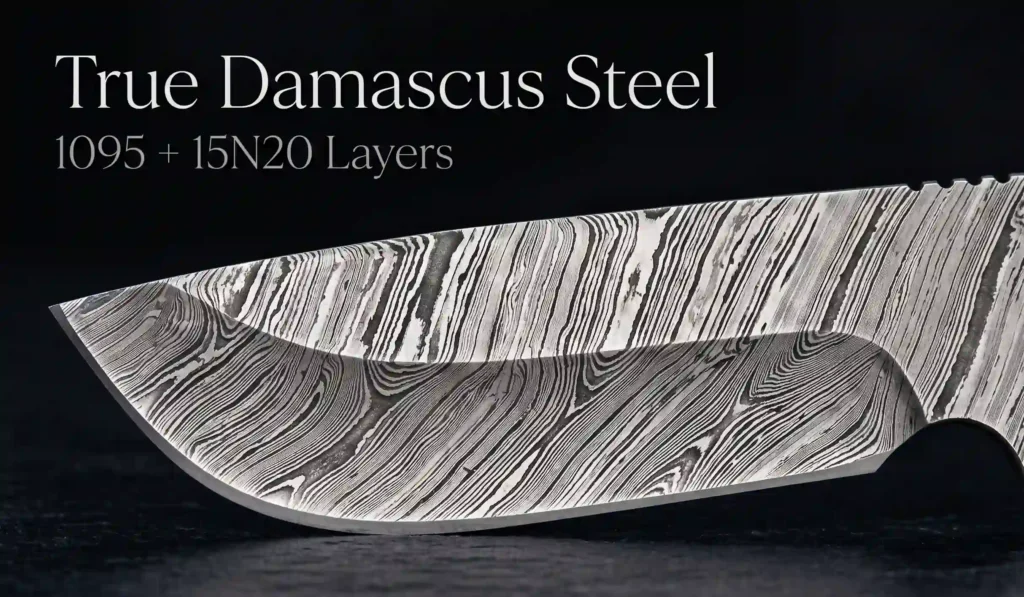
- Real damascus shows pattern on both sides and into the bevel, has visible layers under magnification, and will rust without care.
- Fake damascus has pattern only on the flat surface and never rusts (it’s chemically etched stainless).
Best Steel by User Type
| User Type | Best Steel Choice |
|---|---|
| Beginner | 420HC / 3Cr13 — forgiving and low maintenance |
| EDC User | D2 / 154CM — balance of edge and ease |
| Hunter | S30V / MagnaCut — retention and toughness |
| Bushcrafter | 1095 / 3V — tough and field-sharpenable |
| Collector | Damascus — character, uniqueness, tradition |
Best Drop Point Knife by Use Case
| Use Case | Best Blade Length | Best Steel |
|---|---|---|
EDC | 2.8 to 3.5 in | D2, 154CM, S30V |
| Hunting | 3.5 to 4.5 in | 1095, S30V, MagnaCut, Damascus |
| Bushcraft | 4 to 5 in | 1095, 3V, MagnaCut |
| Skinning | 3.5 to 4.5 in | 1095, Damascus, S30V |
| Tactical | 3.5 to 5 in | S35VN, MagnaCut |
How to Choose Your Drop Point Knife
Seven questions get you to the right knife. Answer them in order.
- Primary use case? Hunting, EDC, skinning, bushcraft, or tactical. Be honest — most people overestimate how often they’ll do bushcraft.
- Fixed or folding? Fixed for hunting, serious work, and bushcraft. Folding for EDC and carry convenience.
- Blade length? EDC: 2.8–3.5″. Hunting: 3.5–4.5″. Bushcraft: 4–5″. Tactical: 5″+ (anything over 5″ moves into bowie knife territory).
- What steel suits your habits? Carbon (1095) if you’ll oil it. Stainless (S30V, MagnaCut) for lower maintenance. Damascus for hand-forged character with working performance.
- Budget tier? Under $50: budget production. $50–$150: mid-range or entry hand-forged. $150–$400: premium production. $400+: custom shop.
- Hand-forged or production? Production = consistency, warranty, easy replacement. Hand-forged = unique craftsmanship and character, more care required.
- Is it legal where you’ll carry? Check blade length, lock type, opening style, and carry method rules in every jurisdiction you’ll travel through.
Common Buying Mistakes
Avoiding these five mistakes will save more money than picking any one “best” knife.
- Choosing too large a blade. A 7-inch blade looks impressive online and feels like overkill the first time you actually field-dress an animal or open a package. Most users are better served by 3.5–4.5 inches.
- Ignoring steel maintenance. Buying a 1095 or damascus blade and never oiling it is a fast way to ruin it. If you won’t maintain a carbon blade, buy stainless. See our knife care guide for a simple maintenance routine.
- Buying fake damascus. Cheap “damascus” knives on big marketplaces are usually chemically etched stainless. The pattern washes off the bevel during sharpening. Look for visible layers in the bevel and the seller’s willingness to confirm the steel makeup.
- Choosing looks over handle grip. A beautiful handle that slips when wet is worse than a plain handle that doesn’t. Test grip with wet hands if you can, or read reviews specifically about wet-hand performance.
- Ignoring local knife laws. Blade length, lock type, opening mechanism, carry method, and even location (school zones, federal buildings, airports) all matter. The blade shape is rarely the legal issue.
How to Sharpen a Drop Point Knife
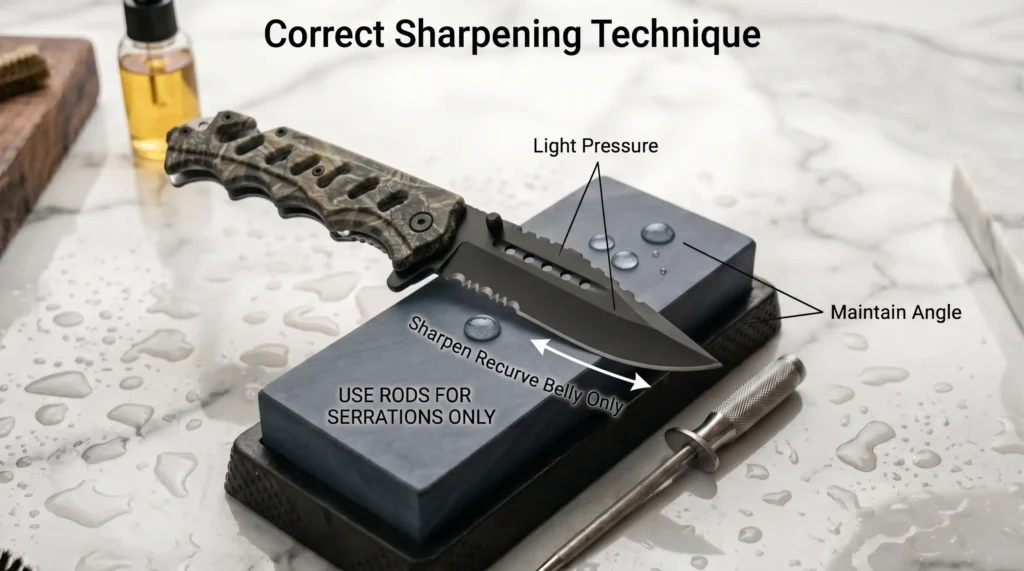
The curved belly and lowered tip need a slightly different approach than a straight-edged blade. Skip this and you’ll round the tip.
- Set your angle. Most drop points run 17–22 degrees per side. Hunting and bushcraft: 17–20. EDC folders: ~20. When unsure, 20° is safe.
- Sharpen the flat section first. Hold your angle and pull the edge from heel to where the belly begins to curve. Match strokes on each side.
- Roll into the belly. As you reach the curve, lift the handle slightly and rotate so your angle stays consistent against the stone. Smooth roll, not a separate motion.
- Finish the tip carefully. As the belly tightens, keep rotating, lift slightly more, and reduce pressure. Heavy pressure here is what rounds the tip off.
- Strop to finish. A leather strop with polishing compound aligns the edge and removes the burr. Five to ten passes per side.
For carbon and damascus blades: wipe dry, then apply a thin coat of food-safe mineral oil or camellia oil. These steels rust without it. Our full knife care guide covers oiling schedules and storage.
Legal and Carry Considerations (U.S.)
Knife law in the United States varies significantly by state, county, and city, and the drop point shape itself is rarely the legal issue. Blade length, lock type, opening mechanism, and how you carry are usually what matters.
Many U.S. jurisdictions are more permissive with common utility knives, but rules vary by state, city, blade length, lock type, opening mechanism, concealment, and intent. The American Knife & Tool Institute (AKTI) maintains a state-by-state breakdown that’s worth checking before you carry. Cities like NYC and parts of California have stricter rules than surrounding state law.
Drop points are often easier to classify as a working knife, since they’re single-edged and clearly utility-shaped. But length, lock type, and carry method still apply.
This is not legal advice. Check your local laws before carrying any knife.
Caring for Your Drop Point Knife
- Clean after use. Wipe with a dry cloth. After cutting food, blood, or anything acidic, clean with warm water and dry immediately. Never put a quality knife in the dishwasher.
- Oil carbon and damascus blades. Thin film of food-safe mineral oil or camellia oil. Once a week for EDC; after every use for hunting.
- Strop between sharpenings. A weekly strop can extend the time between full resharpenings significantly.
- Store properly. Don’t leave a knife in a leather sheath long-term — leather retains moisture. Use a kydex sheath, knife roll, or wall display.
For a complete maintenance routine including oiling schedules, storage, and rust prevention, see our knife care guide.
Frequently Asked Questions (FAQs)
What is a drop point knife used for?
Hunting, field-dressing, skinning, EDC, bushcraft, food prep, and general utility cutting. Its strong tip and wide belly make it one of the most versatile working blade profiles available.
Is drop point better than clip point?
For most users, yes. Drop points are stronger, slice better, and resist tip damage more effectively. Clip points are better only when piercing speed or fine tip work is the priority. See our full drop point vs clip point comparison for the side-by-side breakdown.
Is a drop point knife good for beginners?
Yes. The strong tip is forgiving of beginner mistakes, the wide belly makes basic cutting tasks easier, and the shape is widely accepted legally. Pair it with an easy-to-sharpen steel like 420HC, D2, or 154CM.
What is the best drop point knife size?
EDC: 2.8–3.5 inches.
Hunting: 3.5–4.5 inches.
Bushcraft: 4–5 inches.
Four inches is a reliable sweet spot for North American hunters.
Is drop point good for camping?
Yes. The combination of a strong tip, deep belly, and full-tang construction handles food prep, batoning kindling, cutting cordage, and general camp tasks in one tool.
Is drop point good for self-defense?
It’s not the optimal shape for self-defense. Clip points, spear points, and daggers pierce faster. That said, blade shape matters far less than legal carry rules and personal training.
What’s the best steel for a drop point knife?
For most users: MagnaCut or S30V (stainless, low maintenance). For carbon: 1095 (tough, easy to sharpen, needs oiling). For hand-forged: real pattern-welded 1095 + 15N20 damascus.
Are damascus drop point knives worth it?
Real pattern-welded damascus (not etched stainless) is worth it for hunters and collectors who will maintain their blades. They require regular oiling.
Can you baton wood with a drop point knife?
Yes — if it’s a full-tang fixed blade with a spine of 4mm or more. Folders and thin-spine drop points are not suitable for batoning.
Is a drop point knife legal to carry?
In most jurisdictions, yes, but it depends on blade length, lock type, opening mechanism, and how you carry. Check local law before carrying any knife.
Conclusion
The drop point isn’t the flashiest blade shape, and it isn’t the fastest piercer. It’s the most useful one for the widest range of tasks, which is why hunters, EDC carriers, and bushcrafters keep choosing it.
If you’re buying your first one, focus on three things: a blade length that matches your real use (not your wishlist), a steel that fits how much maintenance you’ll actually do, and a handle that grips when wet. Get those right and the knife will serve you well for years.