Spear Point Knife: The Blade Built to Pierce Without Giving Up the Cut

Table of Contents
A spear point blade is one of the oldest ideas in edged tools, and one of the most misunderstood on the modern knife counter. People see the symmetrical, centered tip and assume one of two things: either it is a dagger they cannot carry, or it is a generic “pointy knife” with no real specialty. Both miss what the shape is actually built to do.
The spear point exists to solve a specific problem: how do you get a strong, controllable piercing tip without throwing away your ability to slice? Most tip-heavy designs sacrifice the cutting edge to get the point. The spear point refuses that trade-off, it puts the tip dead-center on the blade’s long axis so force drives straight through, then keeps just enough belly to do real cutting work.
This guide covers the geometry, the single-edge versus double-edge question that decides whether your knife is legal, the history from ancient spearheads to the Swiss Army Knife, the steels that matter, and how to sharpen a symmetrical edge. For the bigger picture across every common profile, our knife blade types pillar guide maps where the spear point sits in the larger family.
Quick Answer: A spear point knife has a symmetrical blade with the tip aligned to the centerline, where the spine and edge slope toward the point at matching angles. It is best for piercing, thrusting, throwing, and balanced EDC tasks because it combines a strong, controllable tip with enough belly for everyday slicing.
What Is a Spear Point Blade?
A spear point blade is a symmetrical profile where the tip sits exactly on the centerline of the blade’s long axis, with the spine and the cutting edge rising and falling at matching angles to meet at that point. The tip lines up with the middle of the blade, not above it like a clip point or below it like a drop point.
That symmetry is the whole spear point blade shape, and everything the design does well comes from it. Because the point is centered, force travels straight down the spine and out through the tip with nothing pulling it off-axis, an excellent piercing and thrusting geometry. At the same time, the lower edge keeps a small belly, so the knife can still slice, score, and handle ordinary cutting jobs.You will see the name written two ways: spear point and the one-word spearpoint. They mean the same thing. “Spear point” describes where the tip sits, not how many edges are sharpened, a detail that matters enormously, and one we get to next.
Spear Point Blade Anatomy: Understanding the Geometry
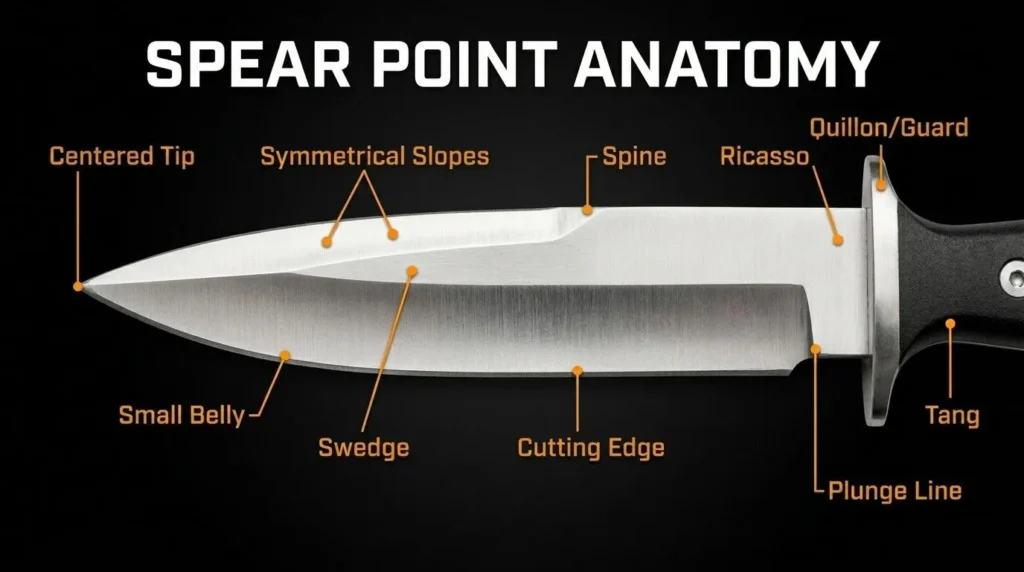
The spear point blade is defined by a few features that set it apart.
The centered tip. The point sits on the blade’s central axis, halfway between spine and edge. A drop point lowers the tip below the spine; a clip point raises it; the spear point puts it dead center. That alignment gives the design its straight-line piercing strength and its natural, controllable feel.
The symmetrical slopes. The spine curves down and the edge curves up to meet at the tip, mirroring each other, which is what makes the profile look like a spearhead and behave like a thrusting tool.
The small belly. Below the tip, the edge keeps a modest curved section: smaller than the deep belly on a drop point or skinner, but enough for slicing and general cutting. Its size is the main thing that varies between one spear point and another.
The swedge or second edge. The top slope is often ground thin. Left unsharpened, it is a swedge (or false edge) that lightens the tip and improves penetration. Sharpened, the knife becomes double-edged, and the legal and practical picture changes completely.
It is a profile engineered to drive a strong tip straight into a target while keeping just enough edge to remain a useful cutter.
Single-Edge vs Double-Edge Spear Points
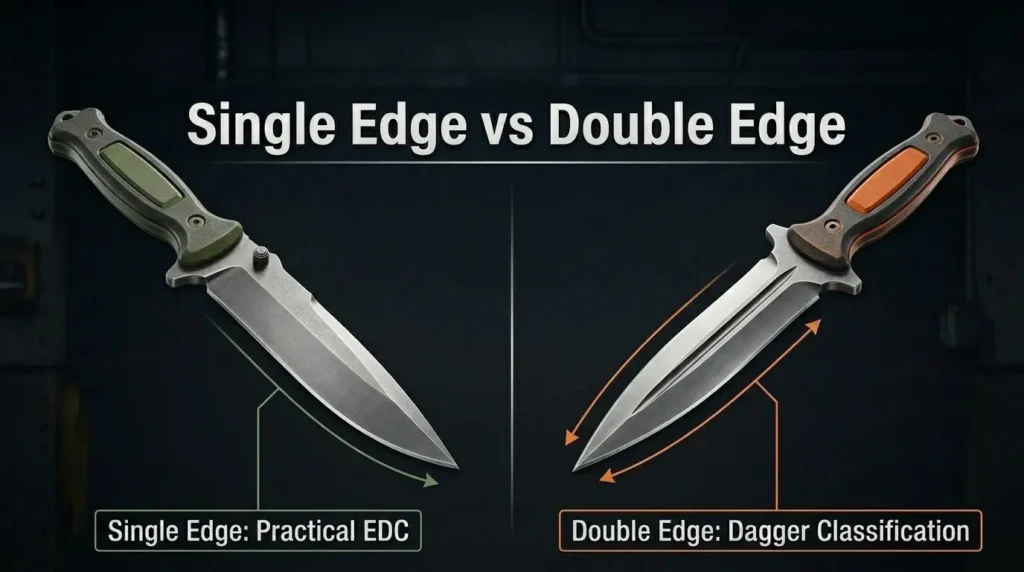
This is the section most blade guides skip, and the single most important thing to understand before you buy a spear point. A spear point is a shape, it says nothing about how many edges are sharpened. The same symmetrical profile is built two completely different ways.
Single-edge spear point. One sharpened edge along the bottom, the top slope left as an unsharpened swedge. This is the practical, everyday version. It still pierces well because the tip is centered and the spine is thinned, but it behaves like a normal working knife: you can rest a thumb on the spine for control, and in most places it carries the same legal status as any single-edged blade. The main blade on a classic Swiss Army Knife is a single-edge spear point, which tells you how useful the shape is for ordinary tasks.
Double-edge spear point. Both slopes sharpened, giving two cutting edges that meet at the centered tip. It cuts on the draw and the push and pierces aggressively. It is also, in many jurisdictions, the point at which a spear point legally becomes a dagger. That is the whole fork in the road. For EDC, utility, camping, or kitchen work, you almost certainly want the single-edge version. If you are drawn to the double-edge version, understand the legal picture first, the second edge is what triggers most knife restrictions.
Is a Spear Point the Same as a Dagger?
Not exactly, and the distinction trips up a lot of buyers. A dagger is a symmetrical, double-edged blade built primarily for thrusting, often with little or no usable belly. A spear point is a shape defined by its centered tip and matching slopes. The overlap is real: a double-edged spear point with a slim profile is essentially a dagger, and many daggers are spear points by geometry.
The practical difference comes down to that second edge. A single-edge spear point with a working belly (a Swiss Army Knife blade, a modern EDC folder) is a knife in every ordinary sense and is treated as one. A fully double-edged spear point with a slim profile and minimal belly is a dagger, regulated accordingly in many regions.
So the honest answer: a spear point can be a dagger, but most sold for everyday use are not. The shape is the family; the dagger is one branch of it. For a full breakdown, see our spear point vs dagger comparison (coming soon).
Spear Point Grind and Swedge
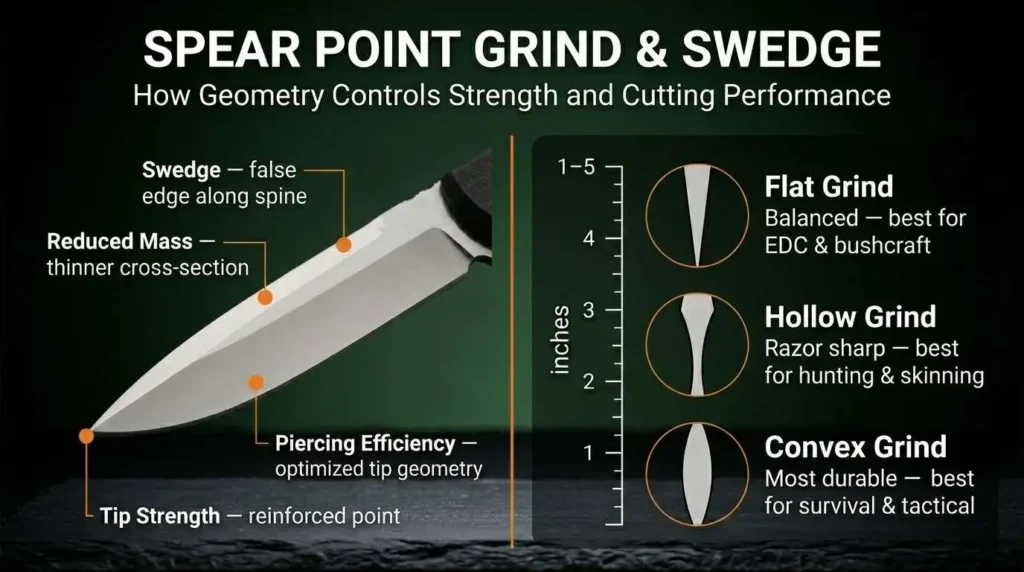
The profile is only half the story. The grind decides how the spear point cuts and how much tip strength that centered point really has.
The swedge. The top slope is frequently ground down to thin the spine as it nears the tip. Left unsharpened, this swedge reduces mass behind the point and helps the blade penetrate more easily, without removing strength lower down the spine. Makers like Rick Hinderer build a signature top swedge into their spear point designs for exactly this reason: better piercing, tough tip. It is one of the most under-explained features on the shape, and one of the most functional.
Grind type. A flat grind is most common on quality working spear points, balancing edge strength and slicing. A hollow grind thins the edge for a keener cut but leaves the tip more fragile, a real concern on a blade built around piercing. A convex grind gives the most durable geometry behind the point but is harder to sharpen freehand. A spear point with a thinned swedge and a flat grind is the versatile, do-everything build.
Spear Point Blade History
The name is as literal as it gets. The shape descends directly from the spearhead, one of humanity’s oldest tools. A spearhead is symmetrical for a reason: a point on the centerline drives straight and true when thrust. Scaled down onto a knife blade, that geometry became the spear point. Through antiquity and the medieval period the symmetrical, double-edged blade was everywhere, from short thrusting weapons to the daggers carried alongside swords. Only later, as restrictive knife laws spread and everyday needs shifted toward utility over combat, did the double-edged version fall out of common carry and the single-edge spear point become the practical survivor.
That survivor shows up in one place almost everyone has handled: the main blade of a traditional Swiss Army Knife is a spear point, and on slip-joint pocketknives the same small symmetrical blade is known as a pen blade, named for the days it trimmed quill pens. That hand-forging tradition survives in custom shops producing pattern-welded steel, the same craft documented by the American Bladesmith Society, where a centered tip and mirrored grinds are still forged by hand.
What Is a Spear Point Blade Used For?
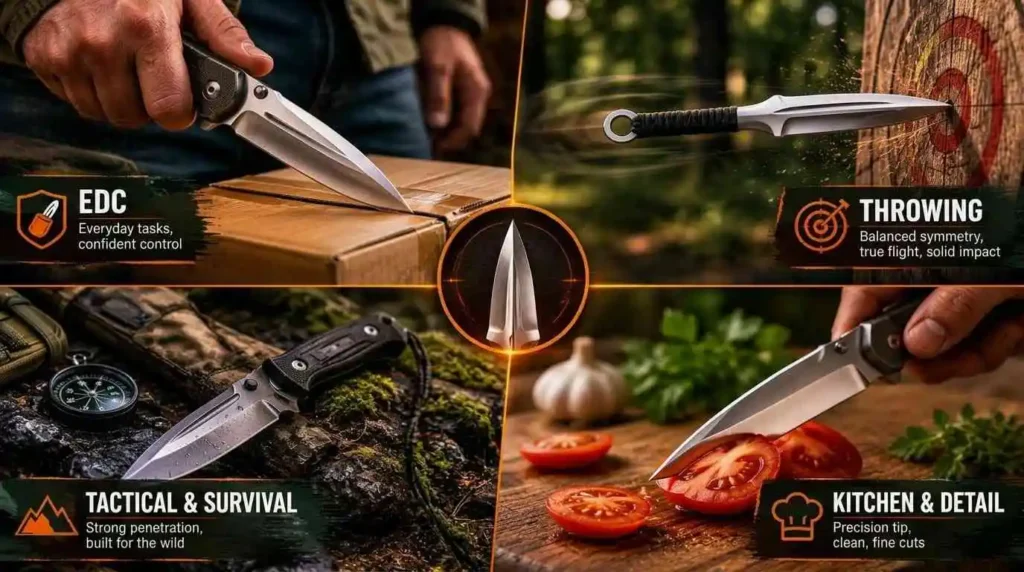
The centered tip and symmetrical profile make the spear point one of the better blade shapes for tasks that reward a strong, precise point without abandoning the cutting edge. Here is how it breaks down by user.
Spear Point for EDC
For everyday carry, a single-edge spear point is a strong all-rounder. The centered tip gives confident piercing for boxes, blister packs, and zip ties, and the small belly handles slicing and food tasks. Because the point sits on the centerline, the knife indexes intuitively and fine tip work feels controlled. A small or mini spear point folder makes an easy, unintimidating pocket knife, a capable do-everything EDC blade, if not the deepest slicer in the drawer.
Spear Point Throwing Knives
This is where the geometry is not just useful but ideal. A throwing knife needs to rotate predictably and strike point-first despite small inconsistencies in the throw, and symmetry makes that possible. With the tip on the centerline and weight distributed evenly around it, a spear point throwing knife flies true and bites reliably, which is why a huge share of dedicated throwing knives use this profile. If throwing is your interest, the spear point is the default answer.
Spear Point for Hunting, Tactical, and Survival
A spear point can serve as a hunting knife, with caveats: the strong centered tip pierces well, but for skinning and field-dressing a deep belly is what keeps the edge on the hide, so a drop point knife out-skins it, and a double-edged spear point is a liability near a hide or gut cavity. Where the shape truly shines is tactical and survival use. A spear point fixed blade gives straight-line penetration and a tough, controllable tip, with a long history in boot knives, dive knives, and combat blades. For a spear point camping or survival knife, the single-edge build keeps your options open, the piercing tip plus a spine you can rest a hand on, while a double-edged version sacrifices batoning and any task needing spine pressure.
Spear Point in the Kitchen and for Self-Defense
A spear point paring knife is a smaller but real niche, using the precise centered tip for peeling, trimming, coring, and detail work while the modest belly handles fine slicing. It manages light whittling too, though a single-edge build is essential there, since you cannot safely brace a thumb on a sharpened spine. As for self-defense: the shape’s reputation comes from its spearhead ancestry, and double-edged versions cut on both push and draw. But capability and legality are different questions, and double-edged blades carry real legal weight. Before considering any blade for self-defense, understand your local laws and the legal section below, and treat carry as a personal responsibility.
Spear Point Variations You Should Know
“Spear point” is a family, not a single shape. Beyond the single-edge and double-edge builds covered above, a few variants are worth knowing:
- Modified spear point. Production tweaks: a slightly raised or lowered tip, a longer swedge, or a deeper belly to improve slicing.
- Pen blade. A small spear point used as the primary or secondary blade on slip-joint and multi-tool knives. Compact, friendly, genuinely useful for light tasks.
- Needle point. A close relative, not the same thing. It narrows to a much finer, sharper, weaker tip built purely for piercing; a spear point keeps more steel behind the point for a stronger, more durable tip. Needle point is the specialist piercer, spear point the balanced one.
Damascus and Hand-Forged Spear Points
The spear point’s mirrored geometry is a natural showcase for pattern-welded steel. Because both slopes are visible and symmetrical, the flowing layers of a hand-forged Damascus blade read cleanly across the whole profile, and the centered tip becomes a focal point for the pattern. A hand-forged Damascus spear point pairs the shape’s straight-line strength with the edge-holding and toughness of layered high-carbon construction.
A true Damascus spear point is forged, not etched: alternating layers of high-carbon and nickel steel folded so the pattern runs all the way through the blade. To tell real from fake before buying any patterned blade, our complete guide to Damascus steel knives walks through the honest tests, and our Damascus knife collection shows what hand-layered steel looks like across working profiles.
Steel Selection for Spear Point Knives
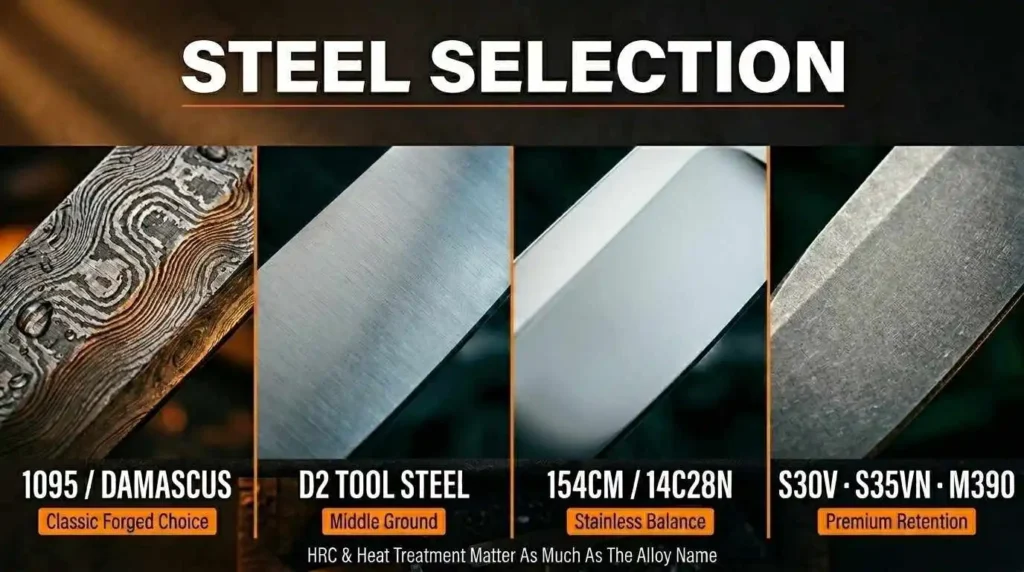
Because the spear point lives and dies by its tip, steel choice matters more than on a forgiving, deep-bellied blade. A thin, centered point under stress wants steel that resists chipping and holds an edge.
- High-carbon (1095, and the 1095 / 15N20 pairing in Damascus). Tough, takes a screaming edge, easy to resharpen, needs care against rust. The classic forged-blade choice.
- D2. Semi-stainless tool steel with excellent edge retention and good toughness, a popular middle ground.
- 154CM and 14C28N. Stainless steels balancing sharpness, edge retention, and corrosion resistance, common on quality production spear points.
- Premium stainless (S30V, S35VN, M390-class). Outstanding edge retention for users who want to sharpen less often.
Prioritize toughness and edge retention so the tip survives the piercing work the shape is built for. Heat treatment and hardness (HRC) matter as much as the alloy name.
How to Sharpen a Spear Point Knife
Sharpening a spear point is straightforward once you account for its symmetry, with one wrinkle most guides ignore: on a double-edged spear point you maintain two edges that meet at the tip, and both must stay consistent or the point drifts off-center.
Set your edge angle. Most spear points sharpen well at roughly 17 to 20 degrees per side, slightly more obtuse for a hard-use piercing blade, slightly more acute for a fine slicer.
Work the edge in zones, and match both sides. Maintain your angle through the straight section near the heel, then sweep up through the curved belly so the tip gets the same attention. Because the profile is symmetrical, alternate sides evenly with the same stroke count; uneven sharpening pushes the centered tip off-axis and ruins the very thing that makes the shape work.
Mind the swedge or second edge. On a single-edge spear point, leave the unsharpened swedge alone. On a double-edge spear point, sharpen the top edge to match the bottom so both meet cleanly at the point.
Protect the tip. Finish with light, edge-trailing strokes and avoid heavy pressure right at the point, where thin steel rounds off easily. A regular bench stone handles a spear point fine; the discipline is consistency, not special tools.
Are Spear Point Blades Legal?
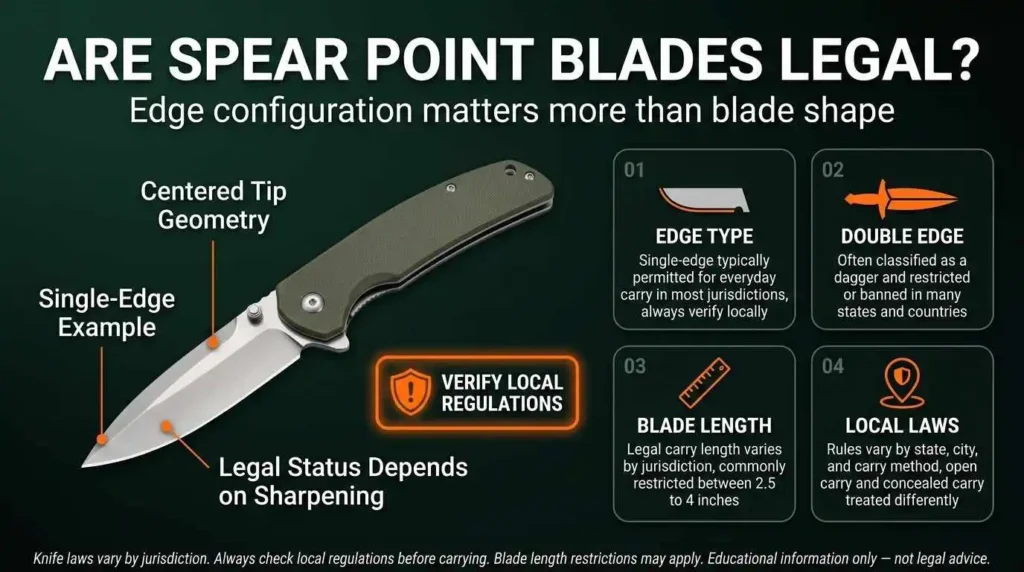
This is the part of the spear point story that genuinely matters, and the part most guides wave away in a single line.
The shape itself, a centered tip with symmetrical slopes, is not what regulations target. What gets regulated is the second edge. A single-edge spear point is, in most places, treated like any other single-edged knife and judged by ordinary blade-length and carry rules. A double-edged spear point is frequently classified as a dagger or dirk, and double-edged blades face the tightest restrictions: some jurisdictions limit them, some ban concealed carry, some prohibit them outright. The same shape can be legal in one build and restricted in another, depending on whether both edges are sharpened, blade length, and where you are. Automatic and out-the-front mechanisms add another layer of rules.
We are not lawyers, and this is not legal advice. Knife laws vary widely by country, state, and even city, and they change. Before you carry any spear point, especially a double-edged one, check your local statutes. Our responsible ownership and legal compliance page covers the principles, and for jurisdiction-specific rules a resource like Knife Up’s state-by-state knife law overview is a useful starting point.
Spear Point vs Other Blade Shapes
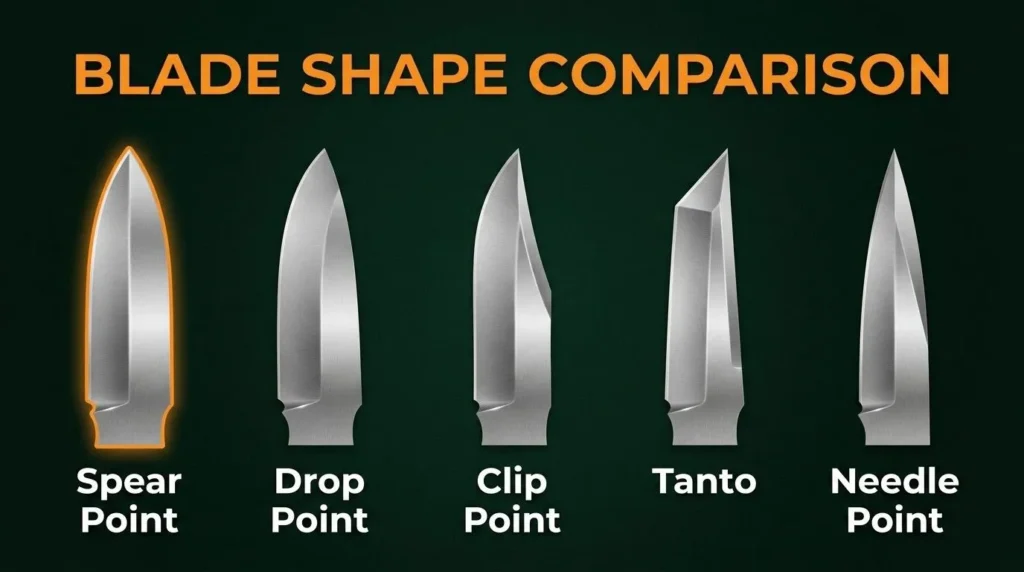
The full head-to-head breakdowns are getting their own dedicated comparison guides. Here is the short version with links to where those deep dives live.
- Spear point vs drop point. A drop point lowers the tip and adds a deep slicing belly; the spear point centers the tip for straighter piercing and keeps less belly. Drop point for hunting and slicing, spear point for piercing and balance. Full spear point vs drop point comparison coming soon.
- Spear point vs clip point. A clip point raises and thins the tip for fast, fine piercing; the spear point’s centered tip is stronger and symmetrical. Breakdown coming soon.
- Spear point vs tanto. A tanto puts a reinforced angular tip ahead of a straight edge for hard-target piercing with little belly; the spear point pierces with more finesse and keeps a usable belly. Coming soon.
- Spear point vs needle point. Same family: needle point is a finer, weaker, pure-piercing tip; the spear point keeps more steel behind the point. Guide coming soon.
- Spear point vs sheepsfoot. Opposite philosophies, the sheepsfoot removes the point for control; the spear point is all about it. Coming soon.
- Spear point vs wharncliffe. The wharncliffe is a straight-edge precision slicer with a low, fine tip; the spear point is a centered piercer. Coming soon.
Spear Point Blade Pros and Cons (Advantages and Disadvantages)
| Pros | Cons |
| Strong, centered tip drives straight for piercing | Smaller belly than a drop point limits long slicing |
| Symmetrical balance feels natural and controllable | Double-edge versions can’t choke up on the spine |
| Excellent for throwing thanks to even weight | Thin, fine tip can chip under prying or hard use |
| Single-edge build keeps it legally simple in most areas | Double-edge build triggers dagger restrictions |
| Versatile EDC: pierces well, still slices | Not the best skinner or dedicated detail blade |
| Showcases hand-forged Damascus patterns beautifully | Rarely the single best tool at any one task |
Frequently Asked Questions
What is a spear point knife good for?
A spear point knife is good for piercing, thrusting, throwing, fine tip work, and balanced everyday carry. The centered tip drives straight and stays controllable, while the small belly handles ordinary slicing and light food prep. It is a strong all-rounder rather than a specialist.
Are spear point knives good?
Yes, for the right user. They offer a strong, precise piercing tip, a naturally balanced feel because the point sits on the centerline, and real versatility, since a single-edge spear point both pierces and slices. They are less ideal if your main job is skinning or deep slicing, where a drop point wins.
Why is it called a spear point?
Because the shape mirrors a spearhead: symmetrical, with the tip centered on the long axis so force drives straight through on a thrust. When that ancient geometry was scaled down onto a knife, the name came with it.
Is a spear point blade legal?
A single-edge spear point is generally treated like any other single-edged knife. A double-edged spear point is often classified as a dagger and faces tighter restrictions. Laws vary by location and change, so always check your local statutes before carrying one.
Can you baton with a spear point?
A single-edge spear point can handle light batoning since you have an unsharpened spine to strike. A double-edged spear point is a poor choice because both edges are sharp with no safe spine to hammer. For serious batoning, a sturdy single-edge fixed blade is better.
Is a spear point good for skinning?
It can skin, but it is not the best choice. Skinning rewards a deep, continuous belly that stays on the hide through long draws, the drop point’s strength. A spear point’s smaller belly and centered tip make accidental punctures more likely near a hide or gut cavity.
Final Take
The spear point is one of the most honest shapes on the knife rack, as long as you understand what it is. It is not a watered-down dagger or a generic pointy blade; it is a deliberate balance: a centered, strong tip for piercing and throwing, paired with just enough belly to stay a real cutter. Get the single-edge version and you have a versatile, legally straightforward EDC blade with a tip you can trust; the double-edge version is a specialist piercing tool that comes with real legal homework. If you value a straight-driving tip and a knife that feels balanced in the hand, the spear point belongs on your shortlist. If your day is mostly slicing, skinning, or detail cutting, one of its siblings will serve you better, and the knife blade types pillar guide will point you to the right one.