Tanto Knife: What It’s Actually Good For (and Where It Falls Short)

Table of Contents
Quick Answer
A tanto knife has a blade with two distinct edges meeting at an angle, creating a reinforced, almost flat-tipped point. The modern shape most Western buyers picture — the American tanto — was popularized by Cold Steel in the early 1980s as a tactical reinterpretation of the historical Japanese tantō, which had a more curved, flowing profile. American tantos excel at piercing hard materials, prying, and tip-abusive tasks. They are poor choices for food prep, fine slicing, or anything that benefits from a curved belly.
This post is part of our broader knife blade types and shapes pillar — see that guide for a side-by-side comparison across every common blade profile.
What Is a Tanto Knife?
A tanto knife is defined by its angular point: a primary cutting edge runs along the bottom of the blade and meets a shorter secondary edge near the tip, with the two edges converging at an obvious vertex. Instead of curving smoothly to a point like a drop point, the blade essentially “turns a corner.”
That single design decision changes everything about how the knife behaves. The tip is thick and braced by steel on both sides, which makes it unusually resistant to snapping under lateral or impact stress. The trade-off is that the blade has almost no belly — the gentle curve a knife uses to roll through a slice — so the tanto is one of the worst common blade shapes for food work and one of the best for piercing and hard-material cutting.
The name comes from the Japanese tantō (短刀), meaning “short blade,” but the historical Japanese tantō and the modern American tanto are different enough that conflating them causes most of the confusion in other guides. We’ll untangle that below.
Tanto Blade Anatomy & Profile
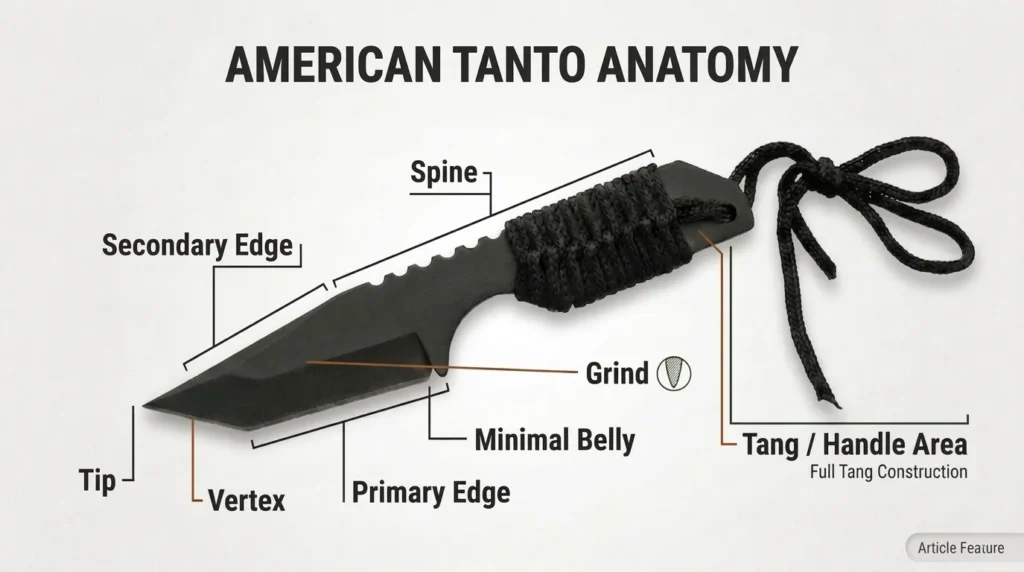
The American tanto silhouette has eight features worth naming:
- Primary edge — the longer cutting edge running along the bottom of the blade.
- Secondary edge — the shorter angled edge running up to the tip. Does most of the piercing work.
- Vertex (the “corner”) — where the primary and secondary edges meet. The defining feature, and a common stress point on cheap steel.
- Tip — the actual point at the top of the secondary edge.
- Spine — usually straight, sometimes with a false edge or swedge.
- Belly — minimal to none. A feature, not a flaw, but it limits what the knife can do well.
- Grind — flat, sabre, hollow, or chisel; varies by maker. Determines how the knife slices versus pries.
- Tang — full tang on quality fixed blades, partial on budget knives. Always check.
The vertex is the single most argued-about part of the knife. Maintain it crisp during sharpening and the blade keeps its design intent. Round it off and you’ve essentially made a budget drop point.
What a Tanto Knife Is Best For
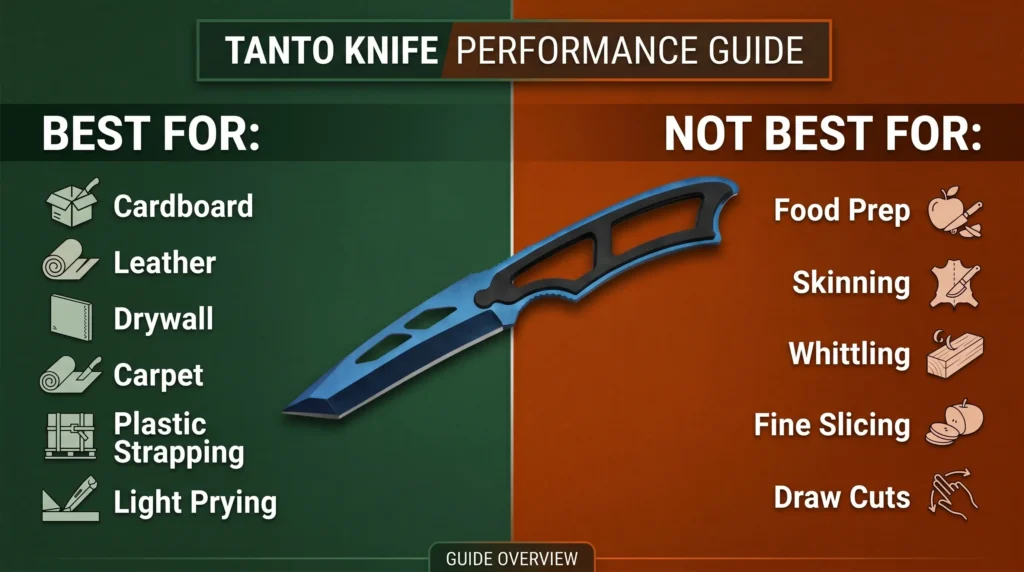
A tanto earns its keep on hard materials and abuse tasks — any cut where you’d rather have a tip that refuses to break than one that slips in more elegantly.
| Best For | Not Best For |
|---|---|
| Piercing cardboard, leather, plastic strapping | Food prep — no belly for rocking cuts |
| Drywall scoring and cutting | Detail slicing and fine carving |
| Carpet cutting and seam work | Skinning game (almost no curve) |
| Light prying on packaging crates | Whittling, bushcraft slicing |
| Penetrating tough exterior layers | Anything requiring a draw cut |
| Hard-use utility on construction sites | Long, continuous slicing motions |
| Tactical / defensive contexts | Apple and cheese pocket knife tasks |
If your daily use is mostly cardboard, boxes, and hard materials, a tanto handles it fine. If half your cutting is food, look at a drop point instead.
A Brief History of the Tanto
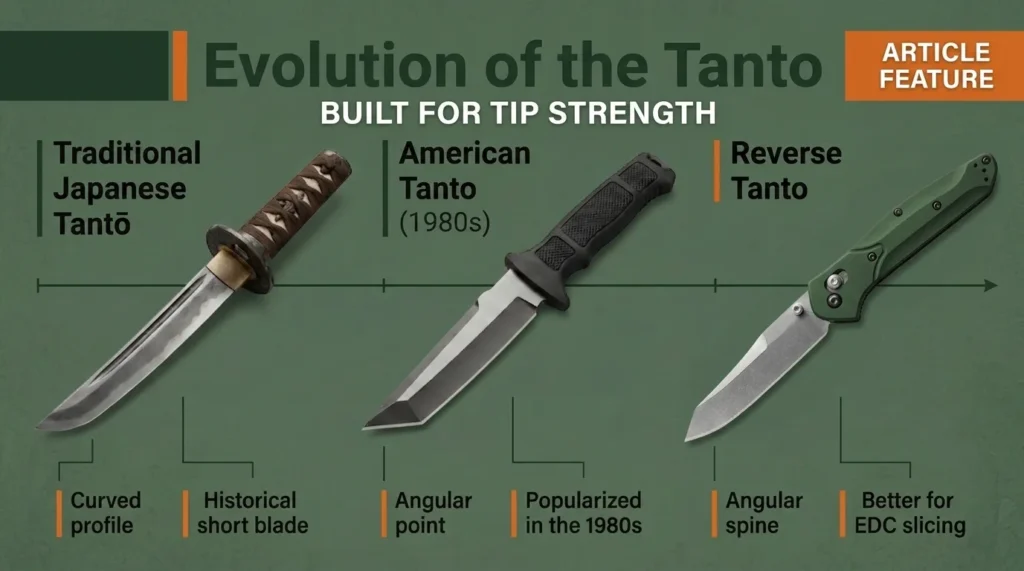
The tantō in Japanese sword culture is a short blade — typically 15–30 cm — historically worn alongside or in place of a wakizashi. Its profile is curved and continuous, often with no shinogi ridge line. It looks almost nothing like what most Americans now call a tanto.
The modern angular shape was largely defined by Lynn Thompson and Cold Steel in the early 1980s, starting with the original Tanto fixed blade and the later Recon Tanto. Thompson marketed the geometry hard, with promotional videos showing the tip punching through car doors and steel drums. Within a decade the angular “tanto” became one of the most recognizable tactical blade silhouettes in the world.
Subsequent makers — Spyderco, Benchmade, Microtech, Spartan Blades — refined the idea. A separate evolution, the reverse tanto, emerged as designers reimagined the angular cut on the spine instead of the edge.
So when someone says “tanto,” they may mean any of three different things: a historical Japanese dagger, an American tactical reinterpretation, or a modern reverse-tanto EDC blade. Each has a different purpose.
American Tanto vs Japanese Tanto
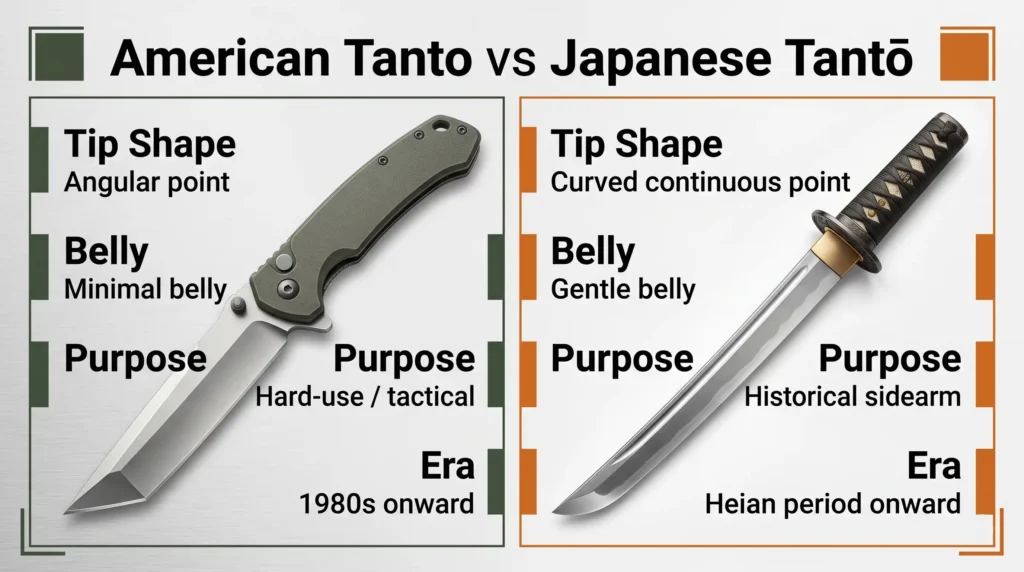
The two share a name and very little else.
| Feature | American Tanto | Japanese Tantō (historical) |
|---|---|---|
| Tip shape | Angular, two edges meeting at vertex | Curved continuous point |
| Belly | Minimal to none | Gentle, continuous curve |
| Primary purpose | Tactical / hard-use cutting | Edged sidearm, ritual, light utility |
| Era | 1980s onward | Heian period onward (~10th century) |
| Geometry name | Compound angular | Often hira-zukuri or shōbu-zukuri |
| Where you’ll see it | Most modern “tanto” knives | Antique collections, traditional smiths |
Both have legitimate histories. They are not the same blade. Calling an American tanto “the same shape samurai used” is a marketing line, not a fact.
Reverse Tanto vs American Tanto
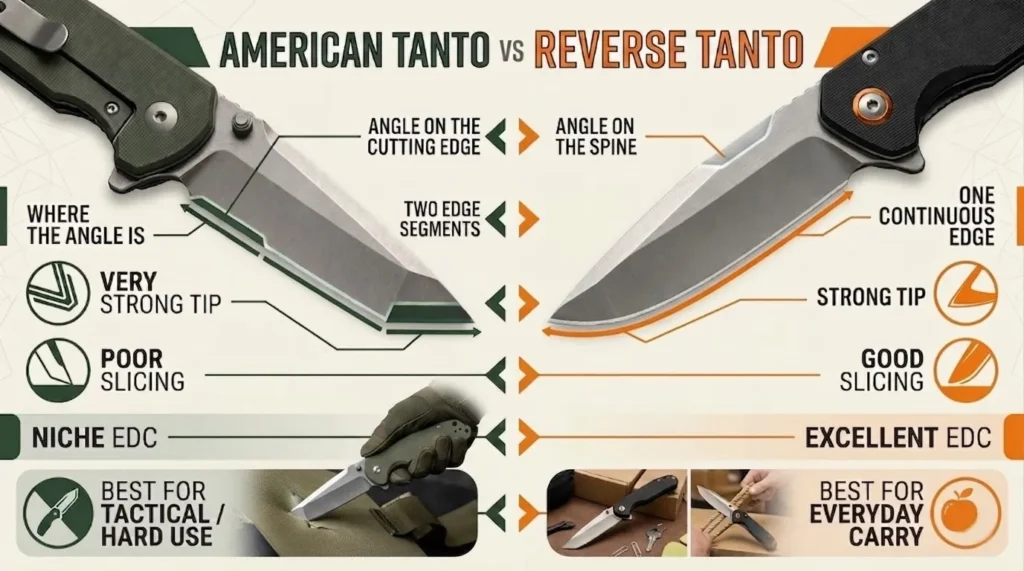
The most under-explained comparison in the category. On an American tanto, the bottom edge has two segments meeting at an angle, while the top spine is usually straight. On a reverse tanto, it’s the opposite: the spine drops down to meet a continuous, flowing edge. The reverse tanto has a single cutting edge with mild belly — geometrically much closer to a wharncliffe than to an American tanto.
| Feature | American Tanto | Reverse Tanto |
|---|---|---|
| Where the angle is | On the cutting edge | On the spine |
| Number of edges | Two distinct edge segments | One continuous edge |
| Tip strength | Very high | High |
| Slicing performance | Poor | Good |
| EDC suitability | Niche | Excellent |
| Iconic example | Cold Steel Recon Tanto | Benchmade 940 Osborne |
| Best use | Tactical, hard-use | Daily carry, controlled cutting |
For a full deep-dive, see our reverse tanto knife guide and the tanto vs reverse tanto comparison.
Tanto vs Drop Point
A tanto and a drop point are opposite design philosophies. The drop point trades tip strength for belly and versatility. The tanto trades belly for tip strength.
| Task | Tanto | Drop Point |
|---|---|---|
| Hunting / skinning | Poor | Excellent |
| Food prep | Poor | Good |
| EDC slicing | Below average | Excellent |
| Piercing hard material | Excellent | Good |
| Prying / abuse | Excellent | Fair |
| Self-defense | Specialized | Capable |
If you’re choosing between them for general daily use, the drop point is the safer pick. If you specifically need tip strength or you mostly cut hard materials, the tanto earns its place. Full breakdown in our Tanto vs drop point and Drop point knife guide.
Tanto vs Clip Point
The clip point is built around a fine, controllable tip — the opposite of the tanto. Where the tanto resists tip damage by keeping steel behind the point, the clip point sharpens its tip to a needle for piercing precision at the cost of fragility.A clip point is a better skinner, a more elegant slicer, and a more precise piercer in light materials. A tanto is the better choice when you’d rather the tip not snap. See our clip point knife guide for the full breakdown.
Tanto vs Wharncliffe and Sheepsfoot
These three look superficially similar — all favor straight or near-straight edges over belly — but the geometry differs. A wharncliffe has a straight edge with a spine that gently curves down to meet it. A sheepsfoot has a straight edge and a sharply rounded spine. Neither has the angular vertex of an American tanto, and neither has a reinforced tip in the same way.
For controlled detail work or whittling, a wharncliffe or sheepsfoot is usually better than a tanto. For abuse-tolerance and piercing, the tanto wins. Full guides on the wharncliffe blade and sheepsfoot blade.
Fixed Blade vs Folding Tantos
Fixed-blade tantos lean hard-use: thicker stock, full tang, sheath carry. They’re the natural home for the original tactical concept — the Cold Steel Recon Tanto, the Spartan Akribis, the SOG SEAL. If your use case includes prying, batoning, or impact work, fixed blade is the only sensible choice.
Folding tantos cover the EDC and tactical-carry market. The geometry compromises slightly — the vertex is more exposed to chipping than a fixed blade’s, and the locking mechanism limits abuse the blade can absorb — but they’re far more practical to carry.
The honest version: buy a fixed-blade tanto if you’ll actually use it hard. Buy a folding tanto if you mostly want the silhouette and tip strength for moderate tasks.
Variants of the Tanto
The tanto family is broader than most buyers realize.
- American tanto — the angular, two-edged silhouette Cold Steel popularized.
- Japanese tantō (traditional) — curved historical short blade. Mostly custom and collector pieces.
- Reverse tanto — angular spine, continuous edge. EDC darling.
- Recurve tanto — primary edge has a slight inward curve. Aggressive slicer for a tanto. See our recurve blade guide.
- Modified tanto — softened vertex with a small bevel between primary and secondary edges. Easier to sharpen, less distinctive.
- Tanto karambit — hybrid: angular point on a karambit-style curved handle. Niche.
- Hira-zukuri tanto — flat-ground traditional Japanese geometry, no ridge line.
Most modern tantos sold in the US are American tantos or reverse tantos. The rest are specialty buys.
Best Steel for a Tanto
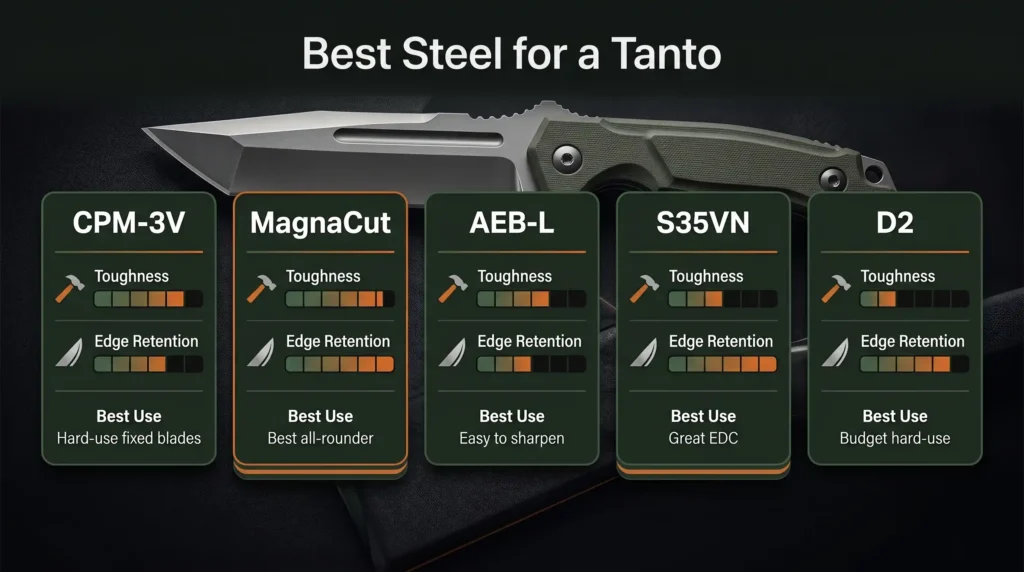
Tantos punish steel differently than slicers do. The tip and vertex see lateral and impact stress that a drop point’s tip never feels, which makes toughness more important than pure edge retention. See Knife Steel Nerds for in-depth metallurgy on any steel below.
| Steel | Toughness | Edge Retention | Best Use |
|---|---|---|---|
| CPM-3V | Excellent | Good | Hard-use fixed blades, tactical |
| CPM-MagnaCut | Very good | Very good | Best modern all-rounder |
| AEB-L | Excellent | Fair | Sharpening-friendly, budget builds |
| S35VN | Good | Good | Quality EDC folding tantos |
| VG-10 | Fair | Good | Mid-tier folders, traditional Japanese style |
| D2 | Fair | Very good | Budget hard-use; can be brittle |
| M390 / 20CV | Fair | Excellent | Premium EDC if abuse is light |
| AUS-8 | Good | Fair | Inexpensive utility |
Steel by user type:
| Buyer | Recommended Steel |
|---|---|
| Hard-use fixed blade owner | CPM-3V or MagnaCut |
| EDC carrier | MagnaCut, S35VN, or 14C28N |
| Tactical / duty carry | CPM-3V, MagnaCut |
| Collector / display | Damascus, traditional carbon steels |
| Budget buyer | AUS-8 or 14C28N |
Avoid pure high-wear, low-toughness steels (S90V, M398) on tantos meant for impact work — the vertex chips more easily than buyers expect. For premium pattern-welded options, see our damascus knife guide.
How to Sharpen a Tanto Knife
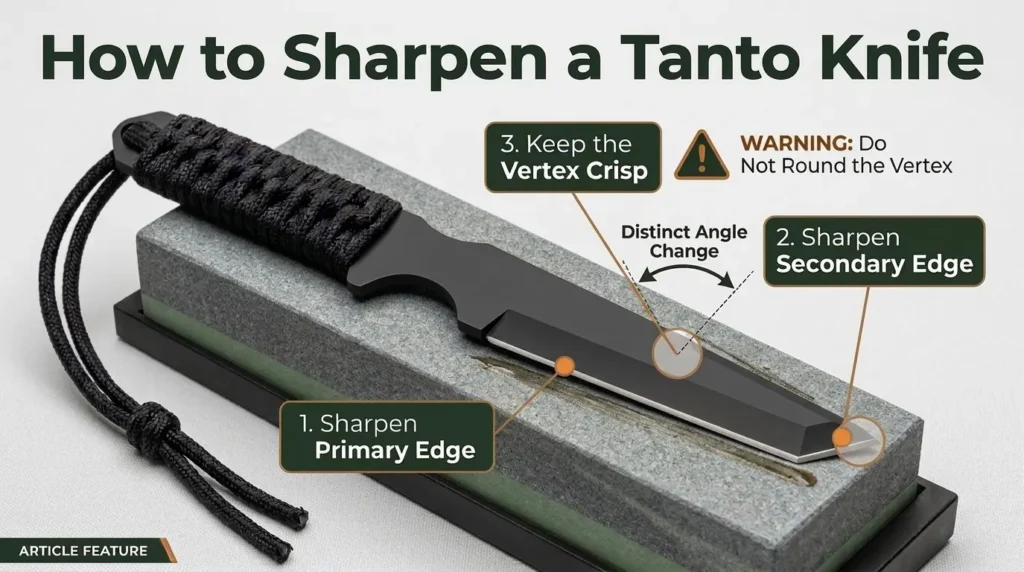
Tantos aren’t actually hard to sharpen — they’re hard to sharpen intuitively. The mistake almost everyone makes is treating the edge like one continuous curve. It isn’t. It’s two separate edges that share a steel.
The mental model: sharpen the primary edge as you would a normal knife, then re-set your wrist and sharpen the secondary edge as a separate operation. Keep the vertex crisp.
On a Spyderco Sharpmaker. Set the rods at 40° inclusive. Run the primary edge in normal alternating strokes. Then lift the handle so the secondary edge contacts the rod at the same angle and run that edge for the same number of strokes. The V-rod geometry naturally tracks both bevels.
On bench stones. Same logic, more skill needed. Maintain a consistent angle on the primary edge, then rotate the knife to bring the secondary edge flat to the stone. Treat the vertex as the boundary between two cuts; do not let your stroke roll over it.
On guided systems or belt sanders. Most guided systems (KME, Wicked Edge) handle compound bevels if you reposition the clamp between edges. Belt sanders are forgiving but watch heat at the vertex.
Common errors. Rounding off the vertex (kills the design). Sharpening the secondary edge at a steeper angle than the primary (chips faster). Treating the whole thing as one curve (gradually erases the tanto profile).
For more on edge maintenance, see our knife care guide.
Common Buying Mistakes
- Buying a tanto for general EDC slicing. It will frustrate you within a week. Buy a reverse tanto or drop point instead.
- Choosing M390 or S90V for a hard-use tanto. Excellent steels, wrong job. Toughness beats wear resistance on impact-prone tips.
- Ignoring the grind. A sabre-ground tanto pries beautifully and slices poorly. A high-flat-ground tanto cuts better but won’t take the abuse. Match the grind to the use.
- Mistaking the angular silhouette for “true Japanese.” Most American tantos are inspired by, not copied from, traditional tantō.
- Buying a thin folding tanto for prying work. Folders flex at the lock. Pry with a fixed blade.
Best Tanto by Use Case
| Use Case | Best Type | Why |
|---|---|---|
| EDC | Reverse tanto | Continuous edge, slicing-capable, controlled tip |
| Tactical / duty | Fixed-blade American tanto | Tip strength under impact and prying |
| Hard-use utility | Fixed-blade tanto in CPM-3V | Toughness handles abuse without chipping |
| Collecting | Traditional Japanese-style tantō | Historical and aesthetic value |
| Outdoor / survival | Reverse tanto or drop point | Tanto’s lack of belly hurts in field tasks |
| Self-defense | Specialized; check legality first | See our best blade shape for self-defense guide |
For full picks across categories, see our best tactical fixed blade knives roundup. For state-by-state knife law guidance, American Knife & Tool Institute maintains current information.
Caring for Your Tanto
Wipe and dry the blade after any cutting task — hard materials trap moisture against the steel. Oil the pivot on folders monthly with a drop of mineral oil. Strop the primary edge between sharpenings. Inspect the vertex periodically; small chips can be polished out before they grow. Avoid sustained contact with acidic foods, salt water, or unprotected leather sheaths in humid storage. See our knife care guide for more.
A Featured Tanto from Axevar
Texas-based Axevar Knives carries a small selection of tanto and reverse-tanto folders and fixed blades, hand-finished and built around the steels and geometry choices we recommend in this guide. If you’ve worked through the use-case matrix above and know what you need, browse the Axevar tanto collection and pick the one matched to your actual use, not the prettiest one.
Pros and Cons of a Tanto Knife
| Pros | Cons |
|---|---|
| Exceptional tip strength | Almost no belly for slicing |
| Excellent on hard materials | Poor for food prep |
| Holds up to prying and impact | Awkward for detail work |
| Distinctive, purposeful silhouette | Harder to sharpen if you don’t understand it |
| Strong tactical / duty performance | Legal ambiguity in some US states |
| Wide model selection across price tiers | Some designs lean “mall-ninja” aesthetic |
Frequently Asked Questions
What is a tanto knife used for?
Piercing hard materials, cutting tough surfaces like leather, drywall, and carpet, and hard-use tasks where tip strength matters more than fine slicing. Commonly carried in tactical and EDC roles.
What’s the difference between a Japanese and an American tanto?
The traditional Japanese tantō is a curved short blade with a continuous tip and gentle belly, from samurai-era weaponry. The American tanto has two distinct edges meeting at an angular vertex — a 1980s Western reinterpretation, not a recreation.
What is a reverse tanto?
A reverse tanto has the angular cut on the spine rather than the edge, leaving a single continuous cutting edge with mild belly. Geometrically much closer to a wharncliffe than to an American tanto. The Benchmade 940 Osborne is the iconic example.
Are tanto knives good for EDC?
American tantos are a niche EDC choice — fine for utility tasks but weak at slicing and food work. Reverse tantos are excellent EDC blades and outperform American tantos for daily carry in almost every dimension.
Are tanto knives hard to sharpen?
No, but they are harder to sharpen intuitively. The trick is to treat the primary and secondary edges as two separate operations rather than one continuous curve. A Spyderco Sharpmaker handles this naturally.
Is a tanto knife good for self-defense?
The tanto’s tip resists breakage under impact, which is meaningful in stabbing motions. It is not magically better than other point shapes, and legal carry rules vary by state. Always check local law.
Are tanto knives illegal?
Knife legality in the US is governed mainly by blade length, locking mechanism, and concealed-carry rules — not blade shape. Some states have nuanced rules around “dirk and dagger” classifications that can apply to certain tantos. Check the AKTI state knife laws database before carrying.
Why is it called a tanto?
The word comes from the Japanese tantō (短刀), literally “short blade.” The modern American tanto borrows the name from the historical Japanese weapon despite differing significantly in geometry.
What steel is best for a tanto?
For hard-use and tactical applications, CPM-3V and CPM-MagnaCut lead — both prioritize toughness, which matters more on a tanto than on a slicer. For EDC, MagnaCut, S35VN, or 14C28N are excellent.
The Bottom Line
The tanto is neither the magical super-knife the 1980s marketing implied nor the useless fashion shape the snobs dismiss. It’s a specialized tool. Buy one because you actually need a tip that won’t snap, you cut a lot of hard materials, or you specifically want the silhouette — not because it looked cool in a video game. Match the variant (American, reverse, or traditional) to the job, pick a steel that prioritizes the right property for your use, and sharpen it with the correct mental model.
For the bigger picture, return to our knife blade types pillar. For the closest functional alternative, compare against the drop point knife. For the under-appreciated cousin, read the reverse tanto guide.