What Is a Clip Point Knife? Uses, Pros, Cons & Buying Guide

A clip point knife is a fixed or folding blade with a section of the spine cut away near the tip straight or concave creating a sharp, thin, precise point with a working belly behind it. It’s the geometry behind the Bowie knife and most traditional pocket knives, well-suited for EDC, piercing, fine detail work, and tactical carry.
This guide covers what a clip point is, what it’s used for, how it compares to other knife blade types and shapes, the best steels and sizes, common buying mistakes, and how to choose the right one.
Quick Answer: A clip point knife has a “clipped” spine that creates a sharp tip backed by a curved cutting belly. Best for EDC, piercing, fine detail cutting, tactical use, and Bowie-style hunting.
What Is a Clip Point Knife?
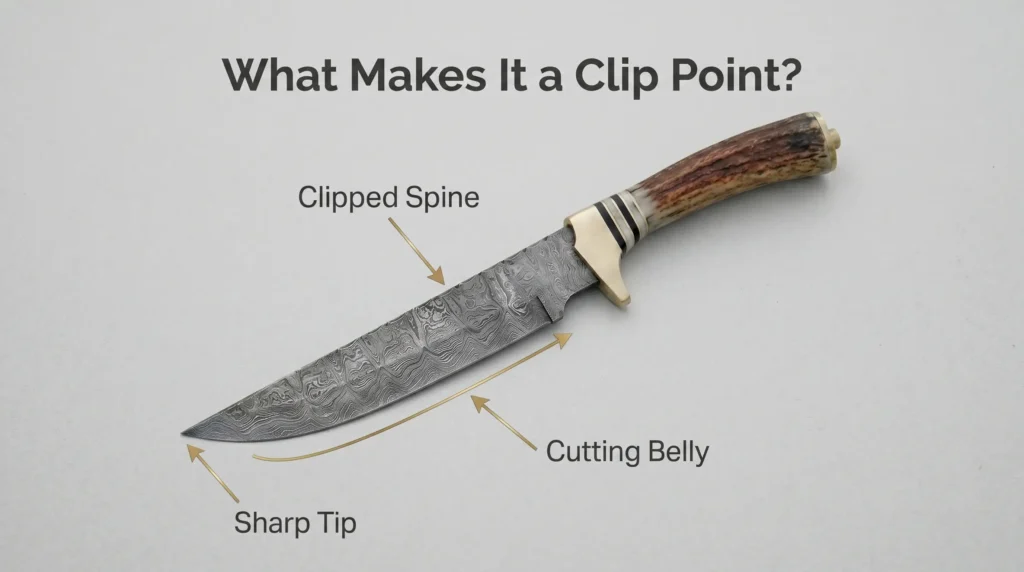
A clip point is defined by one feature: a section of the spine is removed near the tip in a straight or concave cut raising and thinning the point.
That single design choice creates three working advantages:
- A sharp, fast-piercing tip with minimal drag during insertion
- Excellent control for detail work and precision cuts
- A retained belly for slicing and general utility
The clipped tip pierces faster and cuts finer than a drop point. That’s why it remains the dominant profile in EDC folders, traditional pocket knives, and the entire Bowie family.
Best For / Not Best For
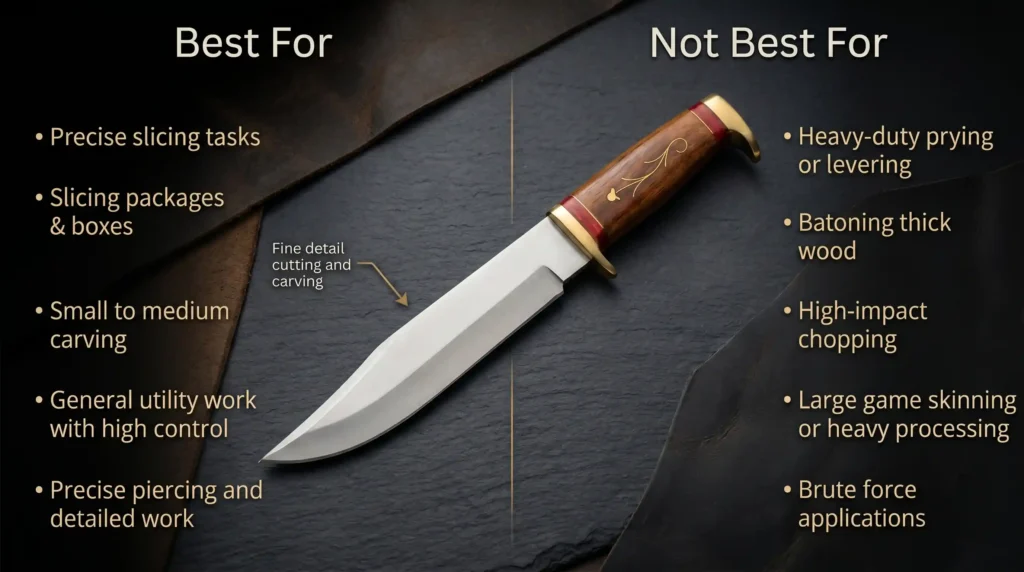
| Best For | Not Best For |
|---|---|
| EDC and pocket knives | Heavy prying or batoning |
| Tactical and self-defense | Hard-use bushcraft |
| Fine detail and precision cutting | Primary skinning of large game |
| Caping and small-game hunting | Users needing maximum tip strength |
| Bowie-style fixed blades | Hard-target metal piercing |
| Traditional and collector knives | Beginners who’ll pry with the tip |
If your priority is heavy utility or maximum tip strength, a drop point or tanto will fit better.
Clip Point vs Other Blade Shapes
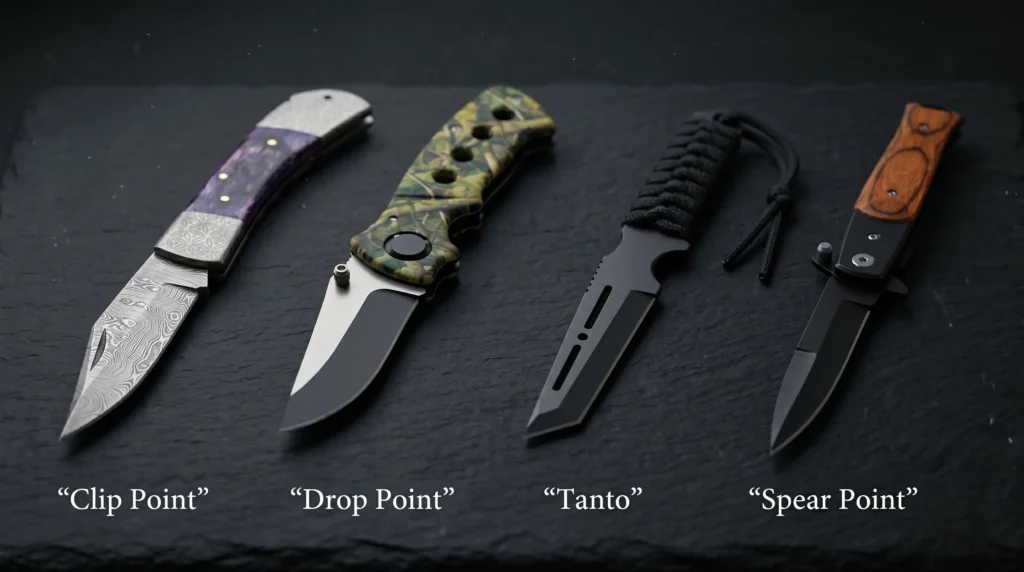
| Blade Shape | Best For | Main Weakness |
|---|---|---|
| Clip Point | EDC, piercing, detail, Bowie | Thinner, more fragile tip |
| Drop Point | Hunting, EDC, skinning | Slower piercing |
| Tanto | Hard-target piercing | Limited slicing belly |
| Spear Point | Thrusting, symmetric work | Often double-edged, more legal restrictions |
Clip Point vs Drop Point
A drop point lowers the tip and adds steel mass for strength. A clip point thins and raises the tip for piercing speed and detail work. Pick the clip point for piercing, fine work, and tactical or traditional carry. Pick the drop point for hunting, skinning, and general utility. See our drop point vs clip point comparison.
Clip Point vs Tanto
The tanto trades belly for an angular reinforced tip built for hard-target piercing. The clip point keeps a usable belly while still piercing faster than a drop point. See our tanto vs drop point comparison.
Clip Point vs Spear Point
A spear point is symmetric and often double-edged, which raises legal concerns. A clip point is asymmetric and single-edged, easier to classify as a working knife. See our spear point vs drop point vs dagger guide.
Is a Clip Point a Bowie Knife?
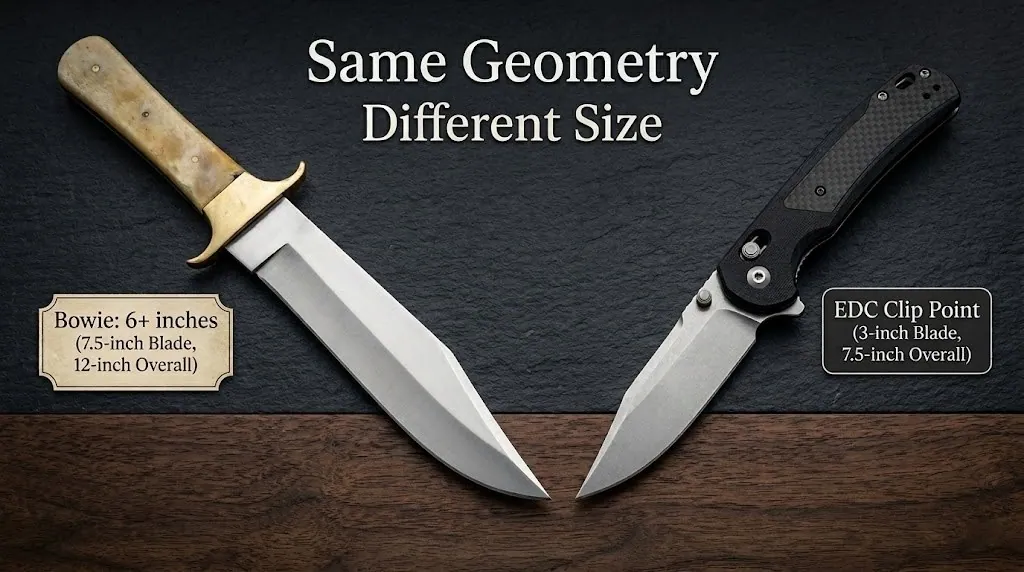
Most Bowies have clip point blades, but not every clip point is a Bowie. A Bowie is a specific large-format clip point — typically 6 inches or longer, with a long dramatic clip and often a sharpened false edge. A small EDC folder shares the geometry but not the heritage. See our Bowie knife guide.
Pros and Cons
| Pros | Cons |
|---|---|
| Sharp, fast-piercing tip | Tip is thinner and more fragile than drop point |
| Excellent control for detail work | Not suited for prying or batoning |
| Retained belly for slicing | Risk of puncturing hide when skinning |
| Iconic Bowie heritage and aesthetics | Curved clip section is harder to sharpen |
| Strong fit for EDC, tactical, traditional | Drop point outperforms it for heavy utility |
Anatomy of a Clip Point Blade
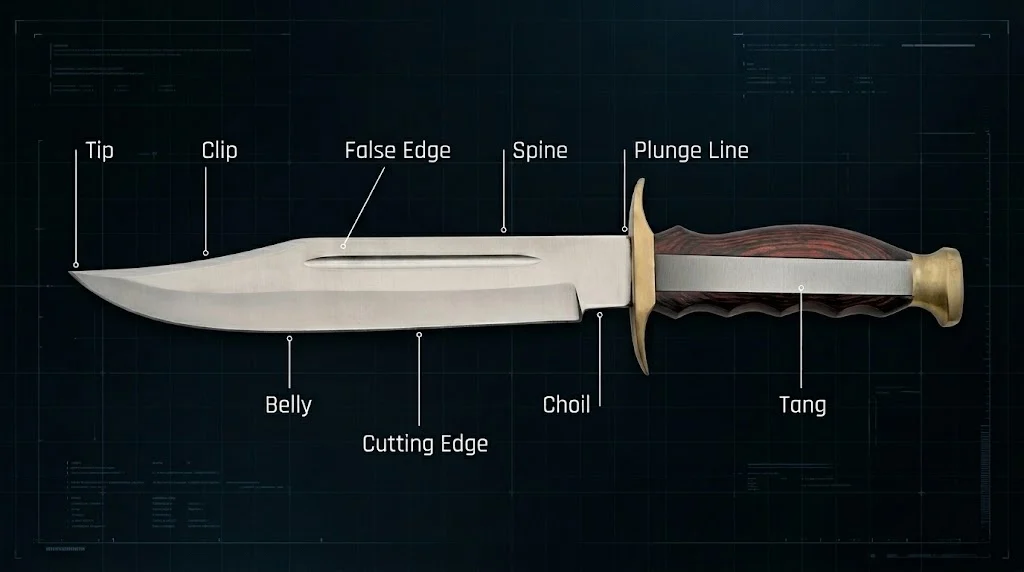
Nine working parts. Knowing them is the difference between buying a knife and buying the right knife.
- Spine. Unsharpened top edge. Runs straight from the handle, then transitions into the clip near the tip. EDC folders run 2.5–3.5mm thick; Bowie-style fixed blades 4–6mm.
- Clip. The section of spine removed near the tip. Short clip = high clip (more belly, stronger tip). Long clip = low clip (sharper tip, more piercing speed).
- False Edge / Swedge. The unsharpened bevel along the clip. Sometimes sharpened into a true secondary edge — common on Bowies. Otherwise it’s a swedge and is left alone.
- Belly. The curved cutting edge near the tip. Shorter than a drop point’s belly but still functional for slicing.
- Tip. Where spine and edge meet. Always thinner than a drop point tip — the trade-off for piercing speed.
- Plunge Line. The transition from unsharpened ricasso to sharpened edge. A clean vertical plunge line is a sign of quality grinding.
- Cutting Edge. Heel, flat working section, and the belly to the point.
- Choil. A small unsharpened notch between edge and handle. Lets you sharpen the full edge without rounding the heel.
- Tang. Steel extending into the handle. Full tang is non-negotiable on serious fixed-blade clip points.
A Brief History
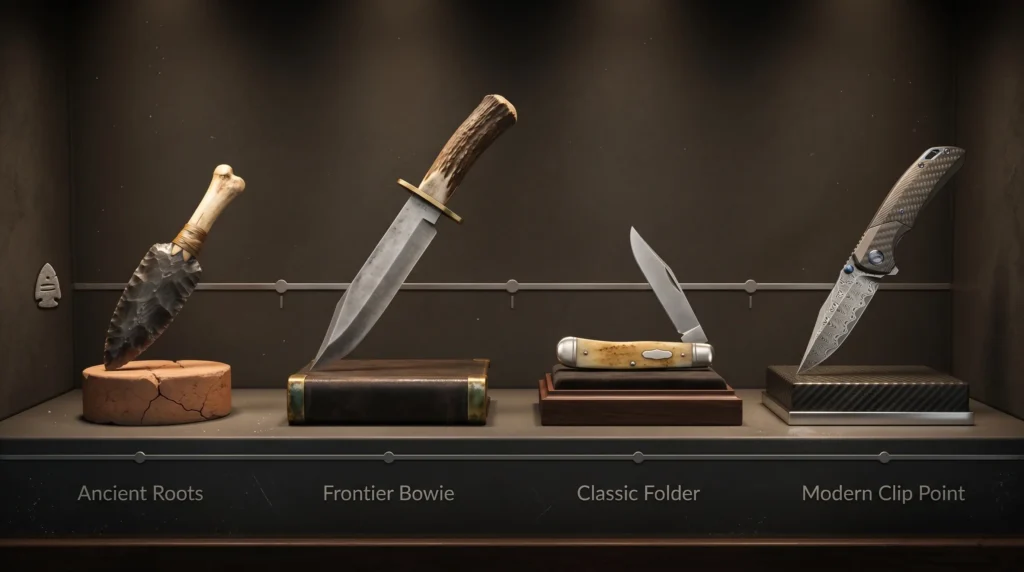
Knapped flint clip points have been unearthed at the estuary of the Drim river, dating back to Macedonian times of the Eneolithic period — one of the oldest functional blade designs in human history.
The modern American clip point was popularized by Rezin Bowie’s design for his brother Jim Bowie in the 1830s. The Sandbar Fight of 1827 made the geometry famous, and the “Bowie knife” became the defining profile of the American frontier.
In the 20th century, makers like Bo Randall and William Scagel refined the clip point using high-carbon tool steels. The American Bladesmith Society maintains a record of the makers who carried that tradition forward. The Buck 110 Folding Hunter (1964) brought the clip point into the modern folder market.
That hand-forging tradition survives today in custom shops producing true Damascus clip points and Bowies, where the clip line showcases the layered pattern more dramatically than any other blade geometry.
Clip Point Variations
“Clip point” isn’t one shape; it’s a family.
- Standard Clip Point. Moderate concave clip with balanced belly. The default on EDC and traditional folders.
- California Clip. Extended, gentle clip running nearly the full back of the blade. Long sweeping false edge.
- Turkish Clip. Extreme recurve — almost trailing-point in feel. Aggressive, less common in production.
- High Clip Point. Short clip with the tip closer to the spine line. Stronger tip, more belly, slightly slower piercing.
- Low Clip Point (Bowie-Style). Long, dramatic concave clip with the tip well below the spine line. Maximum piercing speed and tip control.
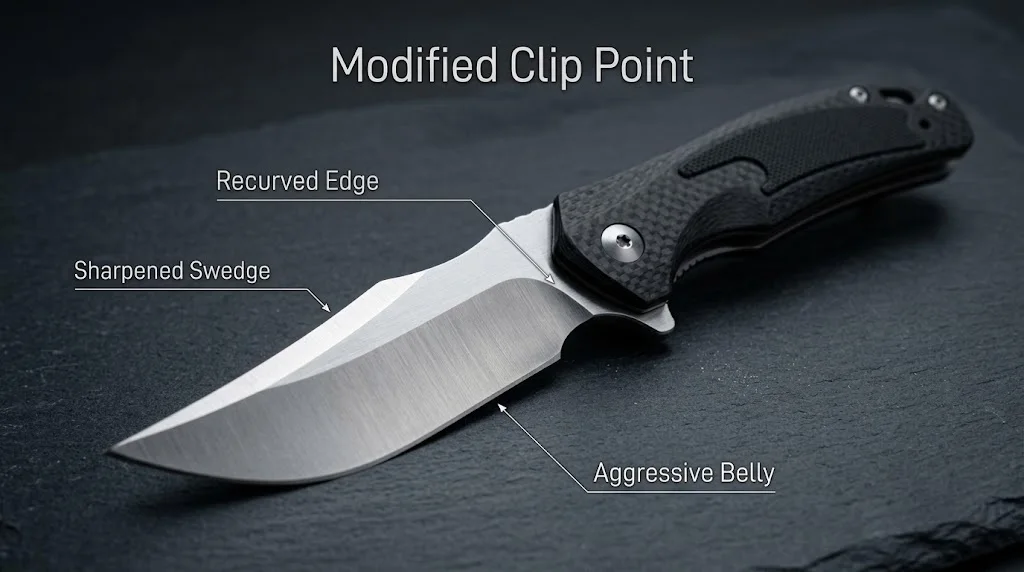
- Modified Clip. Production tweaks — recurved edge, sharpened swedge, or aggressive belly. Common on tactical folders.
Grind Variations
The grind matters as much as the profile, especially on a thin tip.
- Scandi. Easy to sharpen, traditional, but thins the tip aggressively.
- Hollow. Razor-thin edge, fragile under prying — risky on clip point tips.
- Flat. Balanced — the most common on quality clip points.
- Convex. Strongest geometry, hardest to sharpen freehand. Best for hard use.
What Is a Clip Point Used For?
A clip point handles EDC, fine detail cutting, piercing, caping, tactical work, traditional pocket-knife tasks, and Bowie-style heavy field use. The thin precise tip and retained belly make it the go-to profile when piercing speed and control matter more than tip strength.
- EDC. Opens packages, slices food, cuts cordage, handles fine work — opening seams, picking out splinters, detail carving — better than drop points.
- Hunting (Caping & Detail). The thin tip excels at caping and detail work around joints.
- Tactical and Self-Defense. Faster piercing than drop point, controllable tip, traditional fighting-knife geometry.
- Traditional & Collector. The dominant profile in slip-joints, stockmen, trappers, and Bowies.
- Bowie / Heavy Field Use. Large-format clip points (6″+) handle camp tasks, brush clearing, and heavy field work.
Honest exception: for clean primary skinning, batoning, or prying, a drop point or tanto outperforms.
Clip Point Knife by Use Case
EDC
Look for a 2.8–3.5 inch blade, a strong lock (frame, liner, or AXIS), and steel that resharpens easily — D2, 154CM, 14C28N, or S30V. The clip point dominates modern pocket knives because the thin tip handles tasks a drop point struggles with.
Hunting (Caping & Detail)
Look for a 3.5–4.5 inch blade on a full tang, with a tough steel — MagnaCut, S30V, CPM 3V, or hand-forged 1095 + 15N20 Damascus. Caveat: clip points aren’t optimal for primary skinning — a drop point is usually better.
Tactical
Look for a 4–5 inch blade (or longer for fixed-blade Bowies), a strong lock or full tang, and high-toughness steel — CPM 3V, S35VN, or MagnaCut. The clip point is the historically preferred tactical profile because it pierces faster than any other working blade. See our tactical fixed blade roundup.
Bowie & Heritage
True Bowies use clip points 6″+ with full tangs, thick spines, and often a sharpened false edge. 1095 high-carbon and hand-forged Damascus are the traditional picks. See our Bowie knife guide.
Self-Defense
The clip point is historically the preferred defensive geometry — faster piercing, traditional fighting-knife heritage. That said, blade shape matters far less than legal carry rules and training. A consistently carried legal knife beats a “better” knife left at home. See our best blade shape for hunting, EDC, and self-defense guide.
Best Steel for a Clip Point Knife
Steel matters more than profile — and even more on a clip point. The thin tip concentrates stress at the point: soft steel rounds off, brittle steel chips. Prioritize toughness first, edge retention second, corrosion third.
| Steel | Edge Retention | Toughness | Corrosion | Sharpening | Best For | Tier |
|---|---|---|---|---|---|---|
| 1095 (carbon) | Good | Excellent | Poor | Easy | Bowie, traditional | $ |
| D2 | Very good | Moderate | Moderate | Moderate | EDC | $$ |
| 154CM | Good | Good | Good | Easy | EDC, all-around | $$ |
| S30V | Excellent | Good | Excellent | Hard | Premium EDC | $$$ |
| CPM 3V | Very good | Outstanding | Moderate | Moderate | Hard-use clip points | $$$ |
| MagnaCut | Excellent | Excellent | Excellent | Moderate | Premium tactical/EDC | $$$$ |
| Damascus (1095 + 15N20) | Very good | Excellent | Moderate | Moderate | Hand-forged Bowies | $$$ |
| 420HC / 3Cr13 | Fair | Good | Excellent | Very easy | Budget EDC | $ |
1095 is the working standard for Bowies and traditional carry. Tough, sharpens to a razor, patinas naturally.
MagnaCut pairs high edge retention with the toughness a thin tip needs. For the metallurgy, see Larrin Thomas at Knife Steel Nerds — he designed the steel.
CPM 3V is the safest pick if you want a clip point that survives hard use without chipping. Outstanding toughness — exactly what a thin-tip geometry needs.
Damascus. True pattern-welded Damascus (1095 + 15N20) combines high-carbon performance with layered toughness — and the clip line is where the pattern shines. See our Damascus knife guide. Watch out for fakes:
- Real Damascus shows pattern on both sides and into the bevel, has visible layers under magnification, and rusts without care.
- Fake Damascus has pattern only on the flat surface and never rusts (chemically etched stainless).
Best Steel by User Type
User Type | Best Steel Choice |
|---|---|
| Beginner | 420HC / 3Cr13 — forgiving, low maintenance |
| EDC User | D2 / 154CM — balance of edge and ease |
| Hunter (caping/detail) | S30V / MagnaCut — retention and toughness |
| Tactical / Hard Use | CPM 3V / MagnaCut — outstanding toughness |
| Traditional / Bowie | 1095 — heritage steel, easy to sharpen |
| Collector | Damascus — pattern, character, tradition |
Best Clip Point Knife by Use Case
| Use Case | Best Blade Length | Best Steel |
|---|---|---|
| EDC | 2.8 – 3.5 in | D2, 154CM, S30V |
| Hunting (caping/detail) | 3.5 – 4.5 in | S30V, MagnaCut, Damascus |
| Tactical | 4 – 5 in | CPM 3V, S35VN, MagnaCut |
| Bowie / Heritage | 6 – 10 in | 1095, Damascus |
| Traditional Folder | 2.5 – 3.5 in | 1095, 154CM, D2 |
How to Choose Your Clip Point Knife
Seven questions, in order:
- Primary use case? EDC, tactical, hunting (caping/detail), Bowie/heritage, or collector.
- Fixed or folding? Fixed for Bowies, tactical, and serious field work. Folding for EDC and traditional carry.
- Blade length? EDC: 2.8–3.5″. Hunting/tactical: 3.5–5″. Bowie: 6″+ (with the legal caveat below).
- What steel? Carbon (1095) if you’ll oil it. Stainless (S30V, MagnaCut) for low maintenance. Damascus for hand-forged character. Prioritize toughness — soft or brittle steels chip the thin tip.
- Budget tier? Under $50: budget production. $50–$150: mid-range or entry hand-forged. $150–$400: premium production. $400+: custom shop.
- Hand-forged or production? Production = consistency, warranty. Hand-forged = unique craftsmanship, more care required.
- Is it legal where you’ll carry? Bowie lengths and sharpened swedges are the two clip-point traps.
Common Buying Mistakes
- Choosing too long a blade. Bowie-style clip points feel like overkill in real carry. Many states cap legal length at 4–5″. Most users are better served by 3.5–4.5 inches.
- Buying a clip point for primary skinning. The thin tip risks puncturing hide. Get a drop point instead.
- Buying fake Damascus. Cheap “Damascus” on big marketplaces is usually chemically etched stainless. Look for layers in the bevel and confirm the steel makeup.
- Ignoring the false edge. A sharpened swedge changes how you sharpen and can reclassify the knife as a dagger in stricter jurisdictions.
- Ignoring local knife laws. Bowie length limits and dagger reclassification trip up clip point buyers more than buyers of any other blade type.
How to Sharpen a Clip Point Knife
The curved belly, thin tip, and (sometimes) sharpened false edge need a different approach than a straight-edged blade. Skip this and you’ll round the tip — the most-broken part of any clip point.
- Set your angle. 17–22 degrees per side. Tactical and EDC clips lean toward 20°. When unsure, 20° is safe.
- Sharpen the flat section first. Hold your angle and pull the edge from heel to where the belly begins to curve. Match strokes on each side.
- Roll into the belly. As you reach the curve, lift the handle slightly and rotate to keep the angle consistent. The belly is shorter than a drop point’s, so the roll is tighter.
- Sharpen the false edge — only if it was designed sharp. If your clip has a true sharpened false edge, treat it as a separate edge. Never sharpen an unsharpened swedge — you’ll change the geometry permanently.
- Finish the tip carefully. The thin tip rounds faster than any other geometry. Light pressure, fewer passes, more rotation as the belly tightens.
- Strop to finish. Leather strop with polishing compound, five to ten passes per side.
For carbon and Damascus blades: wipe dry, then apply a thin coat of food-safe mineral oil or camellia oil. See our knife care guide.
Legal and Carry Considerations (U.S.)
Knife law varies significantly by state, county, and city. The clip point shape itself is rarely the legal issue — blade length, lock type, opening mechanism, sharpened false edge, and how you carry are what matters.
The American Knife & Tool Institute (AKTI) maintains a state-by-state breakdown worth checking before you carry.
Three clip-point-specific legal traps:
- Bowie length limits. Many states cap legal carry at 4–5″. Most full-size Bowies exceed this.
- Sharpened false edge = dagger. A sharpened swedge can reclassify a single-edged clip point as a double-edged dagger in stricter jurisdictions.
- Concealed carry. Bowie-style clip points are usually too large to legally conceal.
This is not legal advice. Check your local laws before carrying any knife.
Caring for Your Clip Point Knife
- Clean after use. Wipe with a dry cloth. After cutting food, blood, or anything acidic, clean with warm water and dry immediately.
- Oil carbon and Damascus blades. Thin film of food-safe mineral oil or camellia oil. Once a week for EDC; after every use for hunting.
- Strop between sharpenings. A weekly strop extends time between full resharpenings significantly.
- Store properly. Don’t leave a knife in a leather sheath long-term — leather retains moisture. Use kydex, a knife roll, or wall display.
- Avoid lateral pressure on the tip. The single most-broken part of any clip point. Don’t pry, twist, or throw.
For a complete maintenance routine, see our knife care guide.
Frequently Asked Questions (FAQs)
What is a clip point knife used for?
EDC, fine detail cutting, piercing, caping, tactical work, traditional pocket-knife tasks, and Bowie-style heavy field use.
What is the benefit of a clip point blade?
Three main benefits: piercing speed, tip control for detail work, and aesthetic heritage. The thin clipped tip enters materials with less drag than any other working profile.
Are clip point knives good?
Yes, for EDC, piercing tasks, tactical use, and traditional carry. Not the best choice for primary skinning, prying, or batoning.
Is a clip point a Bowie knife?
Most Bowies have clip point blades, but not every clip point is a Bowie. A Bowie is a specific large-format clip point — typically 6 inches or longer with a long dramatic clip and often a sharpened false edge.
Why is the clip point weak?
The “weakness” is geometric. Removing material from the spine to thin the tip trades tip strength for piercing speed. Buy quality steel and avoid prying with the tip.
Which is better, clip point or drop point?
Neither universally. Clip points pierce faster and allow finer detail work. Drop points are stronger and slice better. See our drop point vs clip point comparison.
Is a clip point good for hunting?
For caping and detail work, yes. For primary skinning, the thin tip risks puncturing hide — a drop point is usually better.
Is a clip point good for self-defense?
Historically the preferred defensive geometry, but blade shape matters far less than legal carry rules and training.
Can you baton wood with a clip point?
Not recommended. The thin tip is the weakest part of the blade.
What’s the best steel for a clip point knife?
For most users: CPM 3V or MagnaCut (toughness handles the thin tip). For traditional carbon: 1095. For hand-forged: real pattern-welded 1095 + 15N20 Damascus.
Are Damascus clip point knives worth it?
Real pattern-welded Damascus (not etched stainless) is worth it for collectors and traditional carriers who’ll maintain their blades.
How long should a clip point hunting knife be?
3.5 to 4.5 inches covers most caping and detail work. Larger (5″+) moves into Bowie territory and runs into legal limits.
Is a clip point knife legal to carry?
In most U.S. jurisdictions, yes — but it depends on blade length, lock type, sharpened false edge, and carry method.
Conclusion
The clip point isn’t the strongest blade shape, and it isn’t the most utility-focused. It’s the most traditional, precise, and historically defining profile in American knife-making — which is why EDC carriers, tactical users, traditional pocket-knife fans, and Bowie collectors keep choosing it.